
 Algeria
 Egypt
 Libya
 Morocco
 Sudan
 Tunisia
 Benin
 Burkina Faso
 Cabo Verde
 Côte d'Ivoire
 Ghana
 Guinea
 Guinea-Bissau
 Liberia
 Mali
 Mauritania
 Niger
 Nigeria
 Senegal
 Sierra Leone
 The Gambia
 Togo
 Cameroon
 Central African Republic
 Chad
 Equatorial Guinea
 Gabon
 Republic of the Congo
 São Tomé and Príncipe
 Burundi
 Comoros
 Djibouti
 Eritrea
 Ethiopia
 Kenya
 Madagascar
 Malawi
 Mauritius
 Mozambique
 Rwanda
 Seychelles
 Somalia
 South Sudan
 Tanzania
 Uganda
 Angola
 Botswana
 Eswatini
 Lesotho
 Namibia
 South Africa
 Zambia
 Zimbabwe
In Kinshasa, a legal battle becomes a street test
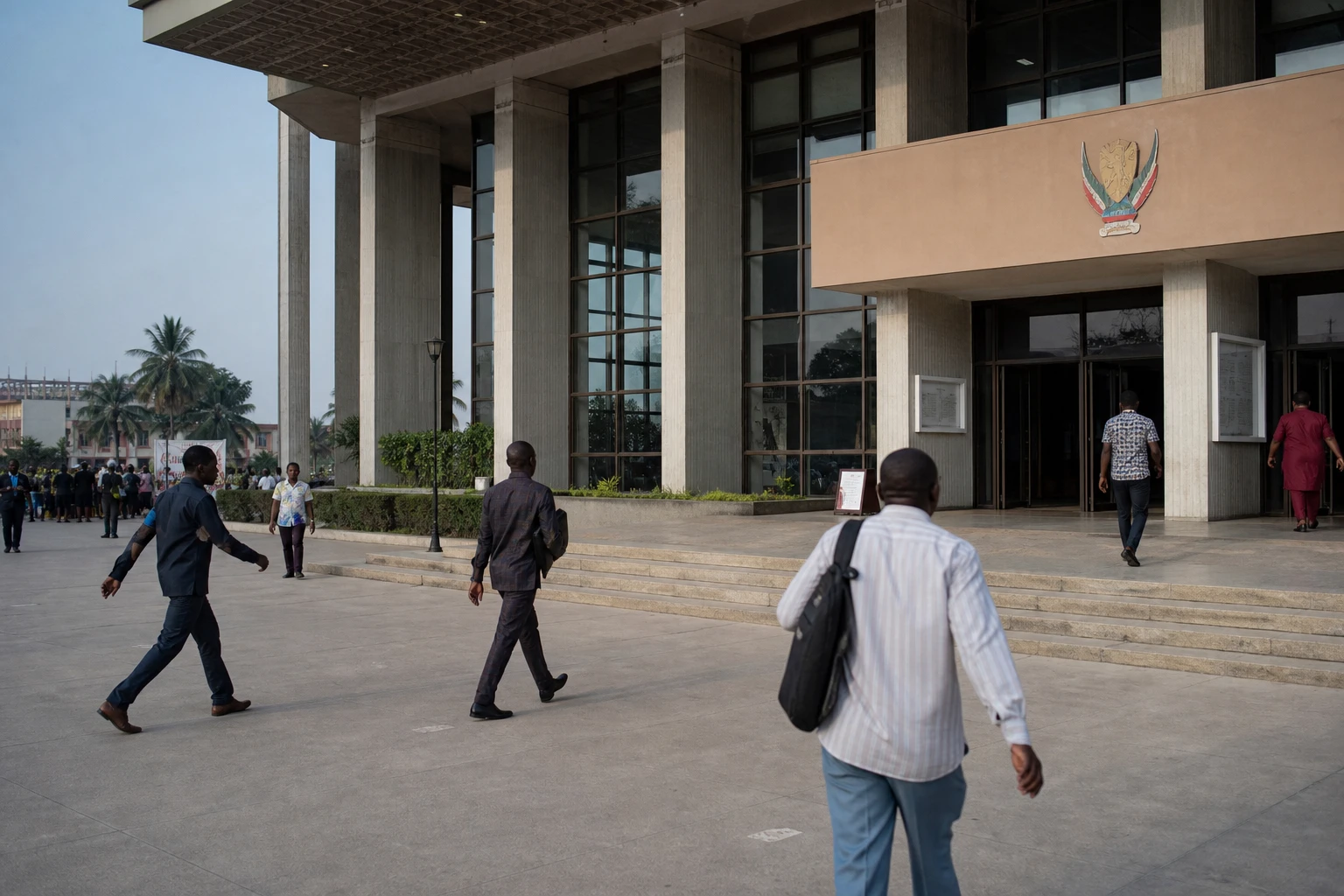
In Kinshasa, institutional debates do not stay in parliamentary chambers for long. They quickly spill into public spaces, where the streets become a stage for political displays as much as a barometer of national tension. On Tuesday 15 September, the opposition coalition C64 sought to occupy this space just as Congolese MPs opened their parliamentary session.
The occasion was far from inconsequential. In the Congolese capital, opposition figures wanted to make their opposition to any change to the Constitution heard, a subject that has crystallised the balance of power around Félix Tshisekedi for months. C64 presented its march as a political warning, with a simple message: do not touch the fundamental text.
In the Congolese context, this episode also matters because it coincides with the institutional calendar. The Constitution of the Democratic Republic of the Congo provides for the opening of Parliament’s ordinary session on 15 March and 15 September. When either date falls on a Sunday or public holiday, the session opens on the next working day. In 2026, parliament therefore resumed at the same time as the opposition’s mobilisation.
What the demonstrators wanted to say beyond the march
C64, a coalition launched in Kinshasa in May 2026, brings together several opposition figures, including Martin Fayulu, Jean-Marc Kabund, Moïse Katumbi, Augustin Matata Ponyo and Delly Sesanga. It has organised around a rallying cry: defend the constitutional order and block any revision deemed dangerous to the political alternation of power.
On 15 September, the original route was revised following talks with Kinshasa’s city authorities. The planned endpoint near the Palais du Peuple was moved to respect, according to the provincial authorities, the inviolability of Parliament. The change avoided a direct confrontation at the foot of the legislative seat, without dispelling the political tensions.
On the ground, the mobilisation was visible in several districts of the capital, notably at the Limete Interchange and in Bandalungwa, while a significant security presence monitored movements. The picture in the provinces was more uneven: the mobilisation was prevented or dispersed in Matadi, Uvira and other cities, according to press reports that day.
In Kinshasa, this kind of march is never just a partisan parade. It is also a test of the balance of power between the central government, provincial authorities and an opposition seeking to prove it can still mobilise in the country’s political capital. The issue therefore goes beyond constitutional reform alone. It concerns each side’s ability to impose its narrative in the public arena.
An issue for the DRC, but also for Central Africa
The Democratic Republic of the Congo is not only a large Central African country. It is also a pivotal part of the Economic Community of Central African States, ECCAS, which has eleven member states, as well as an actor in the East African Community and SADC. In such a setting, every domestic crisis eventually spills over into regional balances.
The Constitution debate is not viewed in the same way by everyone. For the government, it concerns national sovereignty and a political agenda to be defended. For the opposition, it opens the door to extending the institutional game and potentially calling the alternation of power into question. For the urban population, especially in Kinshasa, these standoffs first mean blocked streets, disrupted traffic and another source of uncertainty in lives already marked by economic pressure.
The decision to time the march to coincide with parliament’s resumption therefore carries strong symbolic significance. It confronts MPs with a tense political climate from the very start of the session. It also serves as a reminder that the Palais du Peuple remains a highly sensitive site, where fears of institutional revision and suspicions of a reshaping of power come to a head. The 2006 Constitution, revised in 2011, thus remains at the centre of a battle that goes beyond the law to touch on political legitimacy.
The Congolese episode matters to Central Africa for at least two reasons. First, any prolonged tension in Kinshasa affects trade, mobility and security dynamics in a region already beset by vulnerabilities. Second, the way the DRC handles this kind of protest shapes the continent’s reading of institutional stability. The Congolese issue will therefore be closely watched during upcoming parliamentary sessions, presidential statements and any further C64 mobilisations.



