
 Algeria
 Egypt
 Libya
 Morocco
 Sudan
 Tunisia
 Benin
 Burkina Faso
 Cabo Verde
 Ghana
 Guinea
 Guinea-Bissau
 Liberia
 Mali
 Mauritania
 Niger
 Nigeria
 Senegal
 Sierra Leone
 The Gambia
 Togo
 Cameroon
 Central African Republic
 Chad
 DR Congo
 Equatorial Guinea
 Gabon
 Republic of the Congo
 São Tomé and Príncipe
 Burundi
 Comoros
 Djibouti
 Eritrea
 Ethiopia
 Kenya
 Madagascar
 Malawi
 Mauritius
 Mozambique
 Rwanda
 Seychelles
 Somalia
 South Sudan
 Tanzania
 Uganda
 Angola
 Botswana
 Eswatini
 Lesotho
 Namibia
 South Africa
 Zambia
 Zimbabwe
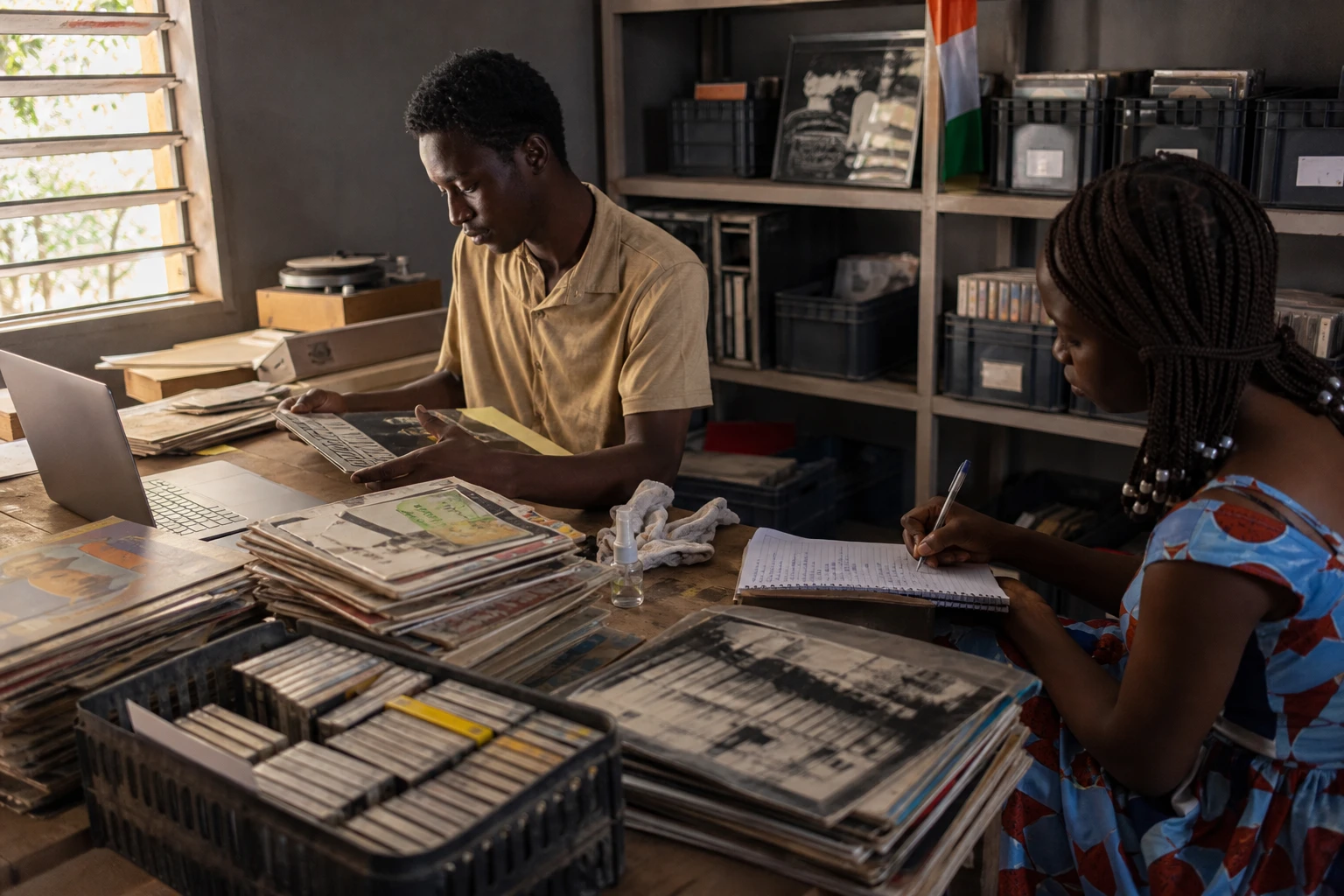
A generation still searching for the sound of its own heyday
In Abidjan, musical memory lives on in more than just people’s recollections. It also survives in boxes, vinyl records, cassettes and archives that enthusiasts patiently sift through. In a country whose current music scene is dominated by Ivorian rap and newer forms of coupé-décalé, this quest speaks to something broader: Côte d’Ivoire continues to reinvent itself by looking back at part of its cultural past, long carried by its economic capital and by networks that reached across West Africa.
The issue goes beyond nostalgia. It touches on Abidjan’s place in the region’s cultural history, the movement of artists between neighbouring countries, and how a country protects — or loses — the record of its creators. In Côte d’Ivoire, where Yamoussoukro is the political capital and Abidjan the artistic and economic heart, this memory is as much a matter of transmission as of industry.
A golden age born of studios, television and stages open to the sub-region
Ivorian music in the 1970s and 1980s is associated with several key figures. François Lougah was among the pioneers who took Ivorian music beyond national borders. Ernesto Djédjé established ziglibithy, a style blending its roots in the Bété people with funk, disco and reggae influences. Then Alpha Blondy gave Ivorian music an international resonance with reggae sung from Abidjan but heard far beyond it.
This momentum was no accident. It was built on orchestras, concerts and nightclubs, as well as television, which served as a springboard. ORTI, the Ivorian Radio and Television Broadcasting Orchestra, was led from 1975 to 1979 by Manu Dibango, invited by Félix Houphouët-Boigny. His time there strengthened musical exchanges with Cameroon, Congo and other scenes in the sub-region, at a time when Abidjan was attracting African artists and producers.
The country also began to organise creators’ rights more systematically. BURIDA, the Ivorian Copyright Office, was established by decree on 15 April 1981 and began operations on 1 June 1981. It mattered to a generation of artists who were often self-taught, although remuneration remained irregular and dependent on customary practices, public support and the local market.
Long careers, fragile archives and an incomplete cultural economy
The story of this golden age is also told through individual careers. Bailly Spinto, for example, embodies a rare continuity. His artistic longevity is a reminder that part of Ivorian music was built on powerful voices, disciplined orchestras and a broad audience. Chantal Taïba, meanwhile, illustrates the role of institutional stages: joining an RTI orchestra could provide training, a salary and visibility that few other platforms offered.
But the golden age had its limits. The system relied on a mix of presidential patronage, radio broadcasting and access to studios. BURIDA was indeed designed to protect rights, but the sector’s economic structures remained incomplete for a long time. In other words, fame did not always bring lasting security for artists. This fragility helps explain why some eventually found themselves far from the comfort associated with their success.
Memory therefore becomes central. The RTI archives in Cocody are said to still hold thousands of cassettes that have not been fully digitised, according to information corroborated in the press and in first-hand accounts. This body of sound is more than a sentimental legacy. It provides a foundation for researchers, producers, music programmers and young artists seeking to understand the origins of today’s styles.
At the same time, private collectors and archivists have stepped in. Their albums, digital channels and personal collections help date tracks, find cover art, identify orchestras and prevent entire swathes of Ivorian output from being lost in moves, inheritances or the wear and tear of time. It is discreet work, but vital.
What this memory says about Côte d’Ivoire today
The continental reach of this history is clear. In the 1970s and 1980s, Abidjan did not just broadcast Ivorian songs. The city served as a platform for African artists from elsewhere, thanks to its studios, media and stages. This movement helped make Côte d’Ivoire a West African cultural crossroads, on a par with Lagos, Kinshasa or Douala at other times.
Today, the context has changed. The population is very young and dominant styles have evolved. Yet the music of the Lougah, Djédjé and Blondy era remains present in covers, tributes and samples. A recent cover of an Ernesto Djédjé classic in 2025 shows that this legacy continues to nourish contemporary creativity, not as a relic but as a living vocabulary.
For Côte d’Ivoire, the challenge is twofold. It must preserve the surviving formats and improve the conditions for remuneration, digitisation and circulation of works. But it must also tell this story without freezing it in past glory. Côte d’Ivoire’s golden age is not just a memory to celebrate. It is a resource for thinking about a music industry capable of connecting heritage, cultural industries and new creativity in a country that remains one of West Africa’s great cultural crossroads.



