
 Algeria
 Egypt
 Libya
 Morocco
 Sudan
 Tunisia
 Benin
 Burkina Faso
 Cabo Verde
 Côte d'Ivoire
 Ghana
 Guinea
 Guinea-Bissau
 Liberia
 Mali
 Mauritania
 Niger
 Nigeria
 Senegal
 Sierra Leone
 The Gambia
 Togo
 Cameroon
 Central African Republic
 Chad
 Equatorial Guinea
 Gabon
 Republic of the Congo
 São Tomé and Príncipe
 Burundi
 Comoros
 Djibouti
 Eritrea
 Ethiopia
 Kenya
 Madagascar
 Malawi
 Mauritius
 Mozambique
 Rwanda
 Seychelles
 Somalia
 South Sudan
 Tanzania
 Uganda
 Angola
 Botswana
 Eswatini
 Lesotho
 Namibia
 South Africa
 Zambia
 Zimbabwe
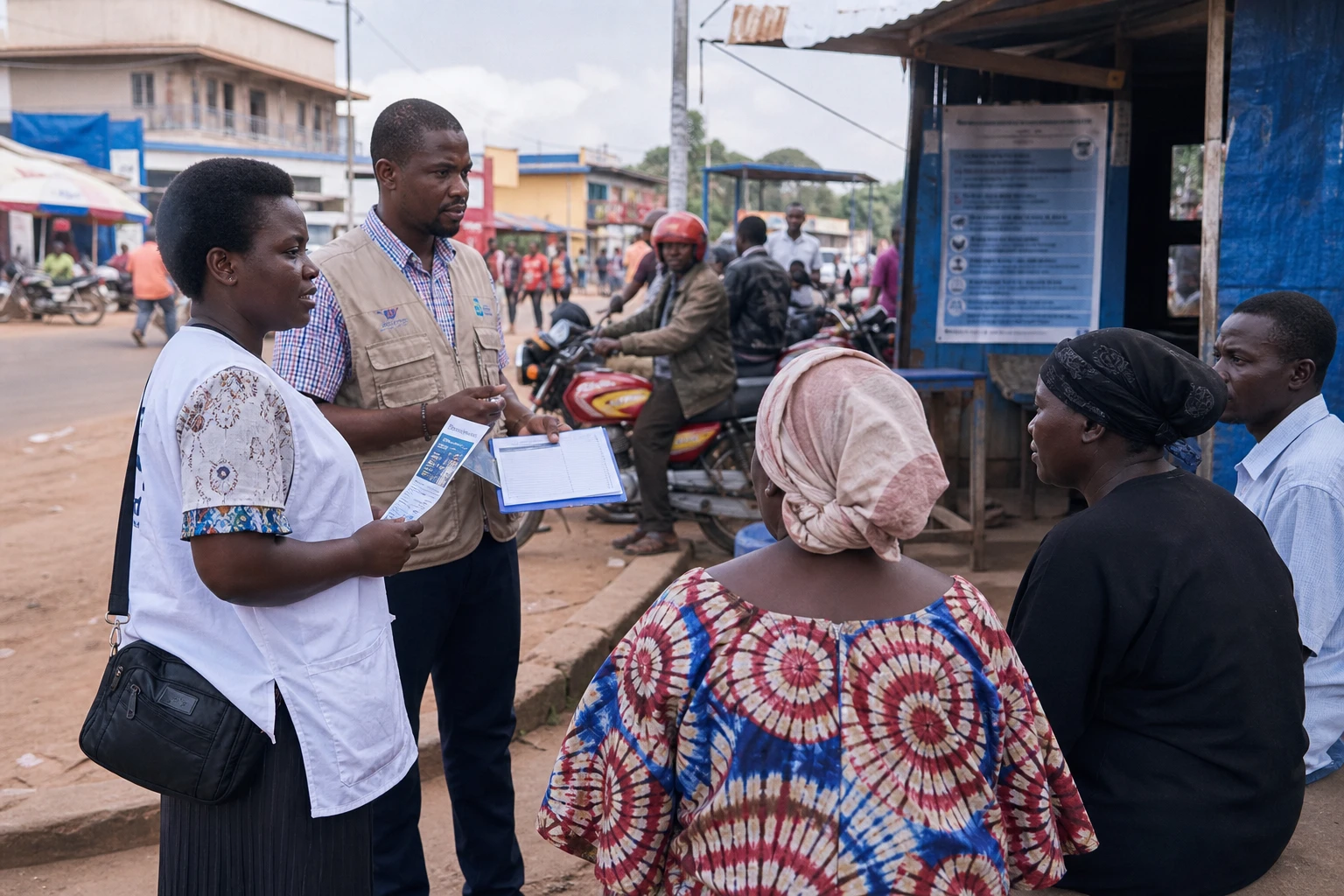
In Ituri, treating Ebola first means holding the front line
In eastern Democratic Republic of the Congo, the fight against Ebola is not taking place only in laboratories or treatment centres. It is also being waged on muddy tracks, in scattered villages and amid a fragile security environment. Where the virus is circulating, every delay in providing care increases the risk to patients, health workers and families burying their dead. In DR Congo, medical work therefore remains inseparable from conditions on the ground, community trust and actual access to affected areas.
The current epidemic is the 17th Ebola outbreak recorded in the country since 1976. It was detected in May 2026 in Ituri province, before spreading to other provinces in the east and north-east. The regional context matters just as much: the area is close to Uganda, South Sudan and the Central African Republic, which explains why the WHO and Africa CDC very quickly treated the outbreak as an issue requiring cross-border coordination.
An evolving epidemic, despite more nuanced signals
Figures published by the WHO give a sense of the challenge. As of 7 September 2026, DR Congo had 6,757 confirmed cases and 3,267 deaths, with an estimated case fatality rate of 48.3%. Ituri remains the epicentre, with 5,406 cumulative confirmed cases. The WHO also reports 61 affected health zones across six provinces, and 51 zones that had reported at least one case in the previous 21 days. These figures point to ongoing transmission, even as some outbreaks are slowing.
On 4 September, in Kinshasa, the Congolese government and its partners launched a revised 180-day plan to accelerate the response. The plan aims to improve coordination of surveillance, contact tracing, care, safe burials and health-worker protection. At the time, the WHO was already warning that progress in Ituri was not enough to conclude that the epidemic was in lasting decline.
The latest assessment of the situation remains cautious. On 17 September, Africa CDC said some areas, particularly in Ituri, were showing encouraging signs of a decline, but that transmission had not yet been sustainably interrupted. The African body also noted increases in some outbreaks in North Kivu and called for the continental emergency status to remain in place, a sign that the problem extends well beyond a single health district.
What medical teams on the ground are facing
The raw news text speaks of gravediggers, isolated patients and hard-to-reach areas. On the ground, these words describe a concrete reality. In an Ebola infection, the body remains contagious after death, making safe burials necessary. In a province where travel is already complicated by insecurity and the remoteness of communities, this public health requirement becomes a painstaking task, often carried out in an emergency and amid tensions with communities.
There is also a major medical constraint: the virus currently circulating is Bundibugyo ebolavirus, a different strain from the one that caused several major past outbreaks. The WHO has said that no vaccine or treatment is specifically approved for this strain, complicating the response. In practice, teams are therefore relying on rapid detection, isolation, staff protection, contact monitoring and clinical support for patients.
The deployment of care has nevertheless been stepped up. In early September, the WHO reported that 25 care facilities were operational in Ituri, including 15 Ebola treatment centres and 10 transit centres, with a total capacity of 974 beds. The same document stated that at the start of the response in May, only one centre with nine beds was operating. In other words, health infrastructure has expanded, but it remains vulnerable to the scale of the outbreak, road conditions, security and community acceptance.
A Congolese challenge, but also a regional and continental one
For DR Congo, this health crisis adds to the already heavy pressure on public services. In its statements on 16 September, the WHO said Ebola was not the only threat facing the Congolese: the country must also contend with other diseases, disruptions to access to care and ongoing humanitarian needs. In this context, the Ebola response is testing the state’s ability to operate far from the capital, Kinshasa, reaching peripheral areas where medical services remain fragile.
The regional dimension is just as clear. The WHO has confirmed that international coordination has been stepped up since the declaration of the public health emergency on 17 May 2026. Africa CDC, for its part, convened officials from DR Congo, Uganda and South Sudan to harmonise border surveillance. This approach matters: in a region with high levels of human mobility, an outbreak contained within one territory can quickly cross an administrative border without changing its epidemiological dynamics.
Resources remain crucial. The WHO said a six-month government plan called for $1.3 billion for the overall response. Africa CDC, for its part, has continued to call for the continental effort to be sustained. This is therefore not just a battle against a rare epidemic. It also says something about African health sovereignty: the ability to detect outbreaks quickly, vaccinate where appropriate, protect health workers and support health systems before a crisis spirals out of control.
In the short term, monitoring health zones in North Kivu, Ituri and neighbouring provinces will remain the most important indicator. The next updates from the WHO, the Congolese health ministry and Africa CDC will show whether the decline observed in some outbreaks finally turns into a lasting retreat, or whether the epidemic continues to move faster than the response.



