Algeria
 Egypt
 Libya
 Morocco
 Sudan
 Tunisia
 Benin
 Burkina Faso
 Cabo Verde
 Côte d'Ivoire
 Ghana
 Guinea
 Guinea-Bissau
 Liberia
 Mali
 Mauritania
 Nigeria
 Senegal
 Sierra Leone
 The Gambia
 Togo
 Cameroon
 Central African Republic
 Chad
 DR Congo
 Equatorial Guinea
 Gabon
 Republic of the Congo
 São Tomé and Príncipe
 Burundi
 Comoros
 Djibouti
 Eritrea
 Ethiopia
 Kenya
 Madagascar
 Malawi
 Mauritius
 Mozambique
 Rwanda
 Seychelles
 Somalia
 South Sudan
 Tanzania
 Uganda
 Angola
 Botswana
 Eswatini
 Lesotho
 Namibia
 South Africa
 Zambia
 Zimbabwe
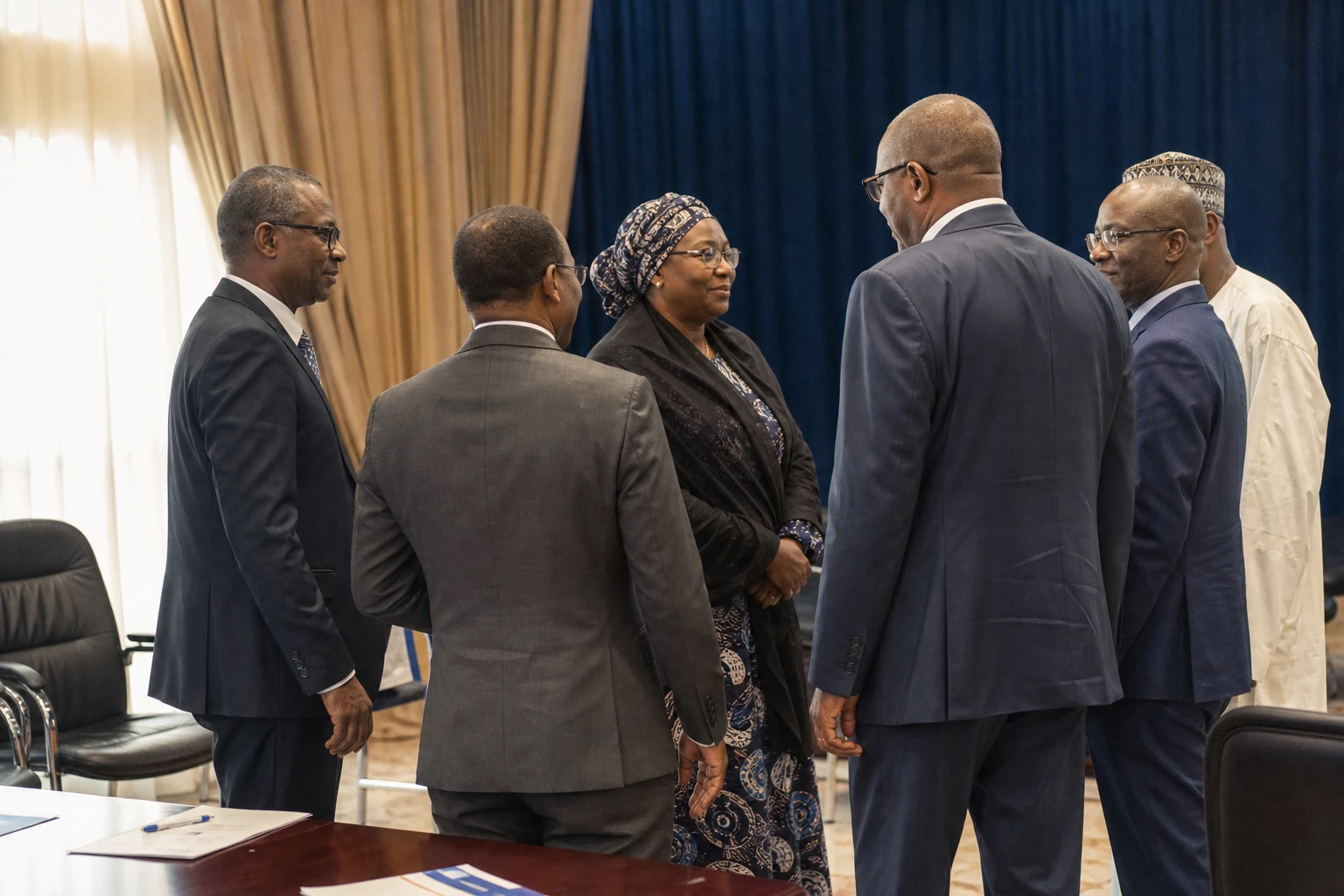
In Niamey, the Dasa project is already about more than a mine
In Niger today, a mining project can no longer be seen simply as a line in an industrial plan. It touches on economic sovereignty, public revenues, mineral transport and the ability of the Nigerien state to restart strategic assets despite regional tensions. The Dasa project is precisely part of this equation: a significant uranium resource, external financing that remains conditional, and a logistics chain dependent as much on the northern tracks as on relations with Benin and the ports of the Gulf of Guinea.
The Dasa site belongs to the Société Minière de Dasa, or SOMIDA, a joint venture between the State of Niger and Global Atomic. The company describes the project as a major Nigerien uranium asset, with a 23-year life and total output of 68.1 million pounds of U3O8, according to the feasibility study published in 2024 and revised in 2026.
US financing advances, but with conditions
On 16 September 2026, Global Atomic announced that the board of the U.S. International Development Finance Corporation, the DFC, had approved a debt facility of up to $414.2m for Dasa. The company said the approval did not yet mean immediate disbursement. The financing can only be put in place once documentation has been finalised and several project-related conditions have been met.
These conditions are demanding, and say much about the risks perceived by lenders. Global Atomic must demonstrate a viable export route for uranium concentrate, secure an extension of its mining convention and operating permit, and obtain guarantees covering the authorisations required for repayment of the loan. The company must also conclude a direct agreement with the Nigerien government. In other words, the financing is there on paper, but the legal, administrative and logistics chains must still hold together.
This caution is not incidental. The DFC regularly backs projects considered strategic to the United States, particularly in critical minerals and supply chains. At the same time, Washington is seeking to reduce its dependence on foreign sources of nuclear fuel and support its civilian industry. The Nigerien project therefore lies at the intersection of two agendas: mining development in Niger and US supply security.
The route through Benin remains the sticking point
For Niamey, the real difficulty is not limited to the financing structure. It also concerns getting production out of the country. Historically, Nigerien uranium has travelled through the Benin corridor to the port of Cotonou. But the Benin-Niger border has been at the centre of a diplomatic standoff since the July 2023 coup, with efforts to ease tensions only beginning in June 2026. The ANP reported that a committee of experts was set up on 2 June 2026 to examine the conditions for reopening the border, and that its findings were submitted to the two heads of state on 16 June.
This sequence matters directly to Dasa. Without a stable export corridor, a loan of this size remains vulnerable. Niger also has an obvious interest in securing its mining value chains at a time when the government is signalling a stronger commitment to economic sovereignty. The Finance Ministry, moreover, included in its 2026 budget law the assumption that SOMIDA production would begin in 2026. This shows that the Nigerien state is counting on the project, at least in its budget projections.
For the population and economic operators, the stakes are immediate. An open border facilitates trade, reduces transport costs and gives a lifeline to traders, transporters and service providers who rely on the southern corridor. For the state, the stakes are broader: to earn foreign currency, increase mining revenues and show that political instability does not paralyse strategic projects.
What Dasa says about Niger and the continent
The Dasa project resonates beyond Niger because it illustrates a reality increasingly visible across the continent: critical minerals are no longer developed through geology alone, but through geopolitics. Financing, the security of export corridors, relations with Western partners and the host state’s role in project governance are now inseparable. Dasa crystallises this new balance of power.
Niger remains a major African uranium producer. World Nuclear Association data note that Dasa is in the Tim Mersoi basin, near other historically productive areas of northern Niger. The country is therefore seeking to turn a long-established source of rent into leverage in negotiations, as several international partners take an interest in strategic mineral value chains.
What happens next will depend on very concrete steps: finalising the financing, clarifying the export corridor and the outcome of talks between Niamey and Cotonou. For now, Global Atomic is still targeting the start of commercial production in the second half of 2028. For Niger, the challenge is not simply to get uranium concentrate out of the country. It is to prove that a strategic project can overcome financial, diplomatic and logistical obstacles all at once.