
 Algeria
 Egypt
 Libya
 Morocco
 Sudan
 Tunisia
 Benin
 Burkina Faso
 Cabo Verde
 Côte d'Ivoire
 Ghana
 Guinea
 Guinea-Bissau
 Liberia
 Mali
 Mauritania
 Niger
 Nigeria
 Senegal
 Sierra Leone
 The Gambia
 Togo
 Cameroon
 Central African Republic
 Chad
 Equatorial Guinea
 Gabon
 Republic of the Congo
 São Tomé and Príncipe
 Burundi
 Comoros
 Djibouti
 Eritrea
 Ethiopia
 Kenya
 Madagascar
 Malawi
 Mauritius
 Mozambique
 Rwanda
 Seychelles
 Somalia
 South Sudan
 Tanzania
 Uganda
 Angola
 Botswana
 Eswatini
 Lesotho
 Namibia
 South Africa
 Zambia
 Zimbabwe
Kinshasa seeks a political way out without relinquishing control
In the Democratic Republic of the Congo, national dialogue is no mere addition to the political debate. It has become a test of trust. In a country still grappling with insecurity in the east, institutional tensions and suspicions that political competition is being restricted, every move on this issue is read as a signal of approach, balance of power and sincerity.
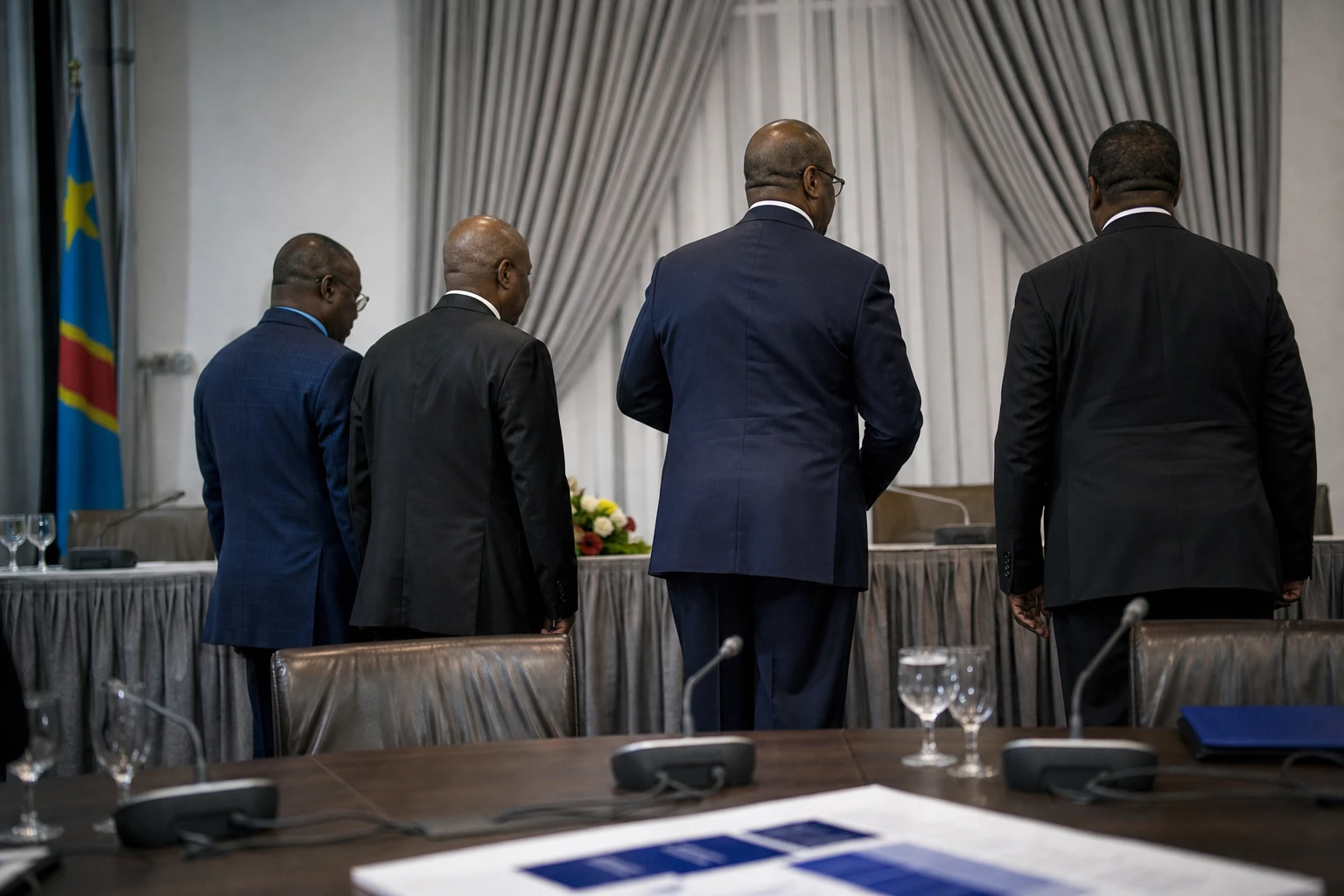
On Monday 14 September 2026, in Kinshasa, the presidency put the issue back at the centre of the agenda. Félix-Antoine Tshisekedi Tshilombo chaired an inter-institutional meeting at the Cité de l’Union africaine with the heads of the National Assembly and Senate, the prime minister and a delegate from the High Council of the Judiciary. Discussions focused on national dialogue, the parliamentary session and monitoring public policies.
A preliminary committee, followed by a preparatory commission
The decisive step came the previous day. A presidential order established a preliminary organising committee tasked with preparing the creation of the preparatory commission for national dialogue on peace, cohesion and state renewal. The text was read out on Sunday 13 September on RTNC by the head of state’s spokesperson, Tina Salama.
In practical terms, the committee is to organise the material, financial, technical, security, logistical, communications and protocol aspects of the process. It is also to contact national and international partners, organise preliminary meetings with the groups concerned and prepare the foundations of the future commission. It operates under the direct authority of the president and reports to him through his chief of staff.
This process does not start from scratch. On 27 August 2026, Félix Tshisekedi announced in an address to the nation that a national dialogue on peace, cohesion and state renewal would be launched. The presidency subsequently confirmed that the initiative would follow a structured sequence, with consultations and institutional preparation before the political phase itself.
A political timetable under scrutiny
In Kinshasa, the real issue is not simply whether there will be dialogue. It is its format. Several political forces have already voiced reservations. The opposition coalition C64 has rejected the consultations launched by the head of state, arguing that they address neither the security emergency nor the social crises. Other actors, close to Joseph Kabila or Martin Fayulu, are calling for a more focused framework, external guarantees and mediation they consider more balanced.
The divisions are clear. The government wants to retain the initiative on Congolese soil. Some opposition groups would like mediation entrusted to CENCO and ECC, the country’s two main Christian denominations, with support from the African Union and the United Nations. The presidency, for its part, has ruled out the idea of holding dialogue in a third country.
The political substance of the future dialogue carries as much weight as its format. According to details made public by Congolese media, the presidential framework rules out a general amnesty for war crimes, crimes against humanity, genocide and serious sexual violence. It also rejects suspending the institutions in place. In other words, Kinshasa is proposing a process of consultation without breaking with the constitutional order.
The security context demands a regional perspective
It is impossible to read this dialogue without looking again at the east of the country. Armed tensions, the crisis of confidence between Congolese actors and debates over governance are intertwined. Regionally, the DRC remains engaged in the diplomatic frameworks of the African Union, SADC and the EAC, which have emphasised dialogue as a way to defuse the conflict in the east. The joint EAC-SADC summit in August 2025 also commended Félix Tshisekedi and Paul Kagame for prioritising dialogue.
In Addis Ababa, at the 2026 African Union summit, the Commission chairperson again praised African initiatives for peace in the DRC, highlighting the importance of inter-Congolese dialogue and regional diplomatic efforts, notably those of Angola and Togolese mediator Faure Gnassingbé. This reminder matters: the Congolese crisis is not playing out only in Kinshasa, but also within a continental framework seeking to prevent the war in the east from becoming a national political deadlock.
What this process could change, and for whom
For the government, dialogue is an opportunity to regain the initiative, demonstrate a willingness to listen and channel dissent into an institutional framework. For the opposition, the question is whether the head of state will accept a genuinely shared space or retain control of the pace, format and selection of participants. The distinction is decisive. It will show whether dialogue serves to build a compromise or legitimise an agenda that has already been set.
For ordinary Congolese, the stakes are even more tangible. Amid pressure from the cost of living, security challenges and high expectations for public services, dialogue without concrete results would quickly be seen as yet another political ceremony. Conversely, a credible process could pave the way for political de-escalation, better institutional coordination and a clearer response to national priorities, from pacification and free primary education to the response to Ebola discussed at the inter-institutional meeting.
The capital, Kinshasa, is where decisions are made. But the effects will be measured in the provinces, where much of the Congolese crisis takes shape. That is where the significance of the dialogue will be determined: not in yet another communiqué, but in its ability to bring together institutions, parties, civil society and communities. The presidency has set out a framework. The question now is whether it will produce a national compromise or merely another round of power struggles.



