Algeria
 Egypt
 Libya
 Morocco
 Sudan
 Tunisia
 Benin
 Burkina Faso
 Cabo Verde
 Côte d'Ivoire
 Ghana
 Guinea
 Guinea-Bissau
 Liberia
 Mali
 Niger
 Nigeria
 Senegal
 Sierra Leone
 The Gambia
 Togo
 Cameroon
 Central African Republic
 Chad
 DR Congo
 Equatorial Guinea
 Gabon
 Republic of the Congo
 São Tomé and Príncipe
 Burundi
 Comoros
 Djibouti
 Eritrea
 Ethiopia
 Kenya
 Madagascar
 Malawi
 Mauritius
 Mozambique
 Rwanda
 Seychelles
 Somalia
 South Sudan
 Tanzania
 Uganda
 Angola
 Botswana
 Eswatini
 Lesotho
 Namibia
 South Africa
 Zambia
 Zimbabwe
When raising the alarm must become instinctive
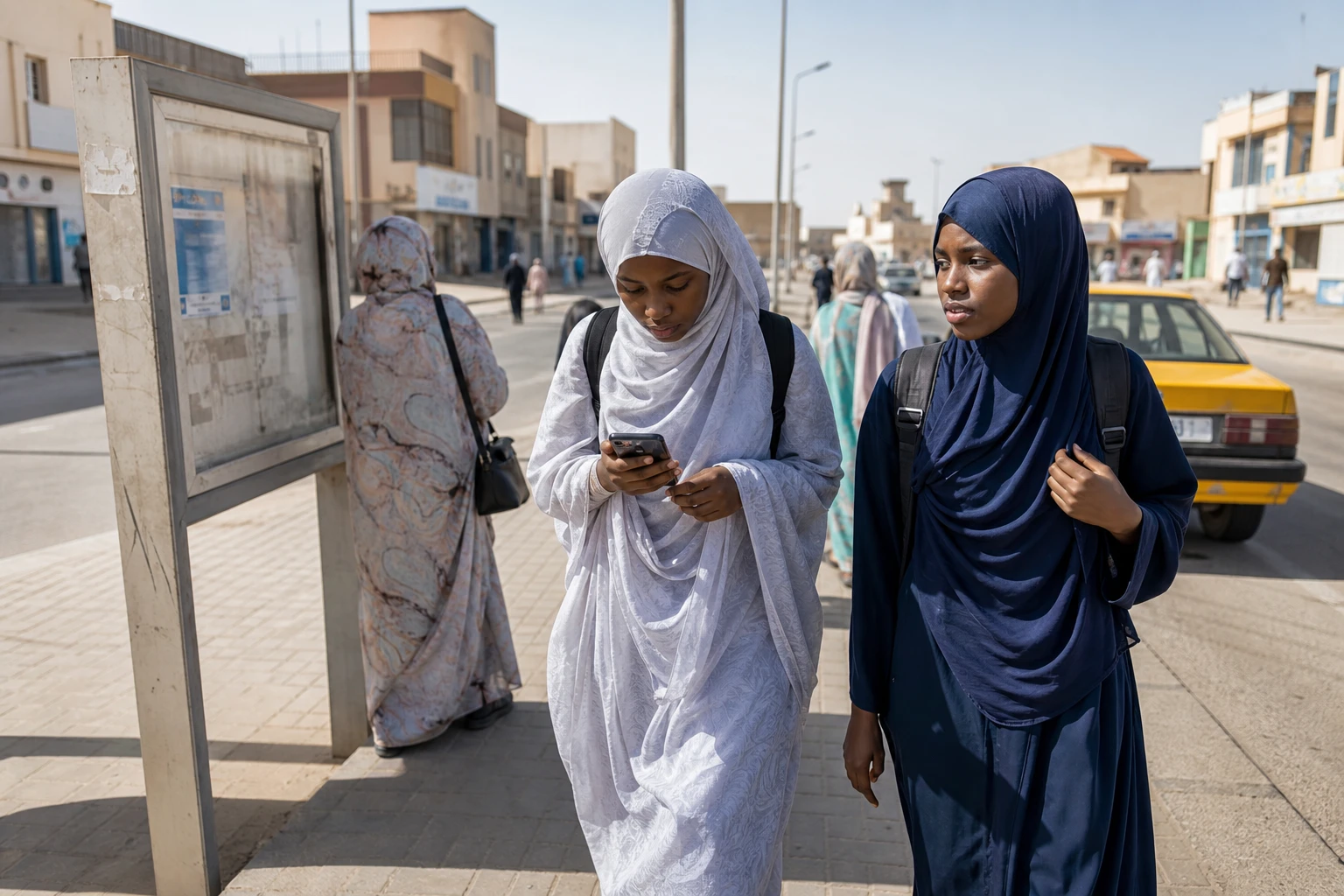
In Nouakchott, many women are not just looking to talk about violence. First, they are trying to survive the moment it happens. A mobile app designed to alert trusted contacts in the event of an assault is aimed at this blind spot: those first few minutes. The idea is simple. The need, however, is longstanding. Available data in Mauritania show that violence against women remains a documented problem, but one whose details are still poorly measured. UN Women notes that only 34.4% of the indicators needed to monitor the country’s SDGs are available, with major gaps in data on violence against women, unpaid domestic work and other key areas.
At the same time, institutional channels are multiplying, but are not always enough. Mauritania has established mechanisms and digital platforms for receiving complaints, whether related to human rights or citizens’ grievances. The state launched the “Himaity” platform for human rights complaints, followed by the “Aïn” platform for citizens’ grievances. This expansion of public digital services signals a clear shift: protection also depends on rapid reporting, traceability and the ability to raise the alarm.
A technological response in a country where violence remains under-reported
The app, presented by young Mauritanian entrepreneur Amara Fofana, reflects this approach. It allows users to enter essential information, share their location and designate trusted contacts who receive an alert in the event of danger. The aim is not to replace the police, but to save time, when every minute counts. The project also envisages easier access for security forces, to speed up the response. These details were made public in an account of the tool’s launch in Nouakchott.
The context helps explain this kind of initiative. In Mauritania, gender-based violence remains a major concern for UN agencies. UNFPA says that nearly 19% of women aged 15 to 49 have experienced physical or emotional violence, according to data it cites, and that more than 63% of women and girls have undergone female genital mutilation, despite its official ban since 2017. UN Women and OHCHR also report persistent gaps in protection, access to redress and the monitoring of cases of violence.
In this landscape, figures cited by local associations should be treated with caution, but they carry political weight. The Association of Women Heads of Household recently reported a high number of cases of violence, while other organisations and the National Observatory for the Rights of Women and Girls continue to document sensitive cases, sometimes involving sexual assault or suspected murders. Institutional authorities themselves call for facts to be verified before any comment is made, a sign that in Mauritania, as elsewhere, public debate still faces a lack of consolidated data and judicial delays.
What an alert app changes in practice
The main appeal of a tool like this lies in its simplicity. It is aimed at women who do not always have access to a nearby police station, immediate support or someone available to help. It could also be useful in Nouakchott’s outlying districts, where travelling at night remains riskier, as indicated by the safety advice on Mauritania published by France’s foreign ministry. In these areas, a phone can sometimes be the only emergency channel.
But a digital alert does not solve everything. If trusted contacts do not know how to respond, if the police cannot be reached, or if medical and legal support is too slow, the app will be just one more signal. That is why the project’s value also lies in what it reveals: the need to link prevention, reporting, intervention and support. This is precisely where Mauritanian institutions, women’s associations, health services and judicial authorities must come together. Without this network, the innovation remains useful, but incomplete.
The debate also extends beyond Mauritania. In several countries in West and Central Africa, UN Women has identified national observatories dedicated to gender or related issues. Mauritania is among the countries covered by this regional initiative, showing that the issue is not isolated. It concerns data governance, access to justice and the ability of states to protect women without waiting for a tragedy to make headlines. In this context, digital tools do not replace public action. They can, however, make it faster, clearer and sometimes more closely attuned to realities on the ground.
The continental significance is clear. In a country such as Mauritania, where Nouakchott concentrates a large share of services, people and decision-making, the challenge is as much urban as institutional. If the app works, it could inspire other local tools across Africa, provided it is backed by reliable public mechanisms and credible civil society networks. Technology alone does not protect people. It is the human and institutional framework around it that does.