Algeria
 Egypt
 Libya
 Sudan
 Tunisia
 Benin
 Burkina Faso
 Cabo Verde
 Côte d'Ivoire
 Ghana
 Guinea
 Guinea-Bissau
 Liberia
 Mali
 Mauritania
 Niger
 Nigeria
 Senegal
 Sierra Leone
 The Gambia
 Togo
 Cameroon
 Central African Republic
 Chad
 DR Congo
 Equatorial Guinea
 Gabon
 Republic of the Congo
 São Tomé and Príncipe
 Burundi
 Comoros
 Djibouti
 Eritrea
 Ethiopia
 Kenya
 Madagascar
 Malawi
 Mauritius
 Mozambique
 Rwanda
 Seychelles
 Somalia
 South Sudan
 Tanzania
 Uganda
 Angola
 Botswana
 Eswatini
 Lesotho
 Namibia
 South Africa
 Zambia
 Zimbabwe
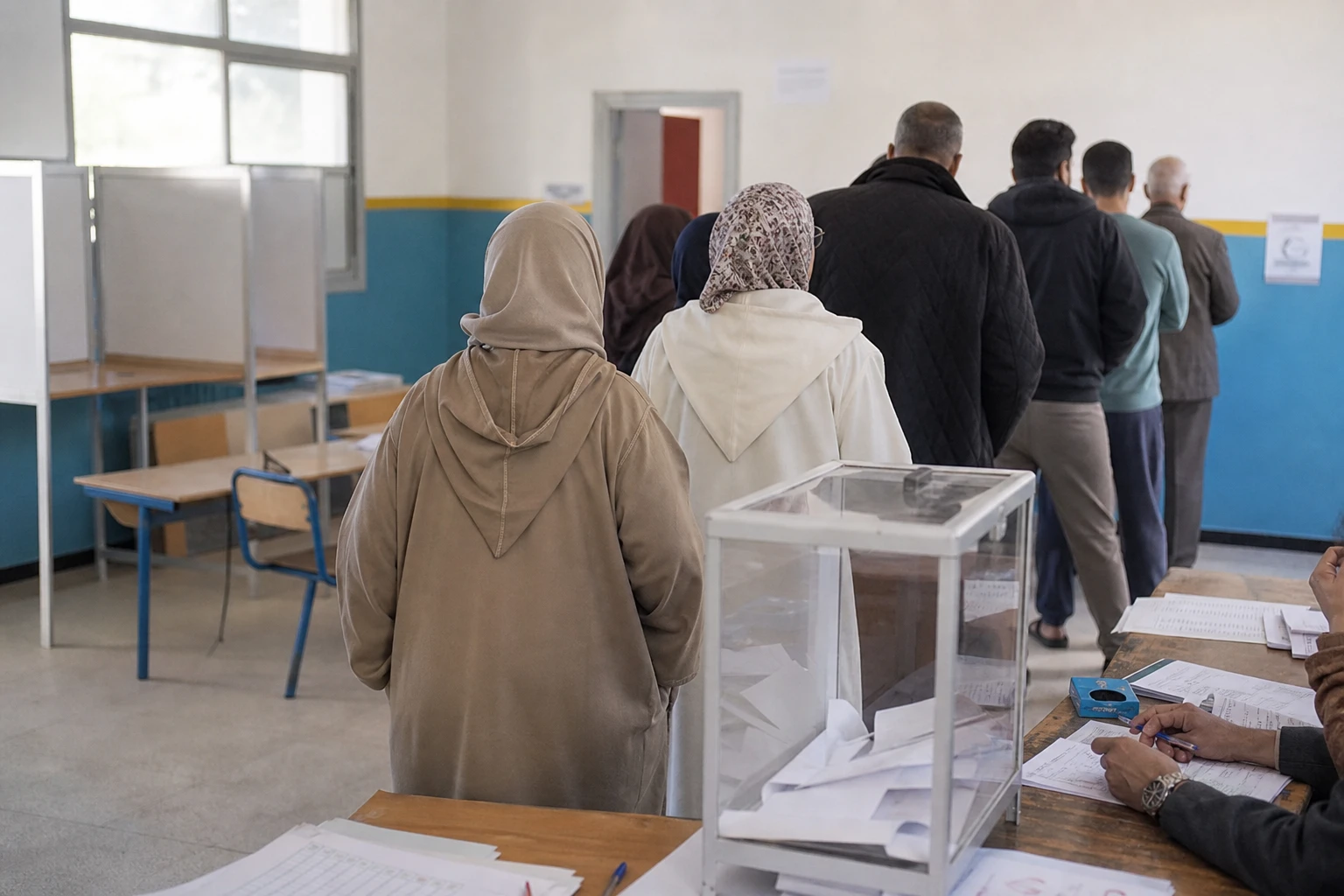
Anger does not fade with the silence
In Morocco, the streets have returned to their usual rhythm. But the malaise has not gone away. A year after the GenZ 212 movement erupted, many young people say they have left the noise of the protests behind without abandoning their grievances: state schools, access to healthcare, corruption, and the persistent feeling that promises only come after a crisis.
The contrast is striking. On one side, a movement born online, with no declared leader, driven by a generation used to platforms and horizontal mobilisation. On the other, a very conventional institutional calendar, with legislative elections scheduled for 23 September 2026. Between the two, this is less a pause than a warning.
The country, its institutions and the social backdrop
Moroccans vote for the House of Representatives in a system where the government depends on a parliamentary majority, but the monarchy retains a central role in setting the political direction. The legislative campaign began on 10 September 2026 and is due to end on 22 September, according to the Moroccan authorities. The vote comes amid a climate in which social issues remain at the forefront, especially in major cities and urban outskirts, where pressure on public services is most visible.
This period is also part of a broader trajectory. The Kingdom has embarked on major projects and has strong regional ambitions, notably with the 2025 Africa Cup of Nations and the 2030 World Cup. But for some young people, these projects only make sense if they are accompanied by massive investment in local hospitals, schools and jobs. That is where the debate shifted: not against modernisation, but against a modernisation seen as incomplete.
In this context, the GenZ 212 movement crystallised widespread frustration. The first demonstrations, which began in late September 2025, called for more resources for healthcare and education, while denouncing corruption and the gap between public priorities and everyday needs. Multiple accounts subsequently described gatherings in several cities, followed by clashes and a heavy-handed security response.
What happened, and what was left behind
The facts are now established. From 27 September 2025, calls shared on social media mobilised thousands of young Moroccans around simple, repeated demands: a better healthcare system, stronger state schools and what they saw as fairer management of resources. Reuters described a movement organised online through TikTok, Instagram and Discord, with no conventional party structure. Human rights organisations subsequently documented mass detentions, prosecutions and, in some cases, prison sentences.
Estimates vary by source. Human Rights Watch cites around 2,100 arrests and at least 1,400 people prosecuted, while Moroccan human rights organisations reported hundreds of court cases. Other, more cautious or earlier estimates put the number of detainees at more than 600 at one point. Beyond the exact figures, what matters is the message sent: the personal cost of taking part was high enough to diminish the movement’s visibility.
In accounts gathered afterwards, activists describe an organisation that is less visible and more cautious, sometimes reduced to providing solidarity with those arrested. This discretion does not necessarily mean it has disappeared. It also resembles a phase of political survival. When a mobilisation produces neither trade union links nor a party-political expression, it risks retreating into private messaging, closed circles and digital memory.
Why the parties did not harness the wave
The central issue is not only repression. It is the lack of intermediaries. In Morocco, established parties have done little to capture the voice of this generation. Trade unions, for their part, have failed to turn anger into a lasting agenda. This vacuum explains why GenZ 212 did not give rise to a structured political offering ahead of the legislative elections.
For several observers, this reflects a break in methods. A generation accustomed to horizontal coordination is wary of hierarchical organisations, long-term promises and established acronyms. But there is also a more concrete divide: some young people say they are too exposed to enter the electoral game, while others no longer see it as immediately effective. In this context, abstention or withdrawal is not simply a matter of disinterest. It expresses distrust.
The underlying problem remains social. The urgent issues that fuelled the movement have not gone away. Hospitals lack resources in several regions, and territorial inequalities remain stark between the major cities, the coast and the country’s interior. Young graduates, meanwhile, continue to face a saturated and segmented labour market. The movement therefore revealed a lasting gap between the rhetoric of reform and everyday life.
This gap also explains the episode’s political significance. Even without a lasting structure, GenZ 212 imposed a simple, concrete vocabulary that is difficult to sidestep: healthcare, schools, dignity, public accountability. The authorities, meanwhile, responded with announcements, calls for dialogue and closer monitoring of the streets. The strategy contained the flare-up. It did not resolve the malaise.
What Morocco tells the rest of North Africa
The Moroccan case reaches beyond its borders. Across North Africa and beyond, youth mobilisations point to the same equation: a connected, educated population confronted with strained public services and political systems struggling to absorb dissent. Morocco offers a particularly clear example, since dissent was expressed within a stable institutional framework, without the collapse of the state, but with a strong demand for social justice.
The message for the region is clear. Young people no longer accept that major national projects be disconnected from basic needs. Governments seeking to avoid further surges of anger will have to treat healthcare and education as political priorities, not secondary budget lines. The elections on 23 September 2026 will show whether this message has been heard at the ballot box or merely retained in speeches.
At the continental level, GenZ 212 is part of a broader wave of youth mobilisations seen in several African countries in recent years. The common thread is not ideology, but a demand for results. That is what makes this movement important, even when it appears to have fallen dormant. In Morocco, as elsewhere, silence on the streets does not necessarily mean the end of dissent. It may also herald its next form.