
 Algeria
 Egypt
 Libya
 Morocco
 Sudan
 Tunisia
 Benin
 Burkina Faso
 Cabo Verde
 Côte d'Ivoire
 Ghana
 Guinea
 Guinea-Bissau
 Liberia
 Mali
 Mauritania
 Niger
 Nigeria
 Senegal
 Sierra Leone
 The Gambia
 Togo
 Cameroon
 Central African Republic
 Chad
 Equatorial Guinea
 Gabon
 Republic of the Congo
 São Tomé and Príncipe
 Burundi
 Comoros
 Djibouti
 Eritrea
 Ethiopia
 Kenya
 Madagascar
 Malawi
 Mauritius
 Mozambique
 Rwanda
 Seychelles
 Somalia
 South Sudan
 Tanzania
 Uganda
 Angola
 Botswana
 Eswatini
 Lesotho
 Namibia
 South Africa
 Zambia
 Zimbabwe
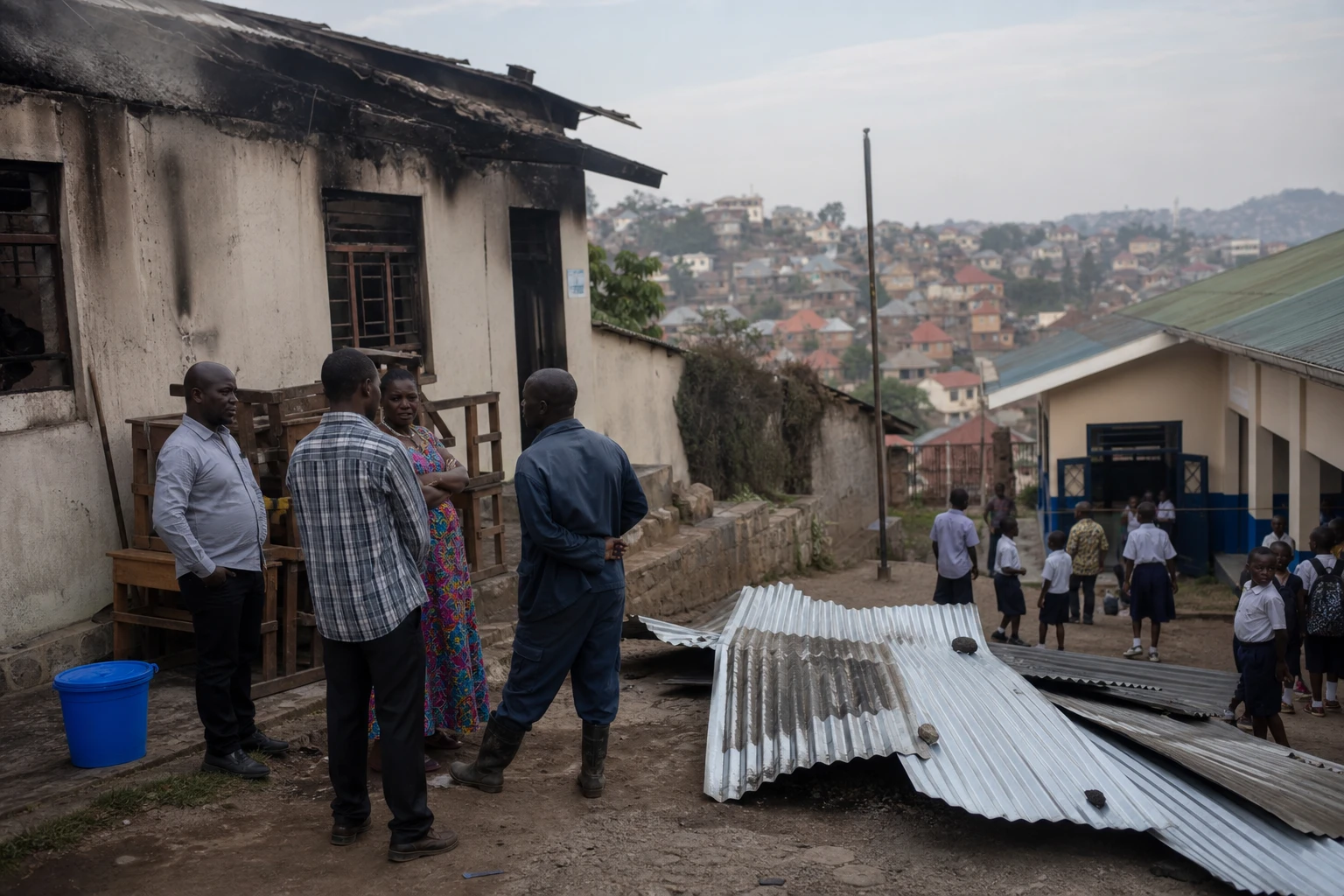
In Bukavu, one disaster follows another
In Bukavu, a fire is no longer limited to material damage. Within minutes, it can also become a school, health and urban emergency. On Thursday 10 September 2026, several primary schools in the Chimpunda neighbourhood were affected by a fire that started in a neighbouring home, in a city already weakened by a series of recent disasters.
The tragedy is a reminder of a reality familiar to families in South Kivu: in very densely populated neighbourhoods, where houses are close together and access routes are narrow, fires spread quickly and leave little room for manoeuvre for emergency services or residents. In Bukavu, this vulnerability is compounded by local administration made more difficult by the security situation.
What we know about the tragedy
The death toll remains provisional, but the initial figures point to a major tragedy. Radio Okapi first reported that 20 pupils had died and several had been injured, before later citing 29 deaths according to hospital sources. Actualité.cd, for its part, reported that at least 20 pupils had been killed and around 20 injured. Other victims were treated at several hospitals in Bukavu, where bodies and injured people were transferred during the afternoon.
Furaha and Ujamaa primary schools were among the establishments affected. According to local sources cited by Congolese media, some children died in the stampede as people fled, while others died from asphyxiation. The cause of the fire had not been established at the time of the first reports, and the authorities stressed that the toll was provisional.
Homes also burned. Here too, the figures varied depending on the time and source: Radio Okapi cited around 50 houses in its evening coverage, while other residents and local community leaders reported dozens of homes reduced to ashes. On the ground, the fire reportedly started early in the morning, at around 8am, before spreading to the schools.
Bukavu, a city under pressure
Bukavu is the capital of South Kivu, in the east of the Democratic Republic of the Congo. Since February 2025, the city has been under the control of the AFC-M23, an armed movement supported by Rwanda according to several international sources, complicating the work of the central government and administrative co-ordination. In this situation, the provincial authorities based in Uvira and local structures carry part of the response, but with limited resources.
The South Kivu governor’s office has criticised the poor management of fires in the region. Civil society actors, meanwhile, have pointed to a lack of prevention, poorly enforced urban planning rules and dense urbanisation in which informal housing leaves little room for emergency vehicles. This local perspective matters: it links the tragedy not to an isolated accident, but to a chain of structural vulnerabilities.
In recent weeks, Bukavu has in fact seen a succession of fires. Radio Okapi reported that more than 700 homes had burned in one week in early September 2026, while Actualité.cd had already cited thousands of cases recorded over two months by the provincial authorities. This context helps explain why the 10 September fire struck a population already under strain.
An education crisis at the heart of an urban crisis
The Congolese Ministry of National Education and New Citizenship responded from Kinshasa by expressing its solidarity, calling for a documented assessment and ordering the identification of the immediate needs of affected pupils, teachers and school communities. The ministry also stressed the importance of continuing education, a key issue in an area where war and fires regularly disrupt schooling.
This issue goes beyond the humanitarian sphere. When schools burn, the entire education system is shaken: the school calendar, children’s safety, teachers’ attendance, the availability of classrooms and families’ ability to absorb another shock. In Bukavu, the question is even more pressing, as schools are often at the heart of a tightly packed urban fabric, where they also serve as community landmarks.
Comparison with other recent disasters in the DRC also highlights the national stakes. In Kinshasa, the state had recently stepped up monitoring of gathering places after a series of incidents involving fires and crowd movements. The Bukavu disaster shows that prevention cannot be considered only in the capital: it must also cover eastern cities, where density, conflict and vulnerable housing create a higher level of risk.
What this episode says about the DRC and the region
Across the DRC, this fire is a reminder of a wider problem: weak prevention infrastructure in rapidly growing cities. At regional level, it also shows how the South Kivu crisis, at the heart of the East African Community and a sensitive border area, continues to weigh on public services, including schools. Children are not merely victims of a fire; they suffer in a territory where authority, emergency services and urban planning remain contested.
What happens next will depend on very concrete factors: confirmation of the final death toll, identification of the cause of the fire, the condition of the injured and the measures taken to rehouse affected pupils or reorganise their schooling. But one thing is already certain: in Bukavu, the urgent task is not only to put out the flames. It is also to finally reduce the conditions that make this kind of tragedy almost predictable.



