
 Algeria
 Egypt
 Libya
 Morocco
 Sudan
 Tunisia
 Benin
 Burkina Faso
 Cabo Verde
 Côte d'Ivoire
 Ghana
 Guinea
 Guinea-Bissau
 Liberia
 Mali
 Mauritania
 Niger
 Nigeria
 Senegal
 Sierra Leone
 The Gambia
 Togo
 Cameroon
 Central African Republic
 Chad
 Equatorial Guinea
 Gabon
 Republic of the Congo
 São Tomé and Príncipe
 Burundi
 Comoros
 Djibouti
 Eritrea
 Ethiopia
 Kenya
 Madagascar
 Malawi
 Mauritius
 Mozambique
 Rwanda
 Seychelles
 Somalia
 South Sudan
 Tanzania
 Uganda
 Angola
 Botswana
 Eswatini
 Lesotho
 Namibia
 South Africa
 Zambia
 Zimbabwe
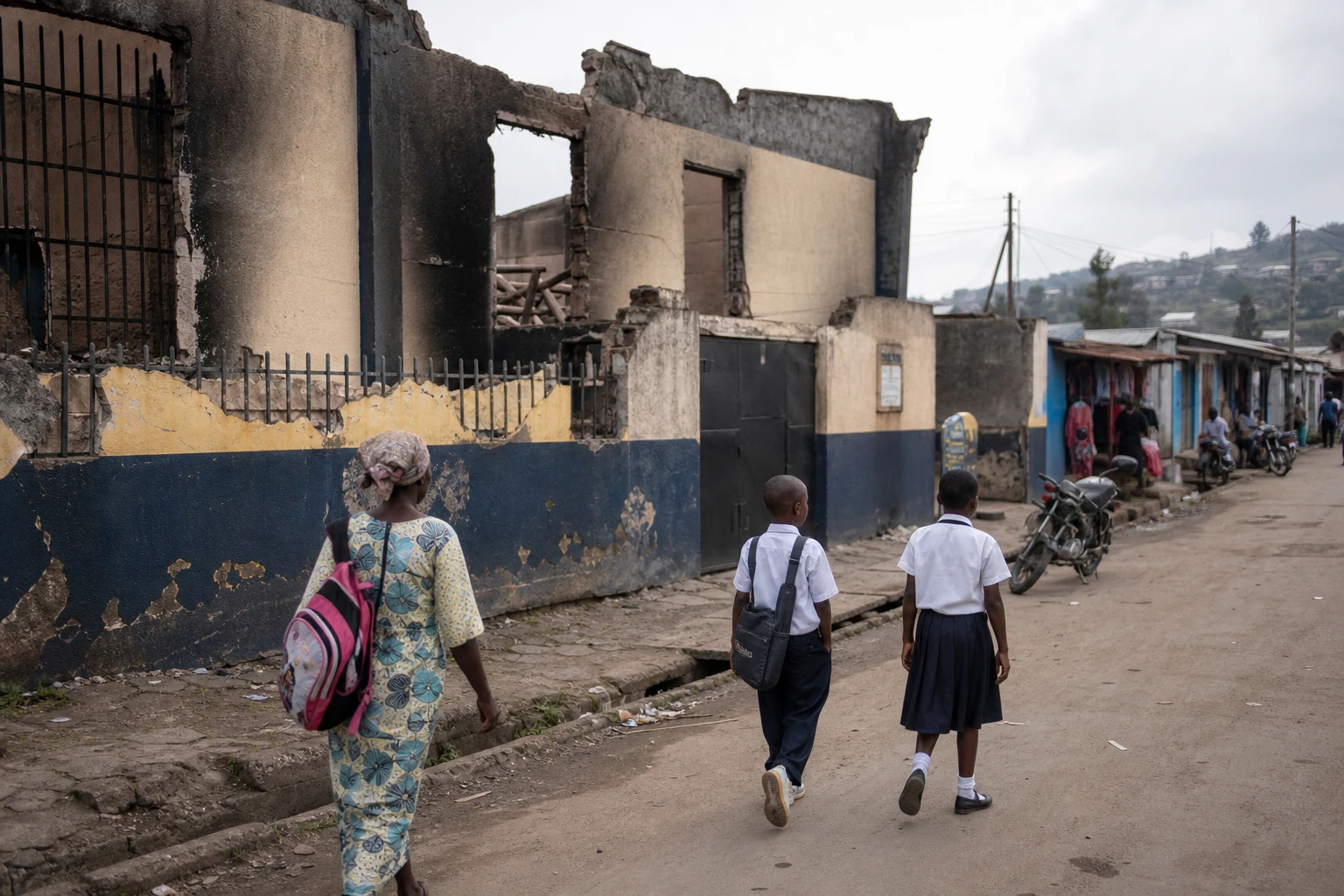
In Bukavu, a neighbourhood fire lays bare the fragility of urban life
In some cities, a fire destroys homes. In Bukavu, it can also engulf a school, entire families and, within minutes, the fragile balance of a neighbourhood already under pressure. In the commune of Kadutu, in the south of the city, the blaze on Thursday struck at the heart of a dense urban area, where homes almost touch and access roads are often too narrow for emergency services.
The disaster struck a city in South Kivu already scarred by security tensions and a series of recurring fires. Bukavu, the provincial capital, has been under the control of AFC/M23 since February 2025, after an offensive shifted the balance of power in the east of the Democratic Republic of the Congo. The UN Security Council has demanded that M23 withdraw from Bukavu and other occupied areas, condemning the support provided by the Rwanda Defence Force for the offensive.
What is known about the Kadutu fire
The provisional toll is at least 24 dead, including 19 girls and five boys, and 29 injured people receiving care at local health facilities. The fire is believed to have started in a house before spreading to two nearby schools, according to information gathered at the scene. The victims were taken to the Nyamulagira BDOM health centre, while local teams continued searching through the rubble.
Several witnesses described the flames spreading rapidly. In an area where much of the built environment is made of wood, the speed at which the fire spread left little room to manoeuvre. Difficult access also hampered the response. At this stage, the exact cause of the fire is unknown. An investigation has been opened, but no sound conclusions can be drawn without technical cross-checking.
The fire also ravaged more than 300 homes, leaving hundreds of people homeless. This kind of toll is unfortunately not unprecedented in Bukavu. In June 2023, more than a thousand homes had already been affected in the city over the space of two weeks, especially in Kadutu, and local authorities and community organisations had pointed to the extreme density of buildings and the lack of passable roads for emergency services.
Why Kadutu remains vulnerable
Kadutu concentrates some of Bukavu’s urban vulnerabilities. The neighbourhood is densely populated, houses are built close together, and lightweight materials are widely used in several areas. Reports carried by Congolese media and a recent study on household fires in Bukavu show that the commune faces a particularly high risk, notably because of unplanned urbanisation and limited access for emergency services.
This reality weighs first on households. When a fire breaks out, losses extend beyond the walls. Families lose exercise books, uniforms, food stocks, small businesses run from home and sometimes savings kept in a bedroom. In a city where part of economic activity is informal, a single night of fire can interrupt a household’s income for a long time.
Schools, too, pay a direct price. The destruction of two schools means more than the loss of buildings. It interrupts lessons, delays exams and adds an invisible cost for families already affected. In a border city such as Bukavu, where movement remains constrained by the security situation, every school closure becomes an obstacle to access to education, and then a problem of mobility and protection for children.
The security context adds to the burden. Since Bukavu was taken by AFC/M23, the local administration has been operating amid deep uncertainty. The UN has reported parallel administrations in areas controlled by the movement, while public services are struggling to meet basic needs. In this context, a fire is not merely a civilian disaster. It is also a test of command, emergency response and protection capacity in a city where state authority remains contested.
A local disaster, but a regional warning
What is happening in Bukavu goes beyond the commune of Kadutu. The east of the DRC faces a combination of armed conflict, demographic pressure, rapid urbanisation and inadequate urban services. In this context, fires expose structural weaknesses: poor planning, fragile electricity networks, limited access to water, difficulties for fire engines to get through and a lack of safety space between homes.
The issue is regional, too. Bukavu lies at the heart of an area where crises overlap: conflict with M23, population displacement, pressure on health facilities and the movement of goods across Lake Kivu and neighbouring borders. In a region already shaken by tensions between Kinshasa and Kigali and by African and international mediation efforts, every major incident is a reminder that human security is not limited to fighting. It also includes schools, housing, evacuation routes and civil protection.
For local authorities and humanitarian organisations, the immediate priorities are clear: provide shelter for those affected, treat the injured, secure the area and document the causes. For the city, the challenge is broader: to break a cycle in which the same neighbourhoods repeatedly appear in fire tolls. As long as Bukavu’s urban development remains constrained by overcrowded buildings and inadequate infrastructure, Kadutu will remain one of the city’s most exposed areas.



