Algeria
 Egypt
 Libya
 Morocco
 Sudan
 Tunisia
 Benin
 Burkina Faso
 Cabo Verde
 Côte d'Ivoire
 Guinea
 Guinea-Bissau
 Liberia
 Mali
 Mauritania
 Niger
 Nigeria
 Senegal
 Sierra Leone
 The Gambia
 Togo
 Cameroon
 Central African Republic
 Chad
 DR Congo
 Equatorial Guinea
 Gabon
 Republic of the Congo
 São Tomé and Príncipe
 Burundi
 Comoros
 Djibouti
 Eritrea
 Ethiopia
 Kenya
 Madagascar
 Malawi
 Mauritius
 Mozambique
 Rwanda
 Seychelles
 Somalia
 South Sudan
 Tanzania
 Uganda
 Angola
 Botswana
 Eswatini
 Lesotho
 Namibia
 South Africa
 Zambia
 Zimbabwe

Ghana steps up its digital transformation
In Accra, the recovery has not taken the form of a spectacular rebound in the fields or mines. Instead, it has taken shape in services, payments, telecommunications and digital activities. In the second quarter of 2026, Ghana recorded real year-on-year growth of 6.0%, confirming an economy returning to stability after years of inflationary shocks and external constraints.
This signal matters beyond the headline figure. It shows that part of Ghana’s growth is shifting towards urban, formal and increasingly connected activities. In a West African country integrated into ECOWAS, this trajectory matters to policymakers, businesses and households alike, because it affects employment, tax revenues and the capacity to absorb imported shocks.
Services drive the economy, with ICT in the lead
The national accounts breakdown sheds light on the engine behind this performance. The services sector grew by 8.0% in the second quarter and accounted for 57.6% of total growth. It remains by far the largest component of Ghana’s economy, representing 45.9% of GDP.
Within this sector, information and communication technologies played a decisive role. ICT activity surged by 30.9% year on year and accounted for 41.5% of the quarter’s total growth. Transport, storage and some manufacturing branches also supported the overall figure, but the digital contribution has become strong enough to shape the reading of economic conditions.
Ghana Statistical Service’s chief statistician summed up the situation by describing growth as “substantially digital”. This is more than a rhetorical point. It reflects an economy in which connectivity, mobile services, platforms and data infrastructure carry more weight in value creation than they did a few years ago. The shift is consistent with the growing use of digital services in a major metropolis such as Accra, as well as in secondary urban centres.
Industry, oil and agriculture: a still uneven recovery
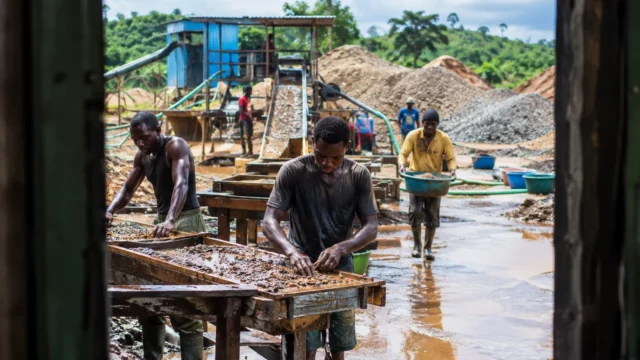
The picture is not uniform, however. Industry grew by 4.3% over the period, helped by a rebound in oil and gas, where activity rose by 22.4% after contracting by 29.0% a year earlier. Agriculture grew by 3.9%, a more modest rate, while fishing declined by 24.7%.
This ranking says much about the structure of the recovery. Urban services are advancing rapidly. Hydrocarbon extraction is providing a temporary boost. Rural activities, by contrast, remain more fragile. For households, this means growth is not yet translating evenly into income or jobs. For the state, it calls for vigilance to ensure the recovery reaches the regions, small farms and informal economy.
The six-month figures confirm this trend. In the first six months of 2026, the economy grew by 6.2%, while non-oil GDP increased by 5.9%. Domestic demand also accelerated, rising by 11.2%, and investment surged by 53.0% in the second quarter. In other words, the recovery rests both on current activity and on the gradual resumption of projects and investment flows.
An economy still shaped by its emergence from crisis
This improvement comes after a difficult period. Ghana defaulted on a large portion of its external debt in 2022 before embarking on a restructuring of its public debt. In May 2023, the country secured a $3 billion programme from the International Monetary Fund. On 27 July 2026, the institution’s Executive Board completed the sixth and final review of the programme, paving the way for a final disbursement of about $371 million.
The IMF said at the time that macroeconomic stabilisation had advanced, with inflation falling, reserves rising, the primary balance returning to surplus and the risk of debt distress moving to a moderate level. It also said the new phase of the economic framework, through a policy coordination instrument, should help anchor fiscal discipline and support growth increasingly driven by the private sector.
For Ghana, this changes the nature of the public debate. The question is no longer only how to emerge from a financial emergency. It is also about which sectors create value, where the gains are concentrated, and how households experience their effects. Second-quarter data suggest a genuine recovery, but one concentrated in a few segments, particularly digital services and some energy activities.
What this trajectory says about West Africa
Ghana’s experience offers lessons for West Africa. It shows that a macroeconomic recovery depends not only on a return of confidence among lenders. It also relies on the ability to develop domestic growth engines, such as digital activity, market services and modern payments. In an ECOWAS region whose economies remain exposed to global prices, financing costs and climate shocks, this diversification is a strategic buffer.
The next steps should nevertheless be watched with caution. If Ghana’s growth continues to be driven by urban and capital-intensive activities, the challenge will be to turn statistical gains into broader employment, productive investment and more stable agricultural incomes. The next Bank of Ghana data and national accounts will show whether the country is settling into a lasting recovery or remains dependent on a few high-performing sectors.