
 Algeria
 Egypt
 Libya
 Morocco
 Sudan
 Tunisia
 Benin
 Burkina Faso
 Cabo Verde
 Côte d'Ivoire
 Ghana
 Guinea
 Guinea-Bissau
 Liberia
 Mali
 Mauritania
 Niger
 Nigeria
 Senegal
 Sierra Leone
 The Gambia
 Togo
 Cameroon
 Central African Republic
 Chad
 Equatorial Guinea
 Gabon
 Republic of the Congo
 São Tomé and Príncipe
 Burundi
 Comoros
 Djibouti
 Eritrea
 Ethiopia
 Kenya
 Madagascar
 Malawi
 Mauritius
 Mozambique
 Rwanda
 Seychelles
 Somalia
 South Sudan
 Tanzania
 Uganda
 Angola
 Botswana
 Eswatini
 Lesotho
 Namibia
 South Africa
 Zambia
 Zimbabwe
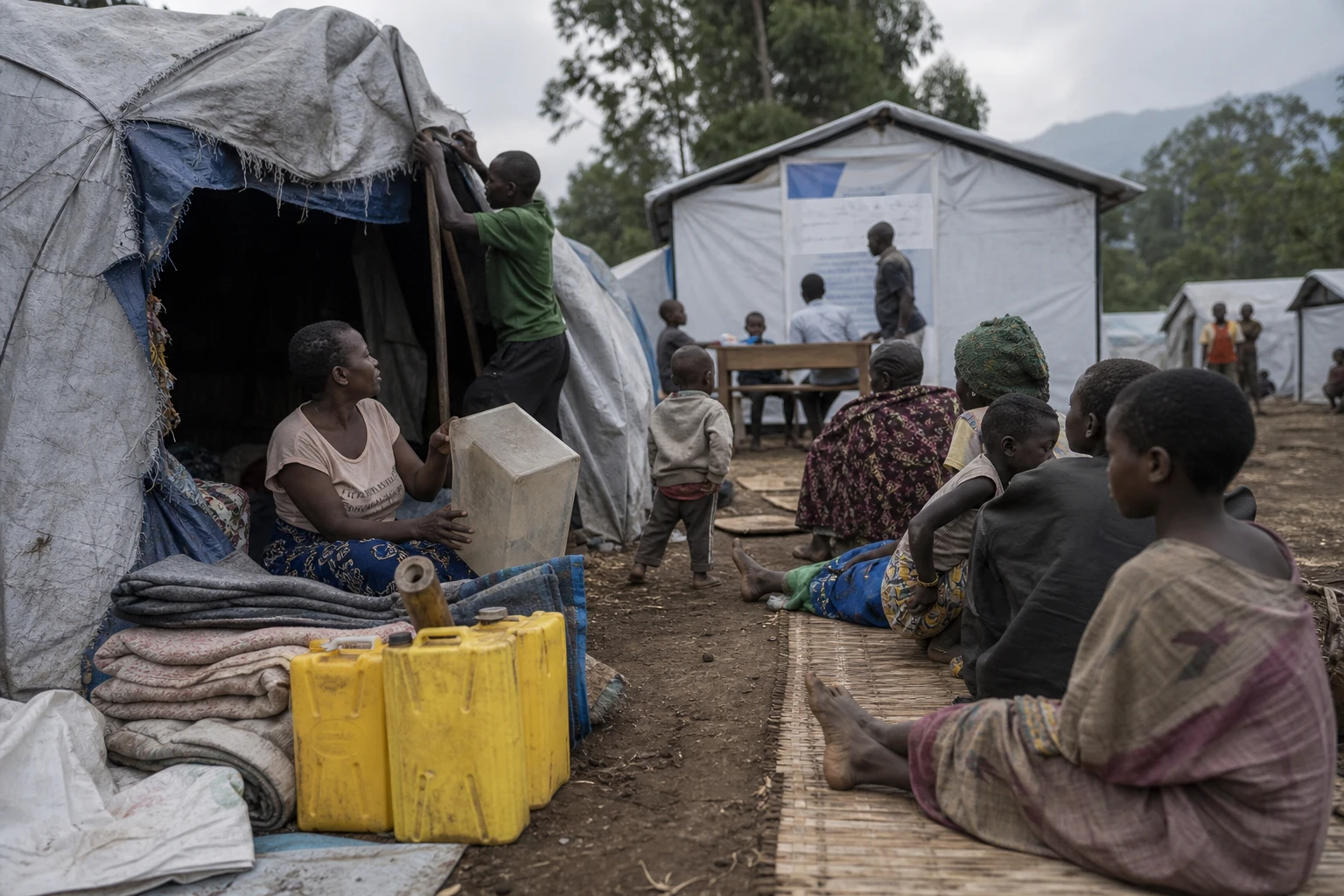
In Boikene, exile changed lives before it changed the landscape
In Beni, North Kivu, Indigenous Pygmy families have had to leave the forest to survive in makeshift shelters in Boikene, north of the city. Displacement has not merely taken away a roof. It has severed a vital link with a territory that fed, healed and sustained these communities in their daily lives.
This upheaval recalls a reality often overlooked in the east of the Democratic Republic of the Congo: for Indigenous Pygmy peoples, the forest is not a backdrop. It is a source of subsistence, mobility, knowledge and transmission. When insecurity drives them from their land, entire economies, modest but real, collapse.
A local crisis, set in a wider regional context
Beni remains scarred by years of violence attributed to the ADF, the Allied Democratic Forces active in eastern Congo and regularly cited in attacks on civilians. In the same area, an Ebola outbreak caused by the Bundibugyo virus was declared in May 2026, with cases in Ituri and a risk to the DRC judged very high by international health authorities. In Beni, this overlap of insecurity and health crisis makes life even more precarious for displaced people.
This situation is unfolding in a country that has nevertheless established a specific legal framework for Indigenous Pygmy peoples. Law No. 22/030 of 15 July 2022 provides for the protection and promotion of their rights. On paper, it recognises their status, safeguards and the participation of the communities concerned. On the ground, implementation remains uneven, especially in conflict zones where access to civil registration, land, healthcare and humanitarian aid remains limited.
The facts: displaced families, an overcrowded site and basic needs
According to information gathered in Beni in August 2026, 67 households from the Indigenous Pygmy community, or about 200 people, are living at the Boikene site after fleeing violence on the outskirts of Beni in late May. They say they left the Ngadi site after attacks attributed to the ADF in the Ndandi area.
Their needs are immediate: food, drinking water, blankets, clothing, healthcare and sturdier shelters. Families are living in makeshift structures, often directly on the ground. Site officials have also reported at least five deaths among displaced people since they arrived, amid extreme hardship. This figure should be understood as a local tally reported on the ground, in an area where independent verification is difficult and population movements are rapid.
Displacement also carries an invisible economic cost. In the forest, these families drew part of their resources from hunting, gathering and daily activities connected to their environment. In Boikene, they now depend largely on outside aid and fragile mutual-support networks. This is not simply a change of location. It is a rupture in their way of life.
Vulnerability compounded by health, law and geography
The situation in Boikene highlights a point often overlooked in crises in eastern Congo: not all displacement is the same. For Pygmy families, leaving the forest means losing access to food resources, cultural reference points and a place where knowledge is passed on. The city, meanwhile, imposes different rules. It demands money, documents, networks and services that are precisely what the most marginalised lack.
The health situation adds to the strain. The WHO confirmed the Bundibugyo Ebola outbreak in the DRC and Uganda in May 2026, then reported that Ituri remained the Congolese epicentre of the outbreak. In such an environment, the lack of water, hygiene, durable shelter and medical follow-up multiplies the risks. A community displaced and already weakened by insecurity is more exposed than others.
Congolese law nevertheless provides a basis for inclusion. The law on Indigenous Pygmy peoples provides for their participation and representation, and respect for free, informed and prior consent. In theory, this paves the way for tailored responses. In practice, the gap between the law and reality remains wide, especially when local authorities lack resources and humanitarian organisations have to address several emergencies at once.
What Boikene reveals about the DRC and the Congo Basin
The situation in Beni extends beyond North Kivu. It points to a wider question, central to the Democratic Republic of the Congo and all of Central Africa: how can peoples whose survival depends directly on the forest be protected when insecurity, displacement and pressure on land are narrowing their room for manoeuvre? In the Congo Basin, the world’s second-largest tropical forest, the issue is not only humanitarian. It also concerns conservation, local governance and the credibility of inclusion policies.
It also has regional significance. The health crisis linked to Ebola is already mobilising the Congolese authorities, the WHO and Africa CDC. The security crisis, meanwhile, is a reminder that the response in eastern DRC cannot be limited to the military or medical emergencies. It must also protect displaced communities, recognise their specific needs and take their livelihoods into account. Without this, the same people will continue to pay twice: first through violence, then through abandonment.
In Boikene, the outlook remains bleak. Displaced families are waiting for safer shelter, regular assistance and, above all, the chance to return home one day. For them, the real challenge is not simply to survive the present moment. It is to find a territory where life can become possible again, without having to choose between safety, dignity and memory.



