Algeria
 Egypt
 Libya
 Morocco
 Sudan
 Benin
 Burkina Faso
 Cabo Verde
 Côte d'Ivoire
 Ghana
 Guinea
 Guinea-Bissau
 Liberia
 Mali
 Mauritania
 Niger
 Nigeria
 Senegal
 Sierra Leone
 The Gambia
 Togo
 Cameroon
 Central African Republic
 Chad
 DR Congo
 Equatorial Guinea
 Gabon
 Republic of the Congo
 São Tomé and Príncipe
 Burundi
 Comoros
 Djibouti
 Eritrea
 Ethiopia
 Kenya
 Madagascar
 Malawi
 Mauritius
 Mozambique
 Rwanda
 Seychelles
 Somalia
 South Sudan
 Tanzania
 Uganda
 Angola
 Botswana
 Eswatini
 Lesotho
 Namibia
 South Africa
 Zambia
 Zimbabwe

In Tunis, a case that extends beyond the courtroom
In Tunisia’s capital, a legal case has become a political test. It concerns not only activists, lawyers and party officials. It also raises questions about the role of the judiciary in a Tunisia where the balance of power has tightened considerably since 2021.
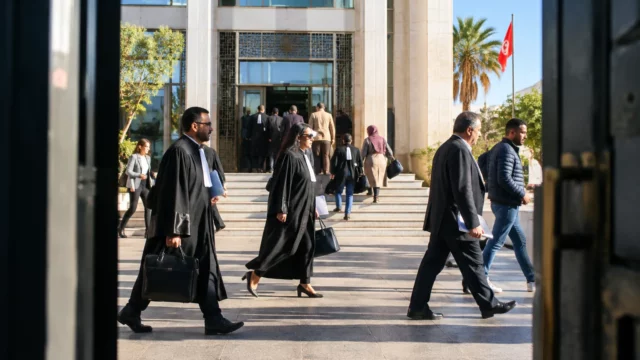
On Thursday 3 September 2026, the Court of Cassation in Tunis rejected the appeals lodged in the so-called “conspiracy against state security” case, thereby upholding the convictions handed down on appeal. The confirmed sentences run to as many as 45 years in prison for opposition figures, lawyers and businessmen prosecuted in the case.
Justice at the heart of Tunisia’s power struggle
To understand this decision, it is necessary to go back to the turning point of 25 July 2021. On that day, President Kaïs Saïed suspended parliament, concentrated extensive powers in his own hands and then embarked on a sweeping overhaul of the institutions. Since then, his opponents have described the move as a power grab. His supporters, by contrast, present it as a necessary correction to a political system they regard as ineffective.
The rupture had a direct effect on the judiciary. The dissolution of the Higher Judicial Council, the dismissal of judges and the increased use of criminal proceedings against critical voices have fuelled accusations that the judiciary is being brought to heel. Human rights organisations say the independence of Tunisia’s courts has weakened over the years.
The case heard in Tunis is therefore part of a broader sequence of events. It concerns a country on the southern shore of the Mediterranean that does not belong to a major African economic community such as ECOWAS or CEMAC, but remains connected to its Maghreb and African surroundings through issues of governance, political rights and institutional stability.
What the Court of Cassation decided
The proceedings took on a new dimension in 2025. In April, a Tunis court of first instance had convicted dozens of defendants in the case. Then, in November 2025, the court of appeal upheld heavy sentences against 34 defendants, with prison terms ranging from five to 45 years. The best-known names include Ghazi Chaouachi, Issam Chebbi, Jawhar Ben Mbarek, Ridha Belhaj, Noureddine Bhiri and Ahmed Nejib Chebbi.
The Court of Cassation, hearing the case as the court of last resort, had two options: uphold the verdicts or quash the decision and order a new trial. By rejecting all 46 appeals, it chose the first course. In practice, the convictions are now final for those concerned, barring extraordinary further appeals or changes in the proceedings.
A few supporters of the defendants had gathered outside the courthouse. Among them, Ezzedine Hazgui, father of Jawher Ben Mbarek and the lawyer Dalila Msaddek, sought to give the hearing national significance. The lawyers denounced procedural irregularities and insufficient time to prepare the defence. Amnesty International had previously called on the Tunisian authorities to remedy what it described as a grave injustice.
A powerful political signal, in Tunis and beyond
The first issue is domestic. For the Tunisian authorities, the case shows that institutions continue to function and that justice is taking its course. For the opposition, by contrast, it illustrates the judicialisation of political conflict. Caught between the two, the public sees substantive debate about the country’s priorities receding: jobs, purchasing power, public services and trust in the state.
The second issue concerns public life. When political figures, legal professionals and activists are prosecuted in the same state-security case, the message to other actors is powerful. It serves as a reminder that criticising the authorities can expose people to severe prosecution. This may chill public debate, but it could also radicalise the opposition and harden divisions in an already tense political arena.
The third issue concerns Tunisia’s image in its African and Mediterranean neighbourhood. Long presented as one of the few Arab countries to have achieved a democratic transition after 2011, Tunisia is now being watched for the opposite reason: its ability, or inability, to preserve credible checks and balances. This matters to the African Union, which regards constitutional governance as a central benchmark, as well as to European and Arab partners closely monitoring the country’s stability.
What to watch after the verdict
The significance of this decision will not be measured only by the number of years in prison confirmed. It will also be reflected in the Tunisian authorities’ next moves, the reactions of lawyers, families and human rights organisations, and the stance of external partners. If the current course continues, the case could fuel further criticism of the state of pluralism in Tunisia.
On a wider scale, the verdict is a reminder of a reality seen in several African countries: conflicts between executives and checks and balances are increasingly being fought in the courts as well as at the ballot box. In Tunisia, the Court of Cassation has closed a legal chapter. But the political debate remains open, in the streets of Tunis, within political parties and across the region.