Algeria
 Egypt
 Libya
 Morocco
 Sudan
 Tunisia
 Benin
 Burkina Faso
 Cabo Verde
 Côte d'Ivoire
 Ghana
 Guinea
 Guinea-Bissau
 Liberia
 Mali
 Mauritania
 Niger
 Nigeria
 Sierra Leone
 The Gambia
 Togo
 Cameroon
 Central African Republic
 Chad
 DR Congo
 Equatorial Guinea
 Gabon
 Republic of the Congo
 São Tomé and Príncipe
 Burundi
 Comoros
 Djibouti
 Eritrea
 Ethiopia
 Kenya
 Madagascar
 Malawi
 Mauritius
 Mozambique
 Rwanda
 Seychelles
 Somalia
 South Sudan
 Tanzania
 Uganda
 Angola
 Botswana
 Eswatini
 Lesotho
 Namibia
 South Africa
 Zambia
 Zimbabwe
Financial support, but above all a test of credibility
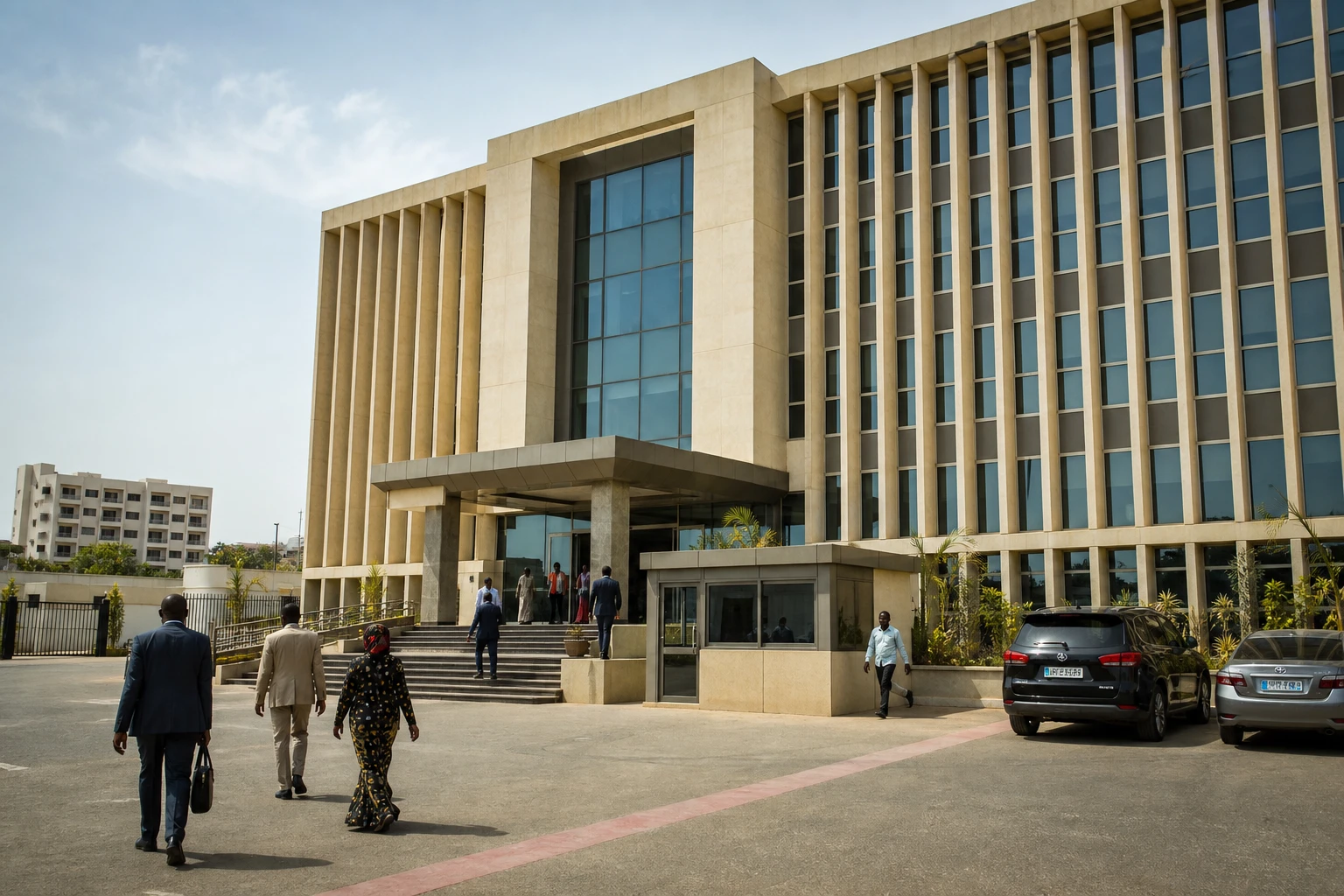
In Dakar, the question is no longer just how to find resources. It has become a broader one: how can Senegal reassure creditors, restore transparency and finance the economy without squeezing its budgetary room for manoeuvre? In this context, the announced agreement with the International Monetary Fund looks less like an immediate lifeline than a test of confidence.
The principle is clear: a heavily indebted country cannot regain access to capital simply by promising a new loan. It must also prove that its accounts are transparent, its debt is under control and its public financial management rules are credible. This is precisely the ground on which Senegal has been moving since debts and deficits for the 2019-2023 period were found to have been underestimated.
What the agreement reached in Dakar provides for
On 1 September 2026, IMF staff announced that they had reached a staff-level agreement with the Senegalese authorities on a 36-month programme under the Extended Credit Facility. The amount cited is about $2.2bn, or SDR 1,537.1 million. The agreement still needs to be approved by IMF management and then by its executive board.
The same statement says the programme is intended to support the authorities’ economic and financial reform programme for 2026-2029. It also provides for measures to strengthen public finances, improve budget transparency, create a healthier business environment and broaden financial inclusion. The IMF nevertheless stresses one essential procedural point: final approval remains conditional on decisive corrective actions in the case of misreporting of budget data.
This sequence did not come out of nowhere. The IMF says its mission worked in Dakar from 19 August to 1 September 2026. The institution also says discussions on a new programme began at the annual meetings in October 2025. The Senegal file therefore went through a lengthy technical process before leading to this agreement.
How Senegal got here
Debt remains at the heart of the problem. Following the audit by the Court of Accounts and reconciliation work conducted with Forvis Mazars, the IMF confirmed that central government debt had been revised to 111.0% of GDP at the end of 2023, from 74.4% previously. Later, the institution estimated public-sector debt at 132% of GDP at the end of 2024, including domestic arrears still under audit.
These figures explain the current pressure. They point to a government that must refinance, clarify and repair at the same time. They also explain why the Senegalese government has launched a Senegal Debt Management Plan. In its official communications, the Ministry of Finance presents the plan as a step towards active debt management, with greater recourse to the WAEMU regional market, the West African Economic and Monetary Union.
Senegal is not starting from scratch. The 2026 budget presented by the authorities is aligned with Senegal Vision 2050 and the 2025-2029 National Development Strategy. The budget document puts public debt at 119% of GDP and the deficit at 12% in 2024, while highlighting the suspension of the IMF programme following the disclosure of hidden liabilities. The Ministry of Finance, for its part, says it wants to restore credible macroeconomic balances.
What the agreement means for households, the state and businesses
For the state, the agreement could reopen a door. It could secure a source of concessional financing at a time when market access has become more constrained. It could also send a signal to investors, donors and regional players monitoring Senegal’s ability to correct its accounts. The Ministry of Finance notes that recent debt operations have taken place against a backdrop of progressively restricted access to external markets.
For households, the stakes are more tangible. If the programme holds, it could help stabilise public finances and prevent adjustment from being achieved solely through drastic spending cuts. But there is a condition: budgetary discipline must go hand in hand with protection for productive spending, particularly investment, energy, public services and social policies. The IMF itself says the agreement aims to strengthen public finances while improving financial inclusion.
For businesses, particularly those reliant on bank financing or the government securities market, budget transparency matters almost as much as the amount of aid. In WAEMU, the regional government securities market already finances a significant share of states’ needs. The BCEAO says outstanding securities issued by auction as a share of the Union’s GDP rose from 5.6% in 2014 to 14.6% in 2025. In other words, Senegal is also negotiating with its own regional market.
A Senegalese issue, but a West African signal
Senegal remains a central economy in West Africa. Dakar is home to the BCEAO, the WAEMU central bank, and plays a major financial, diplomatic and logistical role in the region. The fact that an agreement with the IMF is now tied to efforts to correct accounting figures therefore sends a signal well beyond Senegal’s borders.
At regional level, the question is straightforward: can West African states continue to finance their development amid rising needs, more selective access to capital and greater scrutiny of public accounts? ECOWAS notes that regional growth has proved resilient, but also stresses integration and food security as drivers of stability. The Senegalese case shows that sound budgetary governance is also becoming a factor in economic integration.
What happens next will depend on the IMF executive board and the corrective steps requested of Dakar. If approval is granted, Senegal could consolidate a new cycle of financing. If it is delayed, the country will remain in a costly holding pattern, between domestic adjustment, regional financing and a still-fragile recovery in confidence. The real significance of the agreement announced on 1 September 2026 will be determined in the coming weeks.