
 Algeria
 Egypt
 Libya
 Morocco
 Sudan
 Tunisia
 Benin
 Burkina Faso
 Cabo Verde
 Côte d'Ivoire
 Ghana
 Guinea
 Guinea-Bissau
 Liberia
 Mali
 Mauritania
 Niger
 Nigeria
 Senegal
 Sierra Leone
 The Gambia
 Togo
 Cameroon
 Central African Republic
 Chad
 Equatorial Guinea
 Gabon
 Republic of the Congo
 São Tomé and Príncipe
 Burundi
 Comoros
 Djibouti
 Eritrea
 Ethiopia
 Kenya
 Madagascar
 Malawi
 Mauritius
 Mozambique
 Rwanda
 Seychelles
 Somalia
 South Sudan
 Tanzania
 Uganda
 Angola
 Botswana
 Eswatini
 Lesotho
 Namibia
 South Africa
 Zambia
 Zimbabwe
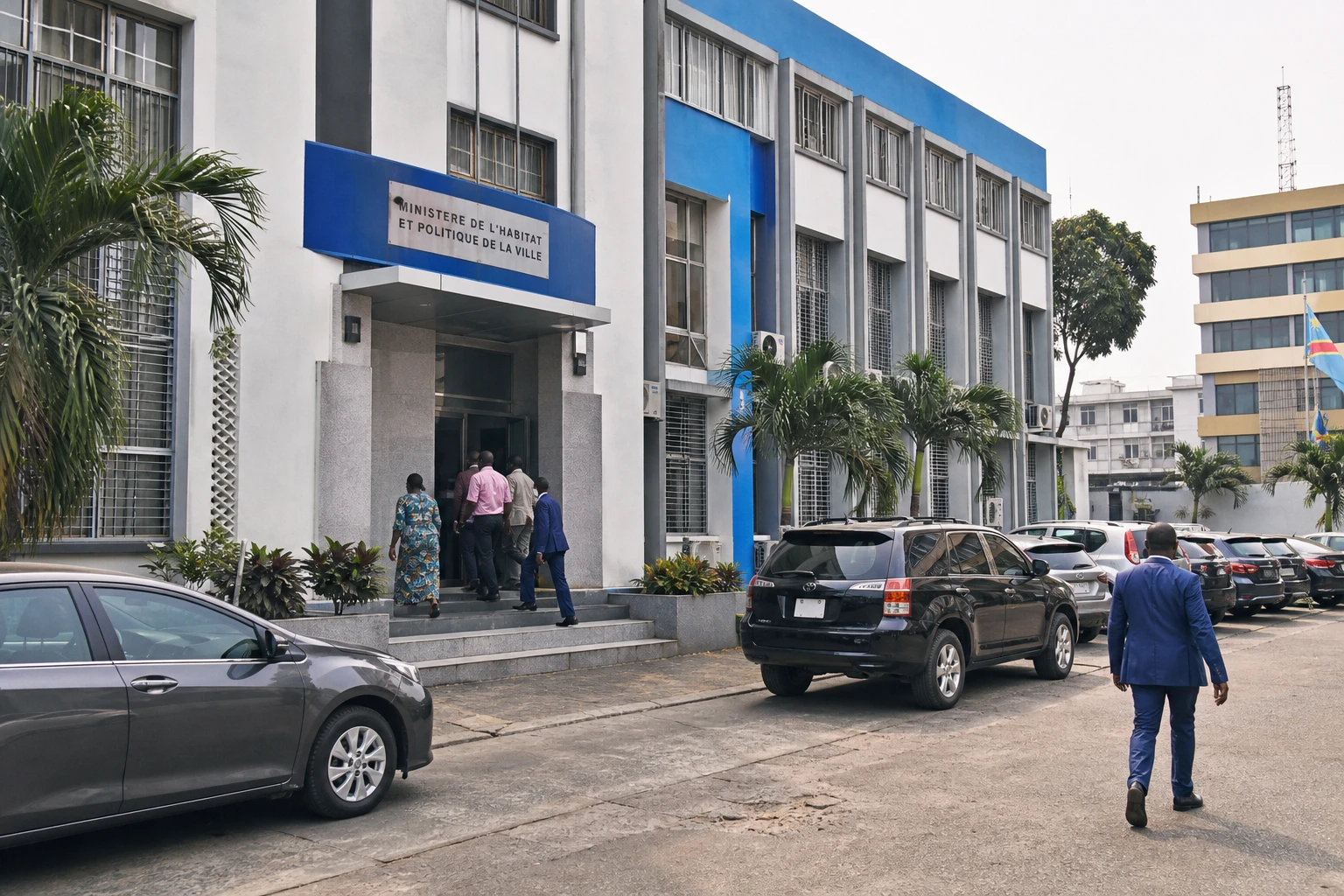
When housing becomes a public financing issue
In Kinshasa, as in many of the Democratic Republic of the Congo’s major cities, housing is no longer simply a matter of building a few more blocks of flats. It now concerns the cost of credit, land security, the quality of building materials and the state’s ability to bring housing within a sustainable financing framework. In the Democratic Republic of the Congo, the issue has become serious enough for the government to consider turning the National Housing Fund, FONHAB, into a specialised public bank.
This debate is taking place against a backdrop of urban pressure. UN-Habitat estimates that the DRC faces a housing deficit of around 4 million units and would need to build nearly 265,000 homes a year to close the gap. The same organisation notes that urban growth is rapid and formal housing production remains low relative to needs.
What the government wants to change
This is not a new initiative. Congolese budget documents have referred for several years to the operationalisation of FONHAB, alongside the Congolese Agency for Property Development, ACOPRIM. They also show that the state has already made the creation of a housing bank a priority, even though implementation remains incomplete.
The core of the proposal is simple: to transform a public fund for mobilising resources into a credit institution capable of raising more stable funding, meeting the banking sector’s prudential requirements and financing longer-term loans. But this transition is not automatic. A bank cannot operate on political will alone. It needs start-up capital, a strong equity base, clear governance and the ability to attract funders beyond the state budget.
For now, the executive has asked the ministries of Urban Planning and Finance to study the terms of the transformation. The project therefore remains at the institutional design stage. At this point, the issue is not yet to issue loans, but to determine which financial model can be sustained over time.
Why mortgage lending remains the weak link
The real problem in the DRC is not just the lack of buildings. It is the absence of a complete housing finance system. In the DRC, people still rely largely on self-build to obtain housing. Mortgage lending remains limited for most households, while incomes are irregular and many families work in the informal economy. This is precisely where a housing bank could act as an intermediary between long-term finance and market participants.
The land context makes the equation even more complicated. In December 2025, the Congolese authorities adopted and then promulgated a new land reform, presented as an effort to secure rights and modernise the property framework. This is an important development, because no serious housing finance can take shape without clearer titles, more straightforward procedures and better protection against land grabs.
For households, the expected impact would be direct: loans better suited to buying, building or completing a home. For developers, the change would also be decisive, as they often lack long-term, low-cost financing. For cities, finally, a well-structured public bank could help shift from informal expansion to more coherent planning, particularly in areas facing the greatest demographic pressure.
A test for Congo’s urban strategy
The DRC is not starting from scratch. Public institutions in the sector already exist on paper and in budget legislation. The question is how effective they will be in practice. If the future bank remains almost entirely dependent on public resources, it risks remaining small relative to the scale of the deficit. If, on the other hand, it can combine sovereign funds, development partners, institutional investors and the private sector, it could become a credible instrument for reviving affordable housing.
The issue also extends beyond the DRC’s borders. In several African countries, housing finance has become a test of economic sovereignty as much as a social policy matter. Research by UN-Habitat and the IFC highlights the continent’s massive housing deficit and structural shortage of long-term finance. In this respect, the Congolese debate is part of a wider discussion about the ability of African states to create their own financial instruments to support urbanisation.
In Kinshasa and across the provinces, what happens next will therefore depend less on an announcement than on the approach chosen. The government will have to say how much start-up capital it will provide, which partners it will involve, what guarantee mechanisms it plans and which populations it will prioritise. Without this, the housing bank could become just another acronym in a sector already saturated with promises. With a solid structure, by contrast, it could become one of the few levers capable of linking urban planning, finance and the right to housing.



