Algeria
 Egypt
 Morocco
 Sudan
 Tunisia
 Benin
 Burkina Faso
 Cabo Verde
 Côte d'Ivoire
 Ghana
 Guinea
 Guinea-Bissau
 Liberia
 Mali
 Mauritania
 Niger
 Nigeria
 Senegal
 Sierra Leone
 The Gambia
 Togo
 Cameroon
 Central African Republic
 Chad
 DR Congo
 Equatorial Guinea
 Gabon
 Republic of the Congo
 São Tomé and Príncipe
 Burundi
 Comoros
 Djibouti
 Eritrea
 Ethiopia
 Kenya
 Madagascar
 Malawi
 Mauritius
 Mozambique
 Rwanda
 Seychelles
 Somalia
 South Sudan
 Tanzania
 Uganda
 Angola
 Botswana
 Eswatini
 Lesotho
 Namibia
 South Africa
 Zambia
 Zimbabwe
An election alone cannot reunify a country
In Libya, the real test is not played out only at the ballot box. It is also played out in public accounts, at the Central Bank, in the circulation of banknotes and in Tripoli’s ability to speak on behalf of the whole country. When institutions remain fragmented, the state continues to exist, but it functions in pieces.
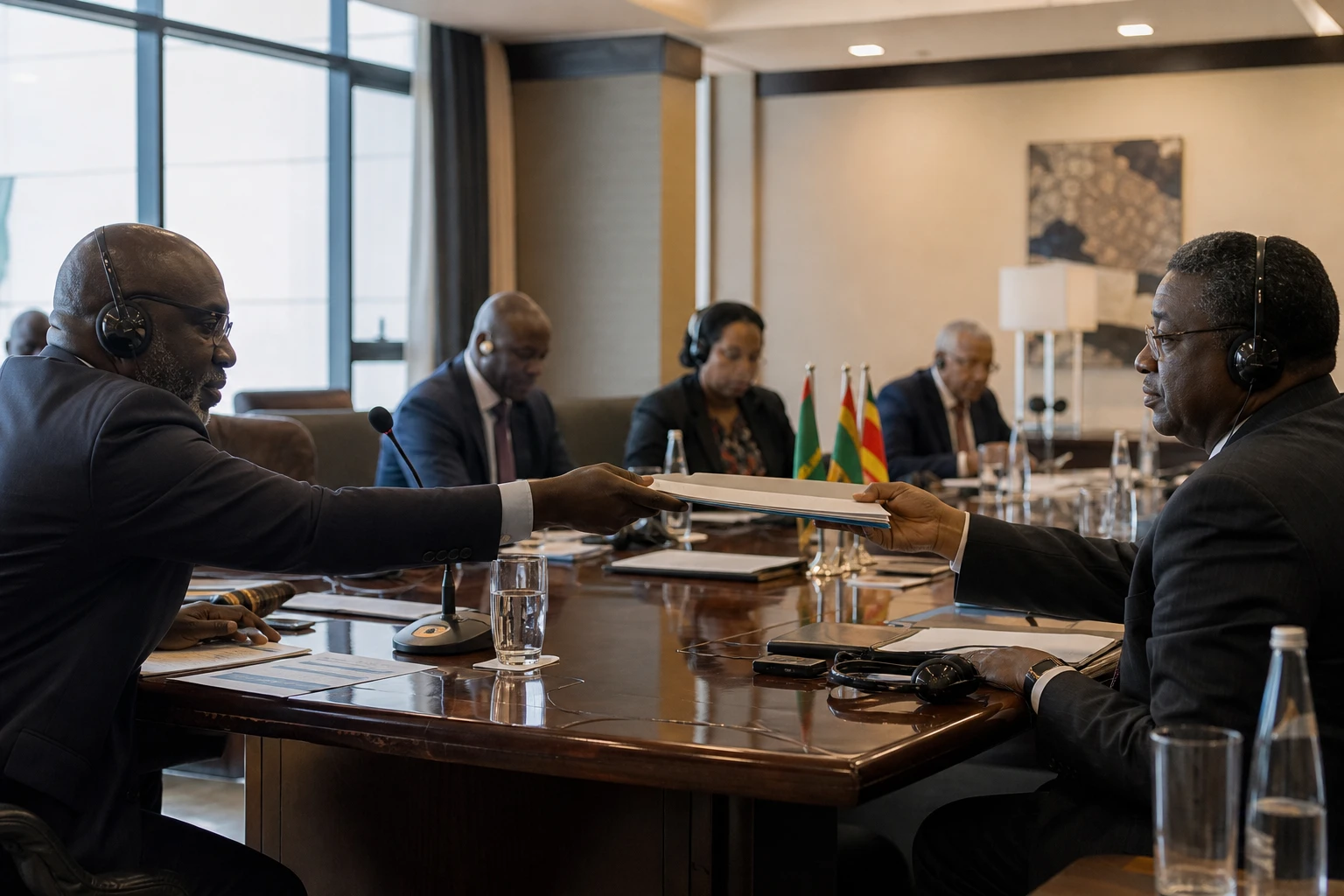
That is why the resumption of political dialogue in August 2026 is attracting so much attention. In Tunis, the United Nations Support Mission in Libya announced that participants in the “small convening” had initialled a draft agreement linked to the first two stages of the roadmap. They must still return to Libya to finalise the implementation arrangements and formalise the text.
The regional context also matters. In North Africa, Libya remains a sensitive point of balance for the African Union and the Maghreb’s neighbours, because its fragmentation fuels political instability, trafficking and migration pressure across the Sahelian and Mediterranean corridor. In June 2026, the African Union also welcomed the signing of a principles document aimed at ending the transition period.
Separate institutions, but an economy that kept running
Since the fall of Muammar Gaddafi in 2011, Libya has never regained a lasting, uncontested political centre. The country fractured from 2014 onwards between rival centres in the East and West. The 2020 ceasefire reduced open fighting without erasing the institutional divide. In 2025, the International Monetary Fund still described Libya as “de facto” split between two political centres.
Despite this rupture, several essential functions held up. The National Oil Corporation remained the backbone of oil production, while the Central Bank of Libya continued to manage reserves and the monetary system. The Central Bank began rapprochement with its eastern branch in 2022, then accelerated the reunification of its operations in 2023 and 2024.
This continuity explains why the country avoided total collapse. The World Bank estimates that hydrocarbons still accounted for about 65% of GDP, 93% of exports and 72% of public revenue in 2024. In 2025, the economy rebounded, driven by oil and some non-oil sectors.
Oil production illustrates this resilience. According to the official Libyan press, citing NOC figures, the daily average in 2025 reached 1.374 million barrels per day, its highest level in ten years. This figure confirms the central role of oil revenues in the country’s fiscal survival.
What reunification could change in practice
The first issue is the budget. As long as Libya remains politically fragmented, it is difficult to establish a genuinely unified national budget, control spending and align monetary policy with the needs of the economy. For several years, the IMF has stressed the need for a common fiscal framework and better coordination between public finances and the Central Bank.
The second issue concerns liquidity and confidence. The gradual reunification of the Central Bank has improved banking supervision and monetary coordination, according to the IMF. In a country where public-sector salaries, subsidies and some consumption depend on administered transfers, this stability is no technical detail. It shapes the daily lives of households, traders and local administrations.
The third issue is political. Elections scheduled for December 2021 failed because there was no agreement on the rules of the game or the eligibility of several major figures. That experience still weighs heavily. This is why the UN’s new roadmap is not limited to a vote. It also aims to unify institutions and ease the deadlocks that have turned Libya’s transition into an endless wait.
For Libyans, the stakes are tangible. A common framework could facilitate the payment of salaries, management of reserves, supervision of banks, investment planning and the revival of still-weak private-sector activity. The World Bank also notes that the private sector accounts for only a limited share of employment, showing how heavily the economy remains dominated by the state and hydrocarbons.
A process to watch beyond Tripoli
The significance of this issue extends beyond Libya. Across North Africa, credible institutional reunification would reduce tensions running through the central Mediterranean and the southern Sahel basin. At continental level, it would also matter to the African Union, which for several years has advocated a way forward through dialogue, reconciliation and elections accepted by the broadest possible number of people.
The decisive point remains the next phase. Libyan actors must still turn a working compromise into a robust political mechanism, and then into a decision that can be implemented nationwide. Without a credible timetable, agreement on sovereign institutions and guarantees for public finances, the country risks repeating the familiar 2021 scenario: a strong electoral promise, followed by yet another deadlock.