Algeria
 Egypt
 Libya
 Morocco
 Sudan
 Tunisia
 Benin
 Burkina Faso
 Cabo Verde
 Côte d'Ivoire
 Ghana
 Guinea-Bissau
 Liberia
 Mali
 Mauritania
 Niger
 Nigeria
 Senegal
 Sierra Leone
 The Gambia
 Togo
 Cameroon
 Central African Republic
 Chad
 DR Congo
 Equatorial Guinea
 Gabon
 Republic of the Congo
 São Tomé and Príncipe
 Burundi
 Comoros
 Djibouti
 Eritrea
 Ethiopia
 Kenya
 Madagascar
 Malawi
 Mauritius
 Mozambique
 Rwanda
 Seychelles
 Somalia
 South Sudan
 Tanzania
 Uganda
 Angola
 Botswana
 Eswatini
 Lesotho
 Namibia
 South Africa
 Zambia
 Zimbabwe
A video, then a debate that spills across borders
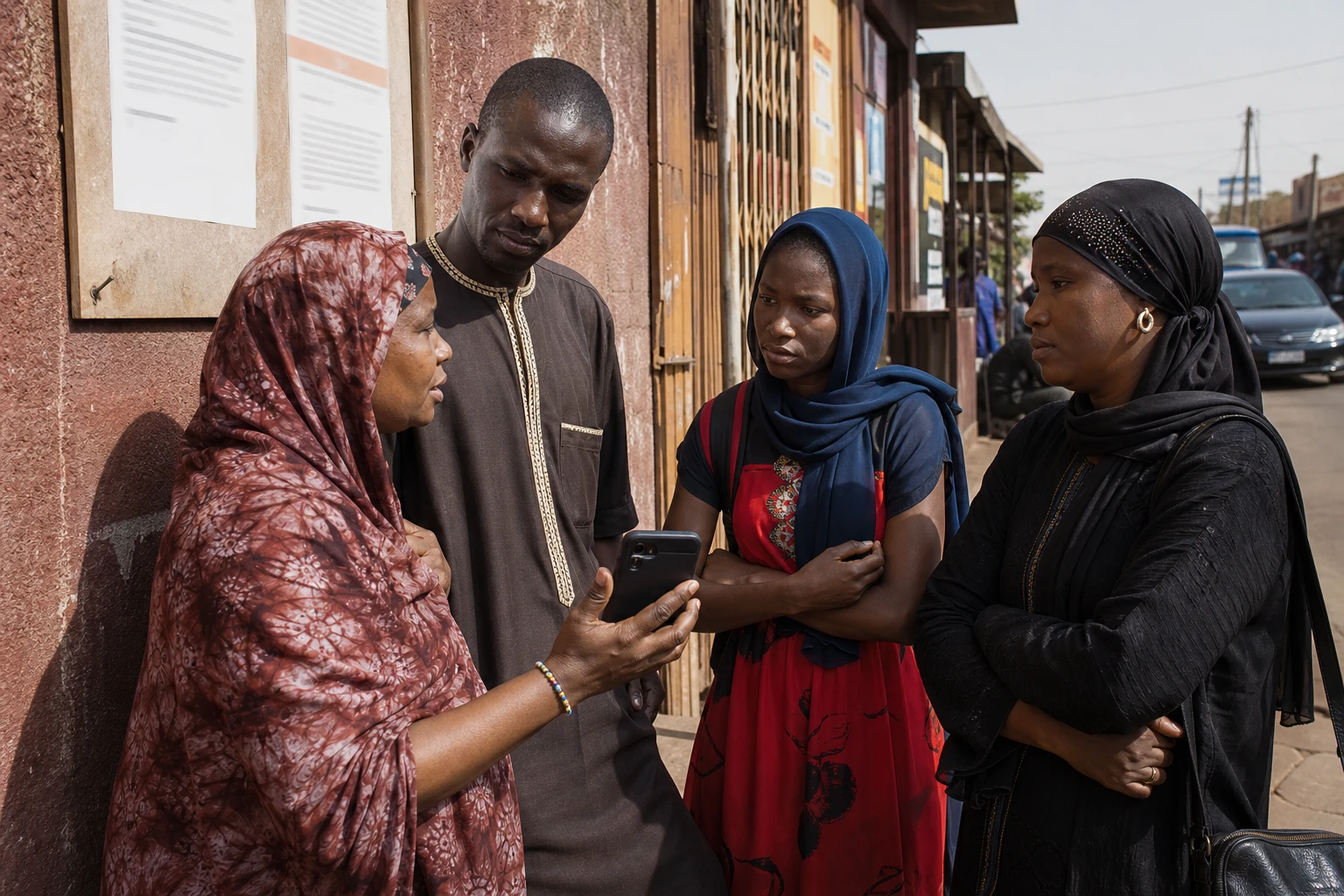
In Mali, a scene filmed in a rural area was enough to reopen an old wound. Images of female genital mutilation (FGM) shared on social media prompted an immediate backlash, followed by an organised counter-offensive spanning Bamako, Conakry and several European capitals. The subject is sensitive, but far from abstract: it concerns girls’ bodies, the power of families, and the relationship between law, religion and custom. The question is all the more pressing because FGM remains widespread in Mali, where UNICEF estimates prevalence at 89% among women and girls aged 15 to 49.
The shock comes amid a West African landscape already marked by divisions over women’s rights. The World Health Organization says FGM still affects more than 230 million women and girls worldwide, particularly in West Africa, East Africa and the north-east of the continent. It also notes that migration has shifted part of the debate to Europe, where women who have undergone FGM and families exposed to the practice now live.
Mali is at the heart of this tension. On one hand, the country bears a heavy statistical legacy: UNICEF data confirm a national prevalence of 89%, with wide disparities between regions. On the other, health and protection partners continue to fund prevention and support programmes there, showing that the practice is no marginal issue. The debate is therefore not confined to an online row. It reveals a battle over norms that remains fierce in a society where the moral authority of religious leaders and that of the state are often in competition.
Mali at the centre, the sub-region on alert
The issue took on a regional dimension because activists opposed to FGM chose to respond on the same platform where the controversy had taken hold: social media. Activists from Mali, Guinea, Senegal, Côte d’Ivoire, Niger and Benin amplified the protests and rallied around a shared message against the normalisation of the practice. This rapid spread illustrates a now familiar feature of West African activism: a local controversy becomes cross-border within hours, especially when it involves religion, family and child protection.
Europe also played a part in the episode. The WHO says that migration means women and girls affected by FGM now live in Europe, North America and Australia. This explains why activists targeted accounts based outside Mali, addressing the authorities in countries where those users live as well. The debate thus moved beyond the Malian context to become part of a transnational human rights discussion, in which national laws can apply to speech or acts carried out from abroad.
Political geography matters here as much as public morality. Mali is undergoing a military transition, while Guinea has been under a transitional regime since the 2021 coup. In such contexts, authorities often seek to avoid issues that could fracture already fragile social coalitions. FGM is therefore a highly combustible issue: too sensitive to address head-on, but too visible to ignore.
Between political caution and a vacuum in the public response
In Mali, the official silence carries significant weight. The authorities’ caution is nothing new. The Malian state has long taken small steps to address gender-based violence, and the FGM issue remains constrained by domestic political balances. Yet there are institutional signs of progress. UNFPA says a new Malian penal code, approved in 2024, includes provisions on gender and gender-based violence. This alone is not enough to create a clear and enforceable ban on FGM, but it shows that the issue has entered the legislative sphere.
On the ground, progress is slower than the law. UNICEF- and UNFPA-backed programmes continue to operate in several regions, including Bamako, offering listening services, support and community-based prevention. UNICEF also says that about 2,000 survivors received psychosocial support in 2023 and, for most, additional medical care. This figure describes more than a health response. It also points to the scale of the need in a country where girls can still undergo FGM at a very young age, sometimes before the age of five.
In Guinea, the tension is different but just as acute. The country is among those with the world’s highest prevalence, estimated by UNICEF at 95% among women and girls aged 15 to 49, even though the practice has been prohibited by law for several years. The contrast is stark: a law exists, but enforcement is uneven, and the authorities have already been criticised by UN bodies for the low number of prosecutions. This situation highlights the heart of the regional problem: criminalisation is not enough if penalties are not enforced.
What this episode says about West Africa
This case is a reminder that girls’ rights are not decided only in parliaments. They are also shaped in families, neighbourhoods and mosques, and now on digital platforms. Pro-FGM and anti-FGM campaigns circulate at the same speed. The former draw on identity and religious narratives. The latter mobilise the law, public health and feminist networks. The balance of power is therefore also informational. Whoever controls the narrative gains ground in society.
The continental implications are clear. The Economic Community of West African States has not made this issue a central institutional battleground, but it cuts across the entire region, from Guinea to Senegal and from Mali to Côte d’Ivoire. It also intersects with health, child protection and migration policies. Across Africa, the challenge is twofold: to reduce a practice that remains deeply rooted and to prevent the debate from being hijacked by rhetoric that falsely pits cultural sovereignty against fundamental rights. Mali’s experience shows one thing above all: without a clear public position, the vacuum is quickly filled by the loudest voices.
In the coming weeks, the key points to watch are less about a dramatic announcement than concrete action: whether prevention work continues or is withdrawn, the position taken by the relevant ministries, the effective implementation of new laws, and how the authorities in Bamako respond to propaganda distributed from within the country or abroad. That is where, beyond grandstanding, Mali’s ability to break a silence that does little to protect the most vulnerable will be tested.