Algeria
 Egypt
 Libya
 Morocco
 Sudan
 Tunisia
 Benin
 Burkina Faso
 Cabo Verde
 Côte d'Ivoire
 Ghana
 Guinea
 Guinea-Bissau
 Liberia
 Mali
 Mauritania
 Niger
 Nigeria
 Senegal
 Sierra Leone
 The Gambia
 Togo
 Cameroon
 Central African Republic
 Chad
 DR Congo
 Equatorial Guinea
 Gabon
 Republic of the Congo
 São Tomé and Príncipe
 Burundi
 Comoros
 Djibouti
 Eritrea
 Ethiopia
 Kenya
 Madagascar
 Malawi
 Mauritius
 Rwanda
 Seychelles
 Somalia
 South Sudan
 Tanzania
 Uganda
 Angola
 Botswana
 Eswatini
 Lesotho
 Namibia
 South Africa
 Zambia
 Zimbabwe
Economic dialogue beyond diplomatic announcements
In Maputo, the issue is not simply to sign new agreements. The aim is more concrete: to get capital flowing, secure projects and ease the bottlenecks that slow Mozambican and US businesses alike. In a country where investment promises often run up against administrative delays, local insecurity or regulatory uncertainty, the creation of a permanent forum for consultation marks a change in approach.
Mozambique belongs to SADC, the Southern African Development Community, a regional organisation of 16 states whose official mission is to support economic integration, peace and security across southern Africa. This regional context matters, because flows into Mozambique are never viewed in isolation: they also pass through corridors to South Africa, Malawi, Zimbabwe and Tanzania, and depend on stability in Cabo Delgado, a province of strategic importance for energy and infrastructure. Maputo, the capital, is therefore seeking to attract more investment while showing that it can offer foreign partners a more predictable environment.
What the two capitals have agreed
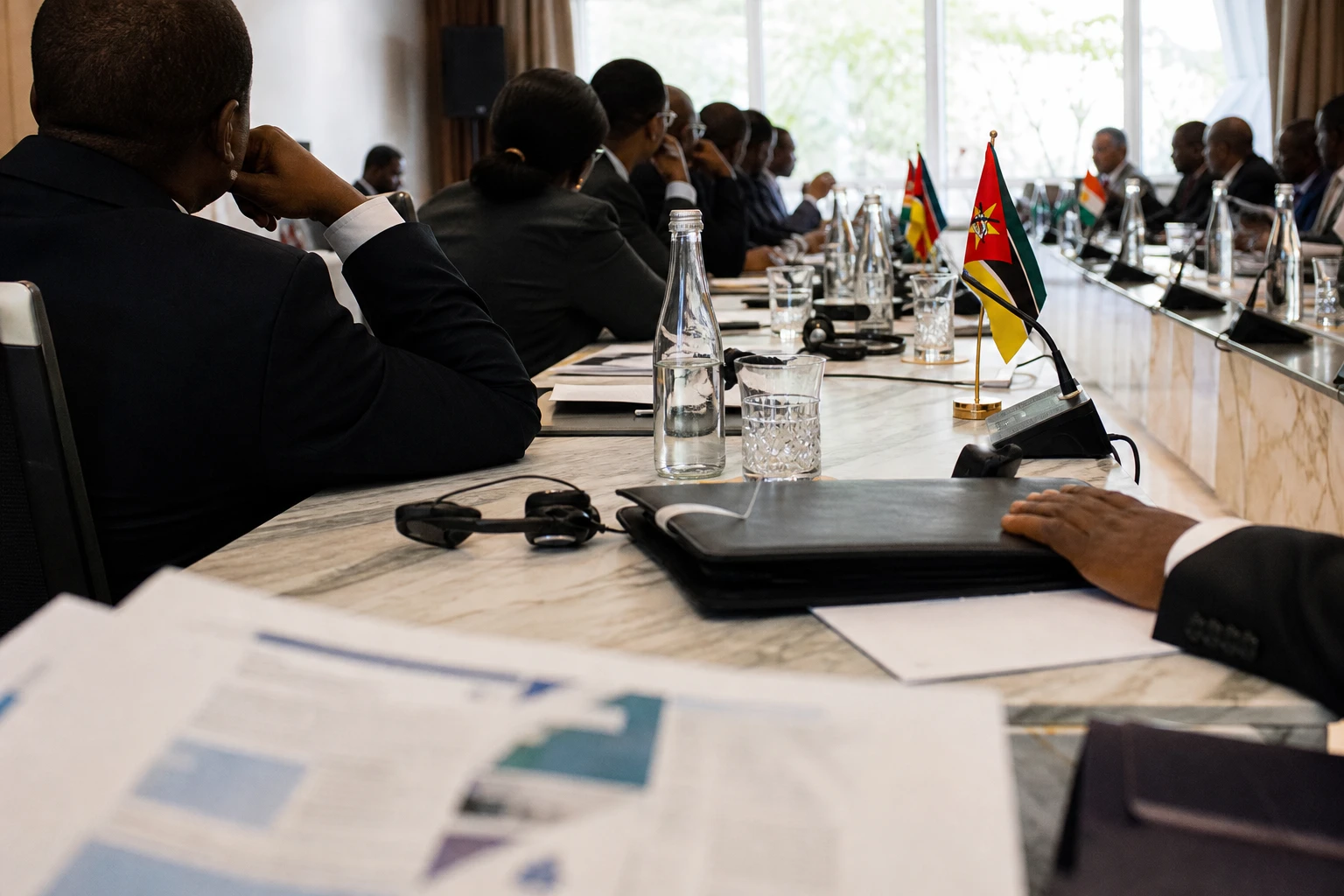
On 27 August 2026, Mozambique and the United States launched a bilateral economic and trade group in Maputo. This permanent mechanism is intended to facilitate trade, boost investment and identify obstacles facing businesses in both countries. It will also provide a forum for dialogue between governments and the private sector, helping to identify new opportunities and turn political contacts into more visible economic results.
For Mozambique, the idea is simple: attract more US capital, technology and expertise. For the US, Maputo offers opportunities in several sectors, not just energy. The chargé d’affaires at the US embassy in Maputo summed up this approach by noting that US companies see opportunities in various fields in Mozambique, while Mozambican businesses can gain easier access to the US market and its private sector.
The new structure is not starting from scratch. The two countries already have a framework agreement on trade and investment, signed in 2005, and an older bilateral memorandum, which US officials have cited as a tool for facilitating cooperation in specific sectors. US statistics also show that trade in goods and services between the two countries reached about $624.6 million in 2024, down 9.3% from 2023. The new dialogue is therefore intended less to create a relationship than to give it a more practical channel.
Gas remains central, but is not the only focus
Energy remains at the heart of closer ties. The Mozambique LNG project, led by TotalEnergies in the north of the country, remains one of the most significant issues in bilateral relations. The US Export-Import Bank approved an amendment to its financing in March 2025, raising its support for the project to as much as $4.7 billion. EXIM also says that the development of liquefied natural gas in Mozambique is one of the largest export-support operations in its history.
This project matters greatly to Mozambique. It was suspended in 2021 amid insecurity in Cabo Delgado, a province where armed attacks disrupted construction sites and travel and undermined investor confidence. The challenge today is not simply to resume work: it is to restore an entire chain, from security and financing to local subcontracting and future tax revenues. For the Mozambican state, every step forward on the project affects revenue, employment and the country’s image among lenders. For local communities, the central questions remain actual jobs, land compensation and everyday security.
The second major lever is Rovuma LNG, a project led by ExxonMobil and its partners in Area 4. The company says it awarded about $1.1 billion in pre-investment contracts in August 2026 for Phase 1. It also gives a target capacity of 18.6 million tonnes a year for this first phase. These figures confirm that US companies are not limited to a commercial presence; they are already involved in the technical preparations for major industrial infrastructure.
The real stakes for Maputo, Washington and the region
This new mechanism has wider significance than a simple bilateral meeting. Mozambique is seeking to diversify its partners and exert greater control over the terms on which investors enter the market. Washington, meanwhile, wants to strengthen its economic presence in a region where China, the European Union, India, the Gulf and neighbouring countries are also advancing their interests. In this kind of competition, dialogue frameworks matter as much as financing announcements, because they reduce uncertainty for businesses and give government departments a common language.
But the effects will not be evenly distributed. Large companies already have the legal, financial and logistics teams needed to benefit from this kind of platform. Mozambican small and medium-sized enterprises, by contrast, are often held back by limited access to credit, compliance costs and customs procedures. This is where the mechanism will have to prove its value: not only through major energy contracts, but also in agribusiness, services, transport, equipment and local supply chains. Mozambican officials have also said they want to expand consultation mechanisms to attract investment and remove barriers facing the private sector.
The regional implications are clear. In southern Africa, Mozambique serves as a gateway between SADC markets and the Indian Ocean. If gas, port and logistics projects move forward, they could also strengthen trade corridors into the continent. Conversely, if security in Cabo Delgado remains fragile or reforms stall, the benefits will remain concentrated around a few major projects. The real test will come in the coming months: whether the bilateral group can remove concrete obstacles, how quickly major energy projects resume, and whether these announcements translate into contracts, jobs and visible revenue for the Mozambican economy.