
 Egypt
 Libya
 Morocco
 Sudan
 Tunisia
 Benin
 Burkina Faso
 Cabo Verde
 Côte d'Ivoire
 Ghana
 Guinea
 Guinea-Bissau
 Liberia
 Mali
 Mauritania
 Niger
 Nigeria
 Senegal
 Sierra Leone
 The Gambia
 Togo
 Cameroon
 Central African Republic
 Chad
 DR Congo
 Equatorial Guinea
 Gabon
 Republic of the Congo
 São Tomé and Príncipe
 Burundi
 Comoros
 Djibouti
 Eritrea
 Ethiopia
 Kenya
 Madagascar
 Malawi
 Mauritius
 Mozambique
 Rwanda
 Seychelles
 Somalia
 South Sudan
 Tanzania
 Uganda
 Angola
 Botswana
 Eswatini
 Lesotho
 Namibia
 South Africa
 Zambia
 Zimbabwe
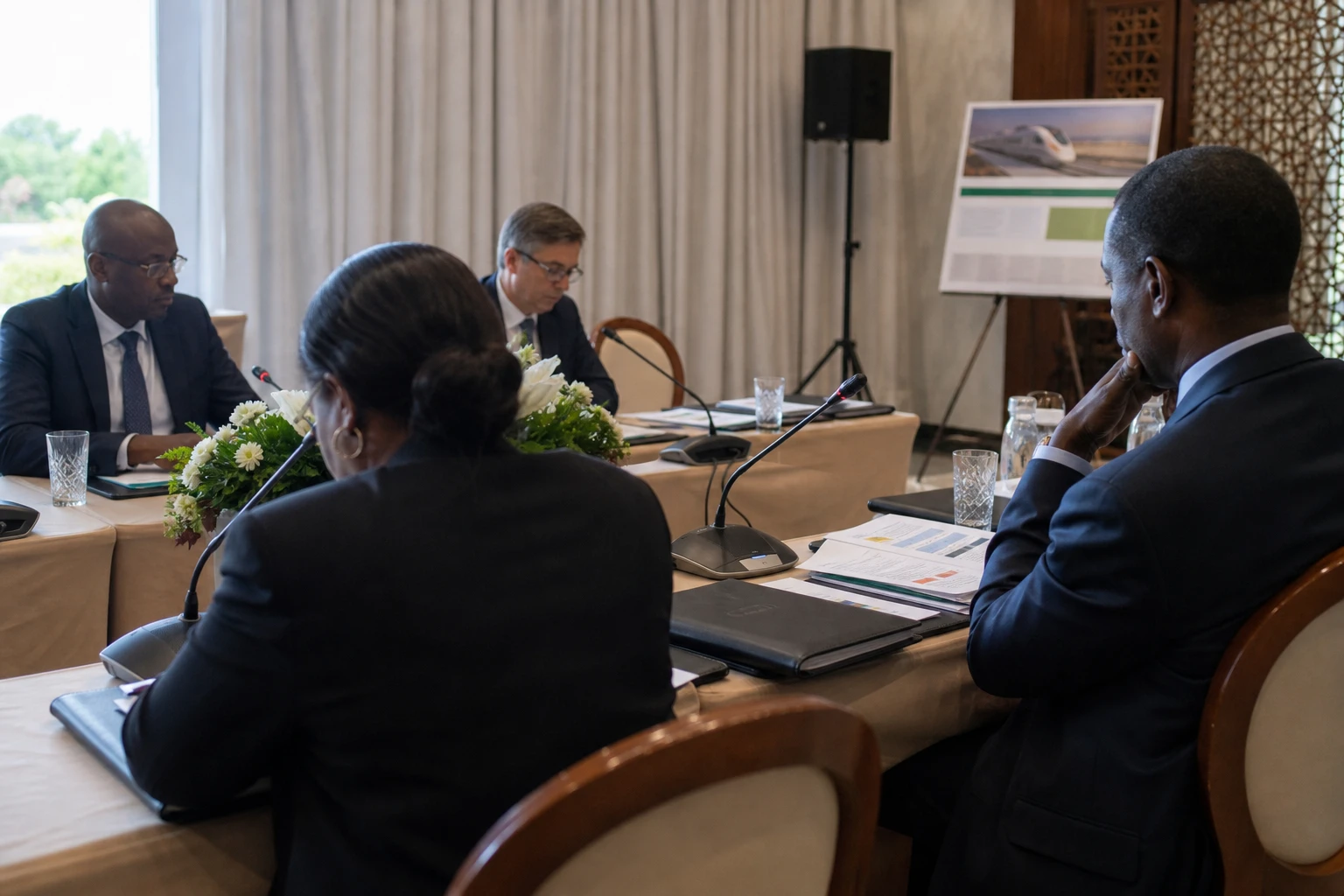
A train, yes. But above all, a political test for the Maghreb
A rail corridor may seem to be only a matter of tracks, signalling and budgets. Between Casablanca, Algiers and Tunis, it tells a different story: the Maghreb’s ability to move goods and passengers and, more broadly, to build trust between its states. The project is back on the table, but remains dependent on one simple and decisive point: without an open border between Morocco and Algeria, no train can link Rabat to Tunis in one continuous journey.
Morocco, whose capital is Rabat, has already shown it can invest in rail on a large scale. At the same time, North Africa continues to run up against political deadlocks that slow regional projects. That is the central issue with the Trans-Maghreb corridor: infrastructure designed for regional integration, but dependent on agreements between three countries and a still-fragile diplomatic climate.
What the AfDB actually completed in June 2026
On 26 June 2026, the African Development Bank published the completion report for a feasibility study on rehabilitating and modernising sections of the Trans-Maghreb railway line. The aim was to assess the technical, economic, environmental, social and institutional viability of a route linking Casablanca, Algiers and Tunis, with modernisation scenarios for critical sections such as Fès-Oujda-Akid Abbas and Annaba-Jedeida.
This publication does not launch construction. It marks the end of a lengthy preparatory phase that began several years ago. The AfDB had already stated in its 2018 documents that the study was complete. At the time, the corridor was estimated to cost about $3.8 billion and stretch approximately 2,350 kilometres. In the Africa Infrastructure Development Programme database, the figure is now rounded to about $4 billion.
The programme under study includes modernising existing sections, doubling some stretches, electrification at 2 × 25 kV and installing the European Train Control System (ERTMS) Level 2, a European railway signalling and traffic-management system. The documents also cite a target journey time of less than 25 hours between Casablanca and Tunis, compared with about 48 hours under the baseline scenario.
The obstacle is not technical; it is the border
The project’s most sensitive section remains Oujda-Akid Abbas, on the Morocco-Algeria border. The land border has been closed since 1994. The diplomatic break between Rabat and Algiers, announced in August 2021, further hardened a project already blocked by politics before railway engineering had even come into play.
The situation is different in eastern Algeria. In August 2024, rail services between Annaba and Tunis resumed after about 30 years of interruption, with the two countries’ public operators confirming the first commercial journey. The return shows that an international line can be reactivated when political will and technical arrangements are in place. But it also highlights the Maghreb’s asymmetry: in the east, rail is connecting places again; in the west, it remains halted at the border.
For Morocco, the stakes go beyond the railway map. The kingdom has strengthened its own infrastructure, particularly along the Tangier-Casablanca-Marrakech route, and the Moroccan network is often described as one of the continent’s most advanced. But this national momentum alone is not enough to create a Trans-Maghreb corridor. The missing link is an intergovernmental decision, not an engineering feat.
Why this project matters to North Africa and beyond
The project forms part of the Programme for Infrastructure Development in Africa, led by the African Union and AUDA-NEPAD. In this framework, rail is not just a means of transport: it helps bring markets closer, cut logistics costs and strengthen regional movement. Yet the Maghreb remains one of Africa’s areas with the weakest intra-regional connections, despite national networks that are often better developed than elsewhere.
In practical terms, such a corridor could benefit major cities, ports, freight operators and regional tourism. It would also affect transit areas such as Fès, Oujda, Annaba and Jendouba, where network continuity shapes local economic activity. Conversely, as long as borders remain closed, residents, transport operators and businesses face longer journeys, transhipments and additional costs.
The continental significance is clear: this project measures the distance between the ambition of African integration and the reality of political relations in the Maghreb. It also shows that an infrastructure project can be technically ready, financially outlined and institutionally studied, yet remain frozen for want of an agreement between neighbours. The real timetable for the Casablanca-Algiers-Tunis train therefore depends less on a construction contract than on a political gesture between Rabat and Algiers.



