Algeria
 Egypt
 Libya
 Morocco
 Sudan
 Tunisia
 Benin
 Burkina Faso
 Cabo Verde
 Côte d'Ivoire
 Ghana
 Guinea
 Guinea-Bissau
 Liberia
 Mali
 Mauritania
 Niger
 Senegal
 Sierra Leone
 The Gambia
 Togo
 Cameroon
 Central African Republic
 Chad
 DR Congo
 Equatorial Guinea
 Gabon
 Republic of the Congo
 São Tomé and Príncipe
 Burundi
 Comoros
 Djibouti
 Eritrea
 Ethiopia
 Kenya
 Madagascar
 Malawi
 Mauritius
 Mozambique
 Rwanda
 Seychelles
 Somalia
 South Sudan
 Tanzania
 Uganda
 Angola
 Botswana
 Eswatini
 Lesotho
 Namibia
 South Africa
 Zambia
 Zimbabwe
An industrial bet to reduce digital dependence
In Nigeria, connectivity is a matter of sovereignty as much as everyday convenience. When terrestrial networks struggle to cover the entire country, satellites become a strategic tool for public administrations, businesses and remote areas, from the north-east to rural fringes where infrastructure arrives more slowly.
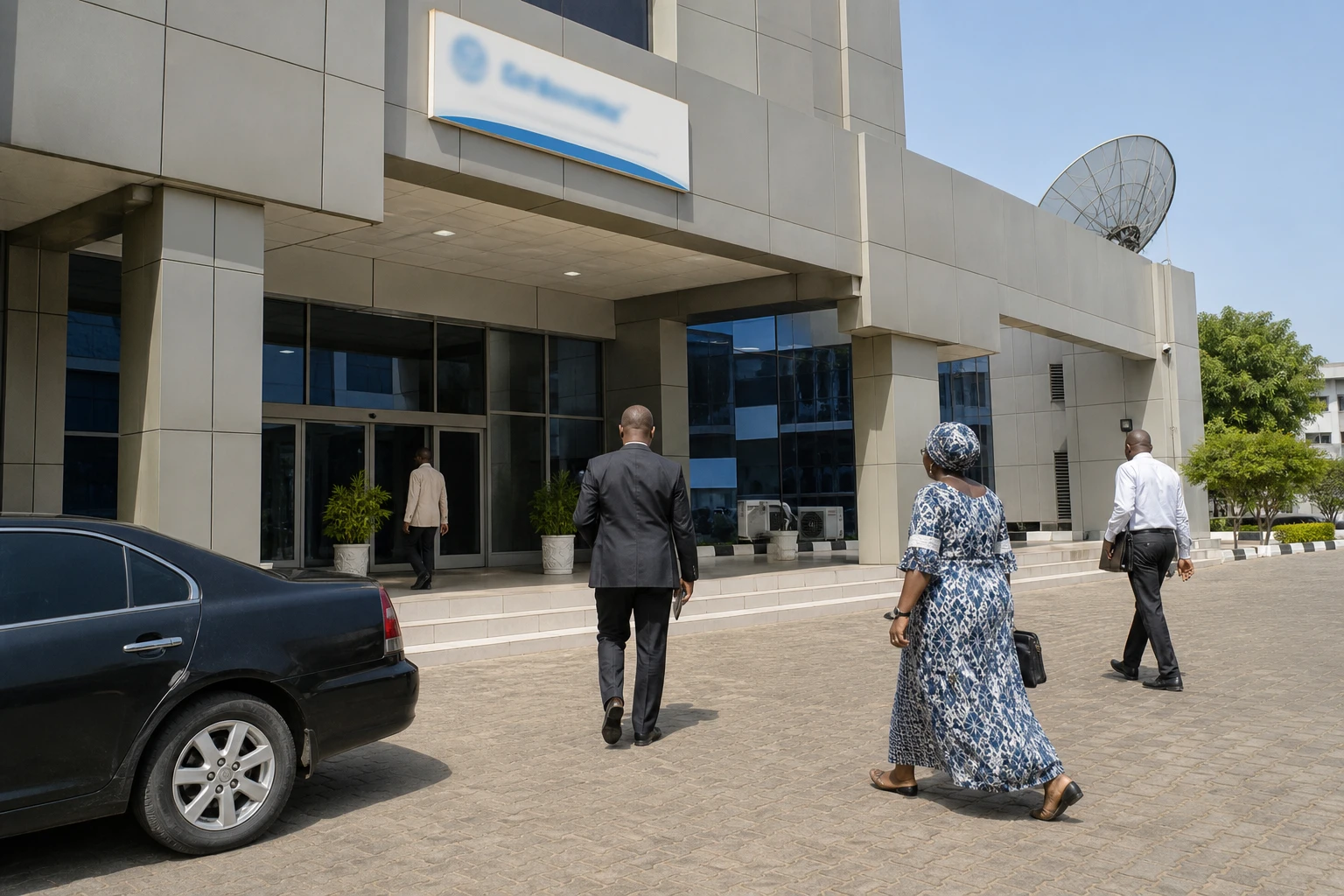
Against this backdrop, the federal executive has approved the acquisition of two telecommunications satellites, NIGCOMSAT-2A and NIGCOMSAT-2B. The objective is clear: to strengthen broadband, broadcasting, business services and government communications, while consolidating the position of Nigerian Communications Satellite Ltd in the national digital ecosystem. This direction forms part of a broader strategy by the Nigerian government, which is relying on fibre, new telecoms towers and satellite capacity to address the country’s structural shortcomings.
What Abuja is planning with NIGCOMSAT-2A and 2B
The political signal is significant. In May 2026, Nigeria’s Ministry of Communications, Innovation and Digital Economy explained that the country’s connectivity difficulties stemmed from prolonged underinvestment in infrastructure. Minister Bosun Tijani then presented Project BRIDGE, a large-scale open-access fibre-optic programme, noting that the state also wanted to expand its satellite capacity. The government is therefore not treating satellites as a stand-alone tool, but as one of the pillars of a broader effort to build the country’s digital backbone.
This approach has already begun to take shape in NIGCOMSAT’s roadmap. An asset upgrade document published by the operator states that the project to replace NigComSat-1R was formally launched in July 2024, with expressions of interest for NigComSat-2A and 2B, followed by technical work on orbital slots in 2024. The same document refers to a target launch date of 2027/2028, showing that the idea did not emerge in August 2026 but is part of an ongoing administrative and technical process.
A long wait remains before launch
The political decision alone is not enough to get a satellite into orbit. Several steps remain: formalising commitments with technology partners, finalising contracts, completing the financing structure and settling the technical planning. This is precisely why the project is progressing in stages, through financing discussions, public-sector decisions and industrial planning. In official statements, NIGCOMSAT and the ministry refer to working with partners such as Israel Aerospace Industries and Thales Alenia Space, signalling Nigeria’s intention to combine local expertise with international industrial know-how.
As for the timetable, the available information points to the satellites becoming operational in the medium term. In March 2026, Nigerian media had already reported a launch window in 2028 for the first satellite and 2029 for the second, while other NIGCOMSAT material suggests a 2027/2028 horizon for the programme as a whole. This difference does not necessarily indicate a fundamental contradiction; it mainly shows that a space project of this scale evolves in line with financing, contracts and technical approvals.
Why the project matters to Nigerians
For users, the stakes are very practical. A next-generation satellite can help serve areas that are not commercially viable for terrestrial operators, improve the resilience of public communications and support professional applications such as banking, distance learning, telemedicine and media. It is also a matter of the real economy: when connections are more stable, businesses save time, public administrations reduce their blind spots and services extend beyond major cities such as Lagos, Abuja and Port Harcourt.
The government, for its part, sees it as an instrument of economic sovereignty. The country has long depended on external solutions for certain satellite capabilities, even as its digital market grows rapidly and demand for connectivity rises across West Africa. In this region, Nigeria is not acting alone: it is also working within ECOWAS, the Economic Community of West African States, where cross-border links, digital services and coverage of remote areas have become issues of regional competitiveness.
Expectations should nevertheless remain measured. A satellite does not replace fibre, telecoms towers or policies to reduce access costs. It complements them. That is the point of the current strategy: fibre, new sites, universal access and space capacity are advancing together. For people in poorly served areas, the promise is less spectacular than a launch into orbit, but more consequential in everyday life: more continuous service, fewer dead zones and greater continuity for schools, markets and public services.
A West African and even continental reach
Beyond Nigeria, this project says something about the digital Africa taking shape. The continent’s states are no longer seeking only to consume foreign capacity; they also want to build their own critical infrastructure, in space as well as on the ground. Nigeria, Africa’s largest economy, thus intends to turn a coverage constraint into an industrial lever, with potential benefits for neighbouring countries that already use its telecommunications traffic, media services or data gateways.
The next steps will be decided on two fronts. First, Abuja’s ability to secure the project’s financing and contractual arrangements. Second, the coherence between this space programme and the other digital initiatives launched by the federal executive. If both move forward at the same pace, NIGCOMSAT-2A and 2B could become more than a technical replacement: they could signal Nigeria’s growing influence in Africa’s space and digital economy.