
 Algeria
 Egypt
 Libya
 Morocco
 Sudan
 Tunisia
 Benin
 Burkina Faso
 Cabo Verde
 Côte d'Ivoire
 Ghana
 Guinea
 Guinea-Bissau
 Liberia
 Mali
 Mauritania
 Niger
 Nigeria
 Senegal
 Sierra Leone
 The Gambia
 Togo
 Cameroon
 Central African Republic
 Chad
 Equatorial Guinea
 Gabon
 Republic of the Congo
 São Tomé and Príncipe
 Burundi
 Comoros
 Djibouti
 Eritrea
 Ethiopia
 Kenya
 Madagascar
 Malawi
 Mauritius
 Mozambique
 Rwanda
 Seychelles
 Somalia
 South Sudan
 Tanzania
 Uganda
 Angola
 Botswana
 Eswatini
 Lesotho
 Namibia
 South Africa
 Zambia
 Zimbabwe
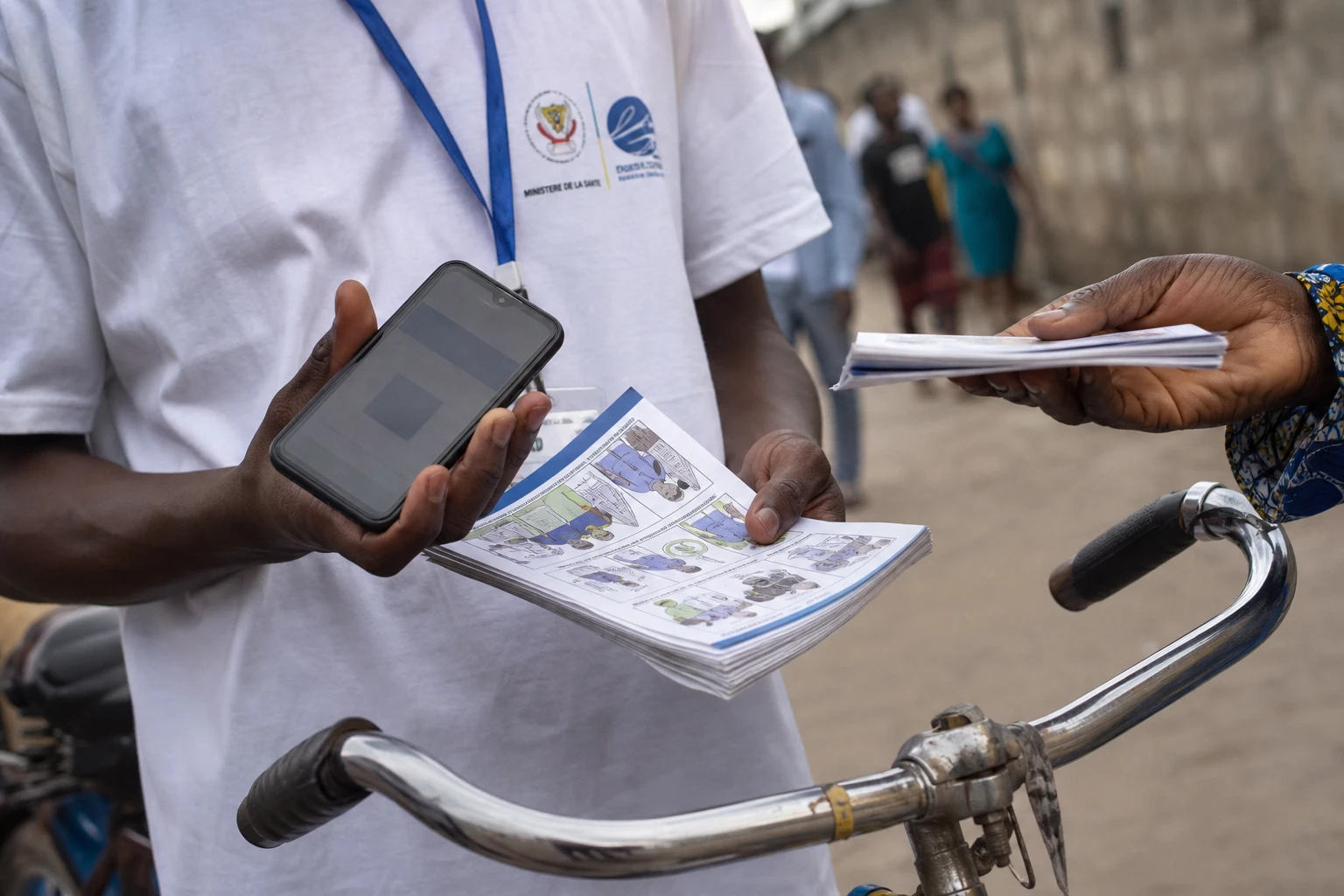
In Beni, the response also takes to the streets
When an epidemic returns to a city marked by fear, the figures are no longer enough. In Beni, in North Kivu, young people have chosen to do what official messages do not always manage: go out among residents, on foot and by bicycle, to explain Ebola, address rumours and remind people of protective measures. This approach is part of a broader community response strategy, which the WHO and Africa CDC now consider central to tackling the 2026 outbreak in the Democratic Republic of Congo.
Beni was not chosen at random. The city remains associated with one of the darkest periods of the 2018-2020 epidemic, which was declared over on 25 June 2020 after 3,470 cases and 2,287 deaths were recorded in eastern DR Congo, according to UNICEF. This public health memory continues to weigh on public trust. It also explains why every new Ebola alert revives caution, rejection or doubt in Beni and other parts of North Kivu.
A North Kivu city caught between insecurity and a health challenge
In 2026, the outbreak is affecting eastern Democratic Republic of Congo in a context already weakened by population displacement, insecurity and access difficulties, the WHO says in its monitoring of the outbreak caused by the Bundibugyo virus. North Kivu is not only an area through which the virus moves; it is also a place where rumours, trauma and mistrust circulate. In such an environment, a health team may be seen as a threat before it is seen as a source of protection.
The initiative by young people in Beni is therefore rooted in a very concrete reality: the fight against Ebola cannot be won solely in treatment centres. It is also waged in neighbourhoods, at crossroads, in families and alongside street leaders. For several years, the WHO has stressed the need to involve local leaders, women’s and youth associations, community volunteers and religious representatives to ease fears and improve acceptance of response measures.
Young people on the front line against disinformation
The idea behind the campaign is simple: turn young people into credible messengers. In Beni, youth leaders have said that the spread of Ebola is accompanied by a worsening security climate and rising tensions with health teams. Response workers have also condemned assaults on staff responsible for safe burials, as well as attacks on treatment facilities and awareness teams. As early as 2019, the WHO reported violence against treatment centres and burial teams in this part of eastern DR Congo.
Turning to young people addresses a clearly identified problem: disinformation. In affected areas, some residents believe Ebola does not exist, or that the response is concealing other intentions. During the previous major outbreak, the WHO documented how prevention messages ran up against mistrust, rumours and social fatigue. In Beni, field teams therefore regard young people as essential intermediaries: they speak the language of the neighbourhoods and can bridge the gap between residents and healthcare workers.
What this mobilisation changes beyond the slogans
The campaign in Beni highlights a decisive point: in eastern DR Congo, public health also depends on the social fabric. If people refuse to report symptoms, oppose safe burials or obstruct response teams, the virus spreads faster than medical services can contain it. Conversely, when young people, neighbourhood leaders and local associations take part in the response, messages get through more effectively and suspected cases can be identified sooner. This is precisely what the WHO and Africa CDC call a “community-led” response.
The debate is also political and budgetary. On the ground, community workers are calling for more resources, a more visible state presence and more tangible follow-up on funding announcements. Behind these demands lies a question of public credibility: if people see no real improvement in their neighbourhoods, the authorities’ words lose their force. In a city such as Beni, this can matter as much as the availability of beds, tests or surveillance teams.
An alert from DR Congo with implications beyond Central Africa
Beni’s case has clear regional significance. DR Congo shares borders with several countries in the Great Lakes region and Central Africa, where cross-border movement is extensive. The WHO has stressed that the response must include cross-border surveillance, because an outbreak that is not contained in the east of the country can quickly become a regional threat. This is also why Africa CDC is closely monitoring the outbreak and calling for stronger early warning, contact tracing and community trust.
For the Congolese health authorities, the challenge is now twofold: contain the epidemic and prevent history from repeating itself. Beni knows the cost of a response undermined by fear, violence and rumours. The youth campaign will not remove these vulnerabilities, but it points to a useful way forward: treating young Congolese not as an audience to persuade, but as public health actors in their own right. In the current crisis, this may be what determines whether transmission drags on or a chain of infections is finally broken.



