Algeria
 Egypt
 Libya
 Sudan
 Tunisia
 Benin
 Burkina Faso
 Cabo Verde
 Côte d'Ivoire
 Ghana
 Guinea
 Guinea-Bissau
 Liberia
 Mali
 Mauritania
 Niger
 Nigeria
 Senegal
 Sierra Leone
 The Gambia
 Togo
 Cameroon
 Central African Republic
 Chad
 DR Congo
 Equatorial Guinea
 Gabon
 Republic of the Congo
 São Tomé and Príncipe
 Burundi
 Comoros
 Djibouti
 Eritrea
 Ethiopia
 Kenya
 Madagascar
 Malawi
 Mauritius
 Mozambique
 Rwanda
 Seychelles
 Somalia
 South Sudan
 Tanzania
 Uganda
 Angola
 Botswana
 Eswatini
 Lesotho
 Namibia
 South Africa
 Zambia
 Zimbabwe
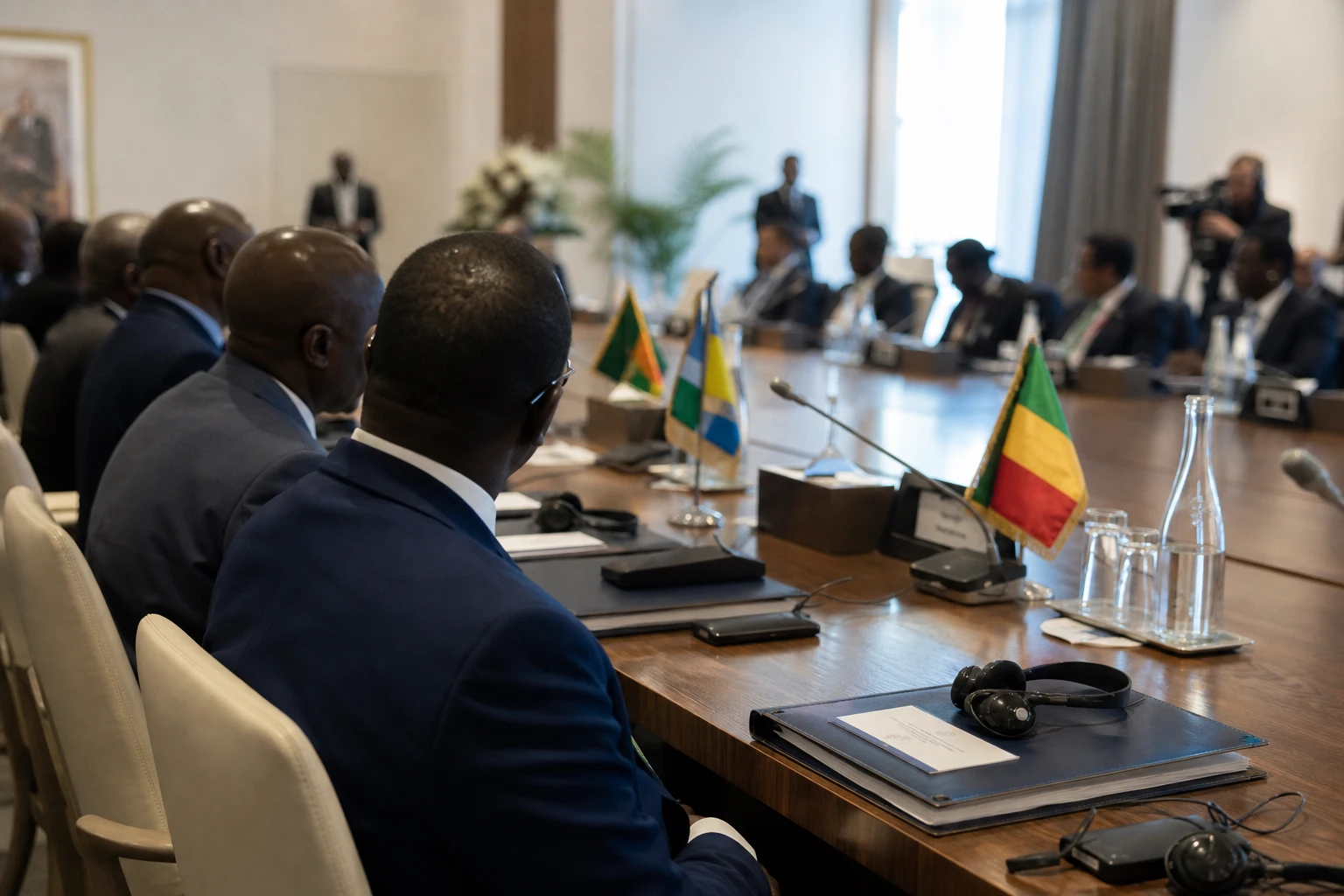
Ceuta, a border that points to Rabat
In Ceuta, the sea and the border often say more than speeches. When thousands of people head towards the Spanish enclave, the debate is not only about policing the limits of the Strait. It also touches on relations between neighbours Spain and Morocco, two states linked by economics, security and an impossible-to-ignore geography. Ceuta has around 85,000 inhabitants, but it regularly finds itself at the centre of a standoff that extends far beyond its urban area.
Morocco, whose capital is Rabat, belongs to the Arab Maghreb Union alongside Algeria, Libya, Mauritania and Tunisia. This regional framework still exists on paper, but its ambitions remain hampered by political tensions. In this context, every crisis with Madrid quickly spills beyond the migration issue alone. It also revives longstanding disputes over Ceuta and Melilla, which Spain considers an integral part of its territory and which Rabat does not recognise as Moroccan cities.
A Spanish debate shifting its focus
The events that began in May 2021 served as the starting point for this shift. Within a few days, around 8,000 to 10,000 people entered Ceuta from Morocco, according to figures reported by Reuters and several international media outlets. Spanish authorities described it as an unprecedented migration crisis, while unaccompanied minors remained stranded there for weeks. The issue was therefore not only humanitarian. It was also diplomatic, because Madrid and Rabat were already emerging from a period of tension linked to Western Sahara and Spain’s hosting of Brahim Ghali, leader of the Polisario Front.
In this context, some Spanish media stopped targeting only “Rabat” or “the Moroccan government”. They began to personalise their portrayal of Moroccan power. This reading is based on a well-known reality: Morocco’s monarchy concentrates much of the political arbitration, while the palace, security services and circles of trust shape the exercise of power. The kingdom’s institutions operate with an executive led by Aziz Akhannouch, but King Mohammed VI remains the key to the system.
This editorial shift is not neutral. It allows for more direct language about those close to the sovereign, the decision-making chain and the mechanics of power. But above all, it says something about Spain’s domestic political battle. The Ceuta crisis fuels accusations that Pedro Sánchez is weak. It also feeds into polls in which public opinion is wary of the Moroccan state and favours a tougher border. At the same time, Madrid officially emphasises cooperation with Morocco and the defence of its sovereignty in Ceuta and Melilla.
The Rif, a sensitive subject and a question of memory
The second shift observed in the Spanish press concerns the Rif. This region in northern Morocco carries a heavy political legacy. It evokes Abdelkrim el-Khattabi and the Republic of the Rif, proclaimed in 1921 and then crushed in 1926 by the French and Spanish armies. It also evokes more recent social protests and the marginalisation denounced by several Rifian activists. The Rif National Party, based outside Morocco, presents itself as a peaceful movement calling for self-determination. The party itself says it defends this right and has made numerous public statements in recent years.
This issue remains explosive because it touches on territoriality, identity and the monarchy. In Morocco, criticism of the king is restricted by repressive laws, and human rights organisations have continued to report convictions for offending the sovereign. In 2024, Human Rights Watch highlighted the continued repression of journalists, activists and influencers prosecuted over remarks deemed offensive to the monarchy or the state. In this context, an open debate in the Spanish press cannot be conducted in the same terms inside Morocco.
For Rabat, this asymmetry matters. Moroccan media close to the authorities respond by denouncing anti-Moroccan hostility in Spain and recalling that Ceuta and Melilla are occupied territories, a phrase regularly used by the Moroccan authorities or their allies. For residents of northern Morocco, the stakes are more concrete: jobs, mobility, police controls, informal smuggling, families’ movement and access to border towns. The border is not a diplomatic abstraction. It is a space of everyday life, work and tension.
What the events say about Morocco and the region
Morocco thus finds itself at the intersection of several fault lines: migration pressure, the Western Sahara issue, political rivalry with Algeria, and the unresolved question of the Spanish presidios. North Africa does not move forward here as a bloc. It advances in fits and starts, driven by the balance of power between Rabat, Algiers, Madrid and the European institutions. In this game, the AMU remains an unfinished regional framework, and the African Union does not treat Ceuta as a conventional African dispute, but as an issue of sovereignty and Euro-Mediterranean neighbourly relations.
Finally, Ceuta forces us to look at the tangible effects of border crises. On the Spanish side, they overwhelm reception, healthcare and policing systems. On the Moroccan side, they strengthen coastal surveillance and give greater weight to the security apparatus. Between the two, local populations pay the price of a border turned into a political instrument. This is where the issue’s continental significance lies: it shows how a bilateral dispute can become a test of migration management, the place of peripheral regions and states’ ability to control their public narrative without conflating security, sovereignty and stigmatisation.