Algeria
 Egypt
 Libya
 Morocco
 Sudan
 Tunisia
 Benin
 Burkina Faso
 Cabo Verde
 Côte d'Ivoire
 Ghana
 Guinea
 Guinea-Bissau
 Liberia
 Mali
 Niger
 Nigeria
 Senegal
 Sierra Leone
 The Gambia
 Togo
 Cameroon
 Central African Republic
 Chad
 DR Congo
 Equatorial Guinea
 Gabon
 Republic of the Congo
 São Tomé and Príncipe
 Burundi
 Comoros
 Djibouti
 Eritrea
 Ethiopia
 Kenya
 Madagascar
 Malawi
 Mauritius
 Mozambique
 Rwanda
 Seychelles
 Somalia
 South Sudan
 Tanzania
 Uganda
 Angola
 Botswana
 Eswatini
 Lesotho
 Namibia
 South Africa
 Zambia
 Zimbabwe
Off Nouadhibou, the sea exposes the fragility of the Atlantic route
Off Nouadhibou, Mauritania, a pirogue carrying 315 people was spotted after drifting for several days. The episode says much about a migration route that has become one of West Africa’s most dangerous, marked by improvised departures, overcrowded boats and increasingly frequent rescues at sea.
In this area, the sea is not merely a passage. It is also a harsh filter. Mauritania’s coastline, and particularly the maritime corridor off Nouadhibou, has for months seen departures, forced returns, interceptions and rescue operations. Mauritania, a Sahelian country facing the Atlantic and a direct neighbour of Senegal, thus finds itself at the crossroads of regional migration pressures and European expectations on controlling flows.
What happened at sea, and what rescuers say
On the night of Wednesday 19 to Thursday 20 August 2026, Mauritanian coastguards rescued a wooden pirogue that had set off from The Gambia. The 315 people on board were taken into care and then received at a temporary reception centre in Nouadhibou, before being referred to the relevant humanitarian organisations. The authorities said the group comprised 191 Senegalese, 123 Gambians and one person from Mali. Women and children were among them.
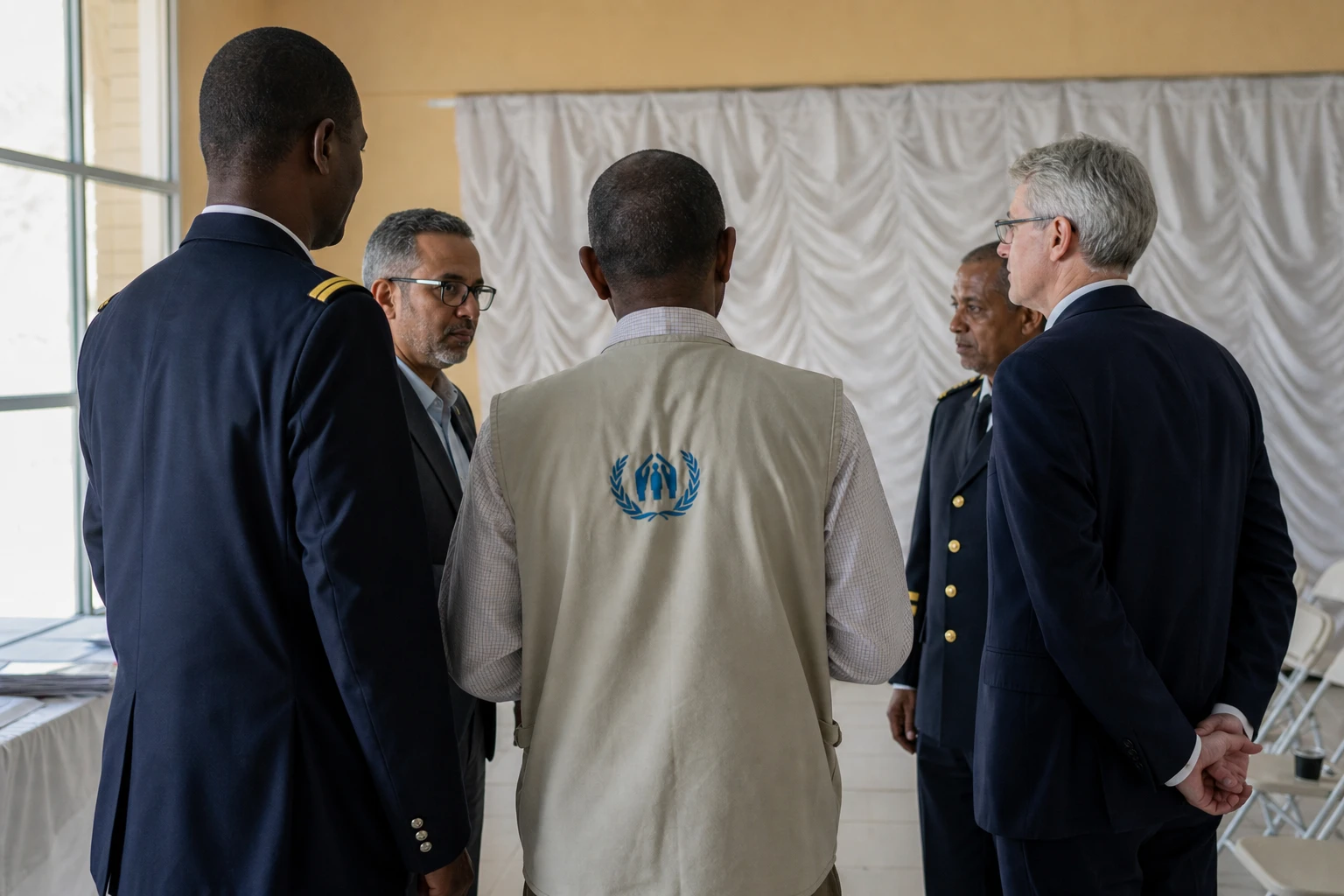
A coastguard official said the boat had been drifting off the fishing port of Nouadhibou and that all passengers had been rescued in accordance with the legal and humanitarian procedures in force. On the ground, the Mauritanian Red Crescent confirmed that survivors had received psychological first aid, accommodation and clothing. The same arrangements also received other passengers referred from the landing stage by the French Red Cross.
The survivors’ accounts shed light on the scale of the danger. One of them described drifting for nearly seven days. According to the SOS Migrants association, most of the survivors were in poor health after a crossing marked by hunger, exhaustion and overcrowding. In an overloaded pirogue, every engine failure, every extra day, every shortage of water or food can turn a journey into a humanitarian crisis.
Pressure that extends beyond Mauritania
This near-disaster did not happen in isolation. It is part of a broader pattern. In July 2026, Mauritanian coastguards had already rescued more than 200 migrants in two days, with one body found on board and 120 people reported missing, according to the information available at the time. A few days later, further operations took place off Nouadhibou. The repeated interventions show that Mauritania’s coastline has become a major crossing point on the West African Atlantic route.
Data from the International Organization for Migration confirm this. The West African route to the Canary Islands has seen a resurgence since 2020, with departures recorded from the coasts of Senegal, Mauritania, The Gambia and Morocco. The IOM also notes that 17,788 migrants reached the Canary Islands irregularly in 2025 from the coasts of West and North Africa, a fall compared with 2024, but a figure that shows the phenomenon persists.
For the Mauritanian authorities, the challenge is twofold. They must secure a vast maritime coastline while ensuring that control does not turn into abandonment of those intercepted. For cities in western Mauritania, above all Nouadhibou, the issue is very practical: healthcare, temporary accommodation, coordination with humanitarian organisations, and then administrative assessment of individual cases. For the countries of departure, particularly Senegal and The Gambia, the issue also points to deeper causes: youth unemployment, regional mobility, smuggling networks and the persistent illusion of a quick crossing to Europe.
Mauritania is not acting alone on this issue. The country is linked to its neighbours by longstanding economic, family and maritime movements, and by regional mechanisms that remain essential, even if ECOWAS does not alone shape the entire Sahel-Atlantic region. In this context, interceptions at sea reflect less an isolated episode than a reshaping of migration routes under pressure from tighter controls and increasingly risky departures.
What this episode means for the region
Across West Africa, the issue is no longer just departures. It is also about states’ ability to share information, document disappearances and organise rescues that comply with the law and respect people’s dignity. Every boat rescued off Nouadhibou is a reminder that maritime surveillance policies are not enough if departure routes continue to be fuelled by precarity and by networks that adapt faster than control measures.
For Mauritania, the current sequence also carries political significance. The country has become a key link on the Atlantic front, as security and migration-management partnerships between African states and external partners expand. But on the ground, the priority remains the same: rescue, provide care, identify, then refer. In Nouadhibou, as elsewhere, this is where the credibility of an African response that does not reduce migrants to a mere flow to be contained is at stake.