Algeria
 Egypt
 Morocco
 Sudan
 Tunisia
 Benin
 Burkina Faso
 Cabo Verde
 Côte d'Ivoire
 Ghana
 Guinea
 Guinea-Bissau
 Liberia
 Mali
 Mauritania
 Niger
 Nigeria
 Senegal
 Sierra Leone
 The Gambia
 Togo
 Cameroon
 Central African Republic
 Chad
 DR Congo
 Equatorial Guinea
 Gabon
 Republic of the Congo
 São Tomé and Príncipe
 Burundi
 Comoros
 Djibouti
 Eritrea
 Ethiopia
 Kenya
 Madagascar
 Malawi
 Mauritius
 Mozambique
 Rwanda
 Seychelles
 Somalia
 South Sudan
 Tanzania
 Uganda
 Angola
 Botswana
 Eswatini
 Lesotho
 Namibia
 South Africa
 Zambia
 Zimbabwe
Stability remains out of reach
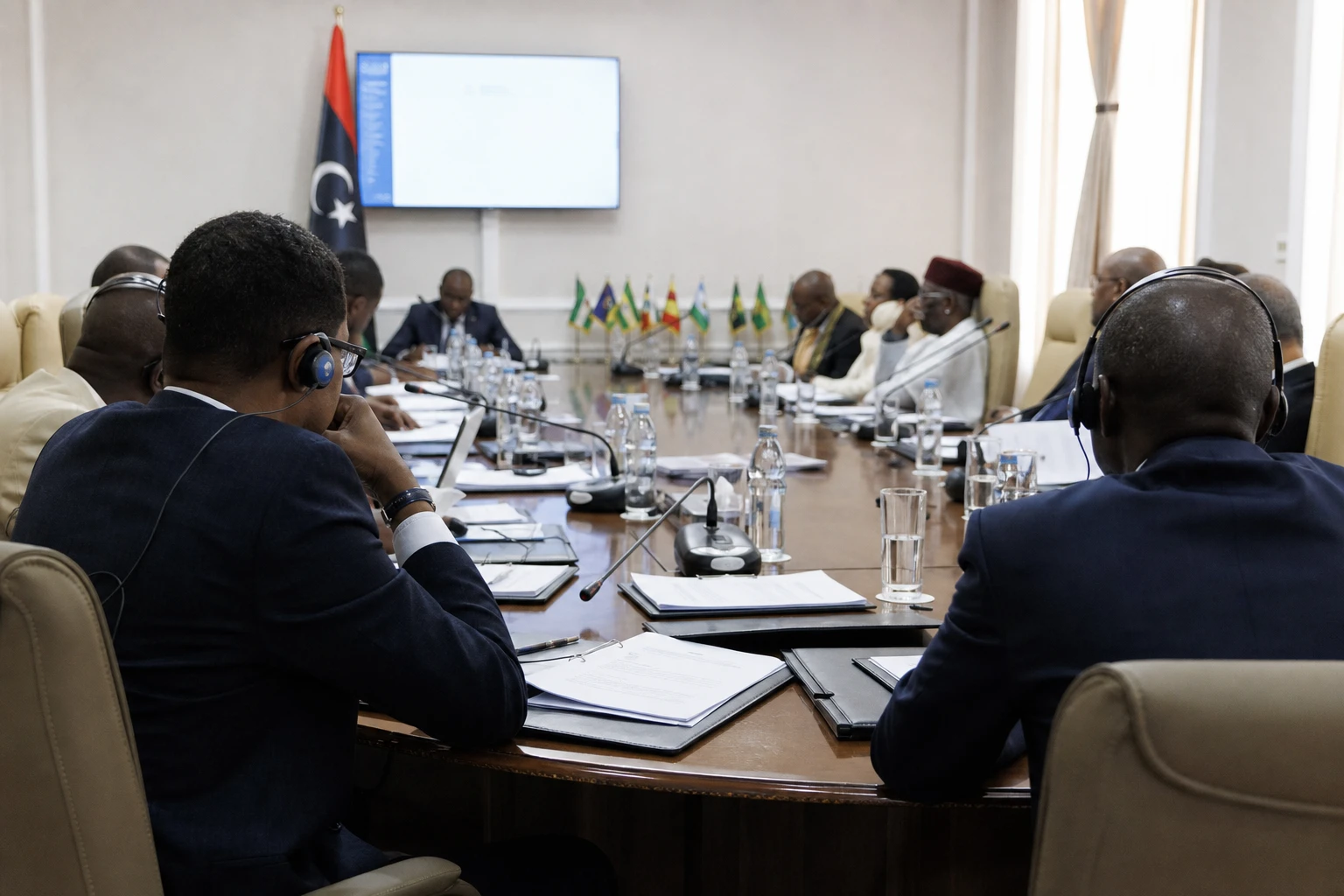
In Tripoli, the Libyan state continues to hold together without truly reunifying. Fifteen years after the fall of Muammar Gaddafi, the country remains divided between two centres of power, rival security apparatuses and economic networks that overlap more than they combine. For Libyans, the question is no longer simply who governs. It is how to govern a country where each institution still has its own base, alliances and, sometimes, means of applying pressure.
The deadlock is not confined to the capital. It weighs on Benghazi in the east, on the major coastal cities, on the south, which is more exposed to trafficking and insecurity, and on the informal economy, which adapts to each political shift. Libya is not isolated in North Africa. It remains a hub for hydrocarbons, migration flows, regional rivalries and mediation efforts led by the UN and the African Union.
Rival institutions, but the same roadblock
The heart of the problem is well known. Since the failure to hold national elections scheduled for December 2021, the transition has ground to a halt. The UN has repeatedly said the status quo is untenable, while supporting a new political roadmap and phased municipal elections. In December 2024, the Security Council was again told that options for a timetable and electoral framework should be put forward to set the country on a credible path.
The institutional landscape therefore remains split between the west, centred on Tripoli, and the east, centred on Benghazi. In practice, two governments are vying for legitimacy, while local officials, armed groups and administrative networks defend the gains they have made since 2011. Reunification would require more than a political agreement. It would mean redistributing posts, budgets, access to rents and security levers. That is precisely what many actors fear.
The political scene is suffering the direct consequences: parties, which emerged in large numbers after the revolution, have lost influence to strongmen, territorial networks and de facto institutions. The African Union, for its part, has stepped up its diplomatic presence. In February 2025, it backed the signing of the Charter for Peace and National Reconciliation, presented as a useful step but still far from a lasting settlement.
Oil: backbone and fault line
In Libya, oil is both the country’s main source of wealth and the main factor binding its rivals together. Data from the International Monetary Fund and UN reports show production of around 1.5 million barrels per day in 2025, with exports remaining the mainstay of external revenue. Meanwhile, the Central Bank of Libya, based in Tripoli, announced in April 2026 the adoption of the first unified budget in more than 13 years. This is an important political signal. But it does not dissolve the underlying rivalry between the producing east and the administering west.
Central bank figures also confirm the central role of hydrocarbons: in 2025, public revenues reached about 136.87 billion dinars, of which 99.6 billion came from oil sales. In other words, the Libyan state still lives almost entirely off energy rents. This dependence explains why rival institutions can oppose each other politically while remaining economically intertwined. Without oil flows, the system grinds to a halt. With them, it carries on.
This is also what makes the recent attacks so sensitive. In early August 2026, drones targeted energy facilities in Zawiya, west of Tripoli, causing fires, power cuts and tensions around a site housing a refinery, a terminal and a power station. At the same time, a military intelligence officer linked to the eastern camp was killed in the east of the country, amid persistent security rivalries. These incidents are a reminder that energy infrastructure and domestic security remain open fronts.
In Zawiya, the impact is tangible. Residents face power cuts, businesses lose visibility, and the national electricity supply becomes more fragile. For armed or political actors controlling the ground, by contrast, every crisis increases the value of leverage. The same situation can therefore be read on two levels: a clear loss for the population, and a tactical resource for those negotiating from a position of strength.
A Libyan crisis that spills across borders
Libya’s influence extends beyond its borders because it links several African issues at once: security in the Sahel, migration routes, hydrocarbon management, arms flows and regional diplomacy. The African Union now speaks of reconciliation, the UN of an electoral roadmap, and financial institutions of fiscal consolidation. These three perspectives are not contradictory. On the contrary, they show that no way out of the crisis will be purely institutional, purely security-based or purely economic. All three will be needed.
The next test will not come only from a summit or a declaration. It will come from the rival authorities’ ability to maintain the unified budget, protect energy infrastructure and create an electoral framework accepted by the main blocs. Without that, Libya will remain in limbo: a state that exists but lacks full authority; wealth that flows but without shared legitimacy; a transition that lasts so long it eventually becomes a system.