
 Algeria
 Egypt
 Libya
 Morocco
 Sudan
 Tunisia
 Benin
 Burkina Faso
 Cabo Verde
 Côte d'Ivoire
 Ghana
 Guinea
 Guinea-Bissau
 Liberia
 Mali
 Mauritania
 Niger
 Nigeria
 Senegal
 Sierra Leone
 The Gambia
 Togo
 Cameroon
 Central African Republic
 Chad
 Equatorial Guinea
 Gabon
 Republic of the Congo
 São Tomé and Príncipe
 Burundi
 Comoros
 Djibouti
 Eritrea
 Ethiopia
 Kenya
 Madagascar
 Malawi
 Mauritius
 Mozambique
 Rwanda
 Seychelles
 Somalia
 South Sudan
 Tanzania
 Uganda
 Angola
 Botswana
 Eswatini
 Lesotho
 Namibia
 South Africa
 Zambia
 Zimbabwe
A vaccine exists, but not for the strain in circulation
In Kinshasa, the question is no longer simply whether doses are available. It is whether they can be useful straight away in an outbreak advancing faster than the response. In the Democratic Republic of the Congo, the health challenge now has two fronts: protecting healthcare workers and contacts, while preparing clinical trials capable of measuring what actually works against the Bundibugyo strain.
This is decisive. Ervebo is the only licensed Ebola vaccine, but its approval covers the most common form of the virus, that associated with the Zaire strain. For the Bundibugyo strain, the WHO says there is no licensed vaccine or specific treatment, and that data on cross-protection remain limited and inconclusive.
DR Congo’s response within a regional framework
The current outbreak was declared on 15 May 2026 by Congolese health authorities, following laboratory confirmation of Bundibugyo virus disease. Two days later, the WHO director-general issued an international alert, bringing DR Congo, Uganda and technical partners into accelerated coordination. Central Africa and the border corridors of eastern Congo are directly affected, as the provinces hit are linked to Uganda and South Sudan in an area of intense movement.
This management decision is not insignificant. In the region, the response does not involve health ministries alone. It also brings in Africa CDC, the WHO and cross-border surveillance bodies, with a simple objective: to prevent the virus from exploiting gaps at entry points, markets, trade routes and areas of human mobility. Ituri, in particular, remains a focus for monitoring because it combines insecurity, population displacement and proximity to borders.
The 70,000 doses: a useful reserve, but with conditions
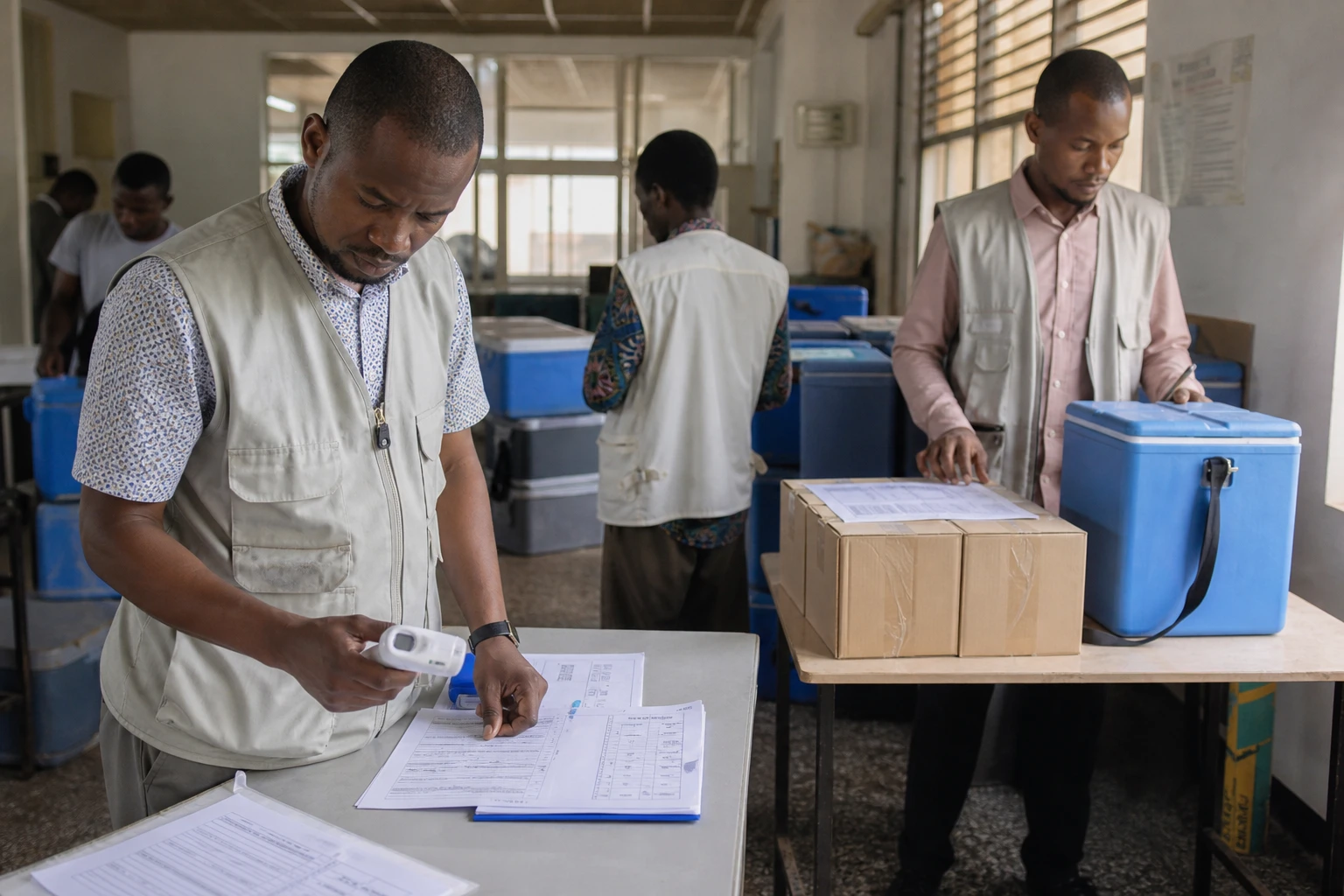
The 70,000 doses mentioned are of Ervebo, made available by the International Coordinating Group on Vaccine Provision. The WHO said that 20,000 doses were intended for a phase 3 clinical trial, while the other 50,000 were to be used for frontline personnel and healthcare workers. The idea is not to launch a mass campaign as for a known strain, but to govern the vaccine’s use within a framework of research and targeted protection.
In practice, this is a pragmatic response to a scientific impasse. Experts convened by the WHO recommended that Ervebo be evaluated during the current epidemic, precisely because no product is currently licensed against Bundibugyo. Radio Okapi reports that the WHO now considers it necessary to accelerate the implementation of a clinical trial in DR Congo, with a possible ring vaccination strategy around cases.
This approach makes a significant difference for field teams. For healthcare workers, it offers possible, if partial, protection where the risk of exposure is high. For communities, it does not replace standard measures: contact tracing, prompt isolation, infection prevention in healthcare facilities, and safe and dignified burials. The WHO stresses this point, as the virus often spreads when care is disrupted and reporting is delayed.
What the Congolese outbreak reveals
The epidemic’s spread also says something about the weaknesses of the Congolese health system in the east of the country. As of 21 May 2026, the WHO had reported 83 confirmed cases and 746 suspected cases, with deaths already recorded among both confirmed and suspected cases. More recently, the WHO director-general referred to “more than 5,000 cases” and more than 2,300 deaths, a sign of an outbreak that has become highly lethal and spread to several provinces. These figures changed over the weeks, but they point to the same conclusion: the response is chasing the virus.
In eastern DR Congo, the obstacles are well known. The authorities and the WHO have cited insufficient triage areas, still-fragile referral pathways, and isolation measures that are not always applied with the same rigour. These are compounded by cross-border mobility, forced displacement, local tensions and the difficulty of maintaining residents’ trust when the disease reaches areas already under pressure. The response therefore depends not only on supplies, but on the ability to work with communities.
Congolese media are also following this aspect closely. Actualite.cd reported that four candidate vaccines against Bundibugyo were continuing clinical trials, while Radio Okapi noted in early August that the WHO considered the disease faster than the response and was calling for the entire system to be urgently strengthened. These two local perspectives echo the WHO’s warnings: science is advancing, but the window for action on the ground remains narrow.
A development to watch beyond Congo’s borders
The significance of this decision extends beyond DR Congo. In the Great Lakes region, every Ebola alert brings the movement of people, border procedures and coordination between neighbouring countries back into focus. Uganda has already reported a case imported from DR Congo, proof that cross-border surveillance is no abstract concern. Africa CDC and the WHO are also working on a joint response, based on the idea that an effective response must be regional, not just national.
For Congolese people, the immediate challenge remains tangible: protecting families, nurses, laboratories and healthcare facilities in a context of high mobility and humanitarian constraints. For Kinshasa, the political challenge is equally clear: showing that a state can coordinate a credible response, in partnership with African and international institutions, without waiting for a health crisis to become a regional one. That is where what happens next will be determined, between clinical trials, increased surveillance and the ability to remain on the ground over time.



