Algeria
 Egypt
 Libya
 Morocco
 Sudan
 Tunisia
 Benin
 Burkina Faso
 Cabo Verde
 Côte d'Ivoire
 Ghana
 Guinea
 Guinea-Bissau
 Liberia
 Mali
 Mauritania
 Niger
 Nigeria
 Sierra Leone
 The Gambia
 Togo
 Cameroon
 Central African Republic
 Chad
 DR Congo
 Equatorial Guinea
 Gabon
 Republic of the Congo
 São Tomé and Príncipe
 Burundi
 Comoros
 Djibouti
 Eritrea
 Ethiopia
 Kenya
 Madagascar
 Malawi
 Mauritius
 Mozambique
 Rwanda
 Seychelles
 Somalia
 South Sudan
 Tanzania
 Uganda
 Angola
 Botswana
 Eswatini
 Lesotho
 Namibia
 South Africa
 Zambia
 Zimbabwe

In Senegal, transparency becomes a political test
In Dakar, the question is no longer simply who governs. It is also what the country’s top officials must show it when they take office, and then when they leave. Amid budgetary mistrust and a reshuffle at the top of the state, publishing assets is not a symbolic gesture. It is a marker of the credibility of Senegalese institutions.
Senegal is part of a broader trajectory in public governance, at a time when the authorities are also pursuing an agenda of transparency, anti-corruption and regional integration. This direction is consistent with commitments already set out in African anti-corruption frameworks, including the African Union Convention on Preventing and Combating Corruption.
What the new law provides
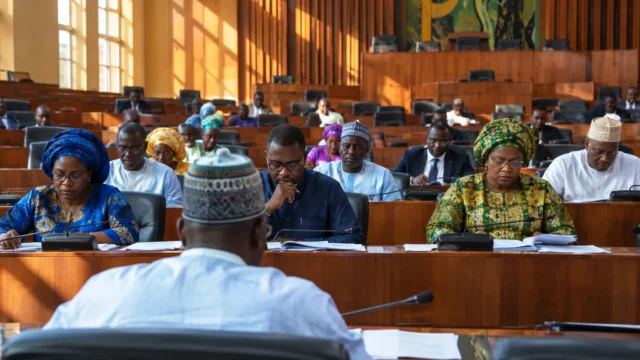
Senegal’s parliament has passed a law requiring the president, the president of the National Assembly and the prime minister to declare and publish their assets when taking and leaving office. The measure therefore extends a system that previously applied only when taking office. A declaration must now be filed three months after taking office and three months after the end of the term.
The vote secured 133 of the 165 MPs’ votes, showing solid majority support for the reform. According to the information available, the proposal was put forward by the parliamentary majority and expanded during debate to include the state’s three main political offices. In Senegal’s system, this extension matters as much as the rule itself, since it subjects parliament and the executive to the same level of public scrutiny.
This change has not come out of nowhere. As early as 2001, Senegal’s constitution required the newly elected president to submit a written declaration of assets to the Constitutional Council, which was then made public. The authorities subsequently strengthened the legal framework through the 2014 law and then the February 2024 law, which set stricter rules for those subject to the requirement and the penalties. The new law is therefore part of a gradual tightening of asset oversight.
A reform driven by a pledge to break with the past
The measure also responds to a longstanding political pledge by the authorities who came to power in April 2024. In official statements from the presidency, asset declarations feature among the promised transparency initiatives, alongside reform of the anti-corruption body, access to information and protection for whistleblowers. In other words, the measure is not an isolated one: it is part of an institutional package presented as a change in approach.
But the political significance of the measure goes beyond its legal content. Since former prime minister Ousmane Sonko was dismissed by President Bassirou Diomaye Faye on 22 May 2026, Senegalese politics has entered a period of rupture between former allies turned rivals. Tensions have led to a rapid reshuffle, with a new prime minister appointed a few days later and visible divisions within the presidential camp. In this climate, asset transparency is also becoming a tool for restoring internal order.
This sequence highlights an essential point: in Senegal, public integrity is not merely an administrative matter. It affects the legitimacy of power, the majority’s image and the state’s ability to ask citizens to make sacrifices. When leaders demand budgetary discipline or restraint in public spending, they must also accept clearer obligations concerning their own assets. That is where the reform takes on its political significance.
What this means for the state, citizens and the region
Institutionally, the measure strengthens the role of the National Anti-Corruption Office, OFNAC, which already administers part of the declaration system. It could also make it easier to detect discrepancies, provided declarations are actually filed, checked and made accessible within clear deadlines. Without follow-up, a publication requirement remains a paper promise.
For citizens, the issue is tangible. Asset transparency will not resolve the cost of living or administrative delays. However, it can shrink the grey area in which suspicions of conflicts of interest, unjustified enrichment or the blurring of public and private resources thrive. In a country where accountability has become a central issue in public debate, the publication of assets also serves as a civic benchmark.
The signal extends beyond the national sphere. Senegal remains an important player in ECOWAS, the Economic Community of West African States, and continues to uphold strong commitments to the rule of law, despite the political tensions of 2026. In a region shaken by military transitions, electoral disputes and governance shocks, a stricter rule on leaders’ assets sends a clear message: institutional stability also depends on oversight mechanisms that everyone can understand.
One fundamental question remains: will the law be enforced with the same rigour at every level covered, from the president and prime minister to the president of the National Assembly? That is where its real impact will be determined. In the months ahead, attention will focus on the implementing decrees, the quality of OFNAC’s checks and the first round of public declarations. It is often at that point that one can judge whether promised transparency has become a practice of government.