
 Algeria
 Egypt
 Libya
 Sudan
 Tunisia
 Benin
 Burkina Faso
 Cabo Verde
 Côte d'Ivoire
 Ghana
 Guinea
 Guinea-Bissau
 Liberia
 Mali
 Mauritania
 Niger
 Nigeria
 Senegal
 Sierra Leone
 The Gambia
 Togo
 Cameroon
 Central African Republic
 Chad
 DR Congo
 Equatorial Guinea
 Gabon
 Republic of the Congo
 São Tomé and Príncipe
 Burundi
 Comoros
 Djibouti
 Eritrea
 Ethiopia
 Kenya
 Madagascar
 Malawi
 Mauritius
 Mozambique
 Rwanda
 Seychelles
 Somalia
 South Sudan
 Tanzania
 Uganda
 Angola
 Botswana
 Eswatini
 Lesotho
 Namibia
 South Africa
 Zambia
 Zimbabwe
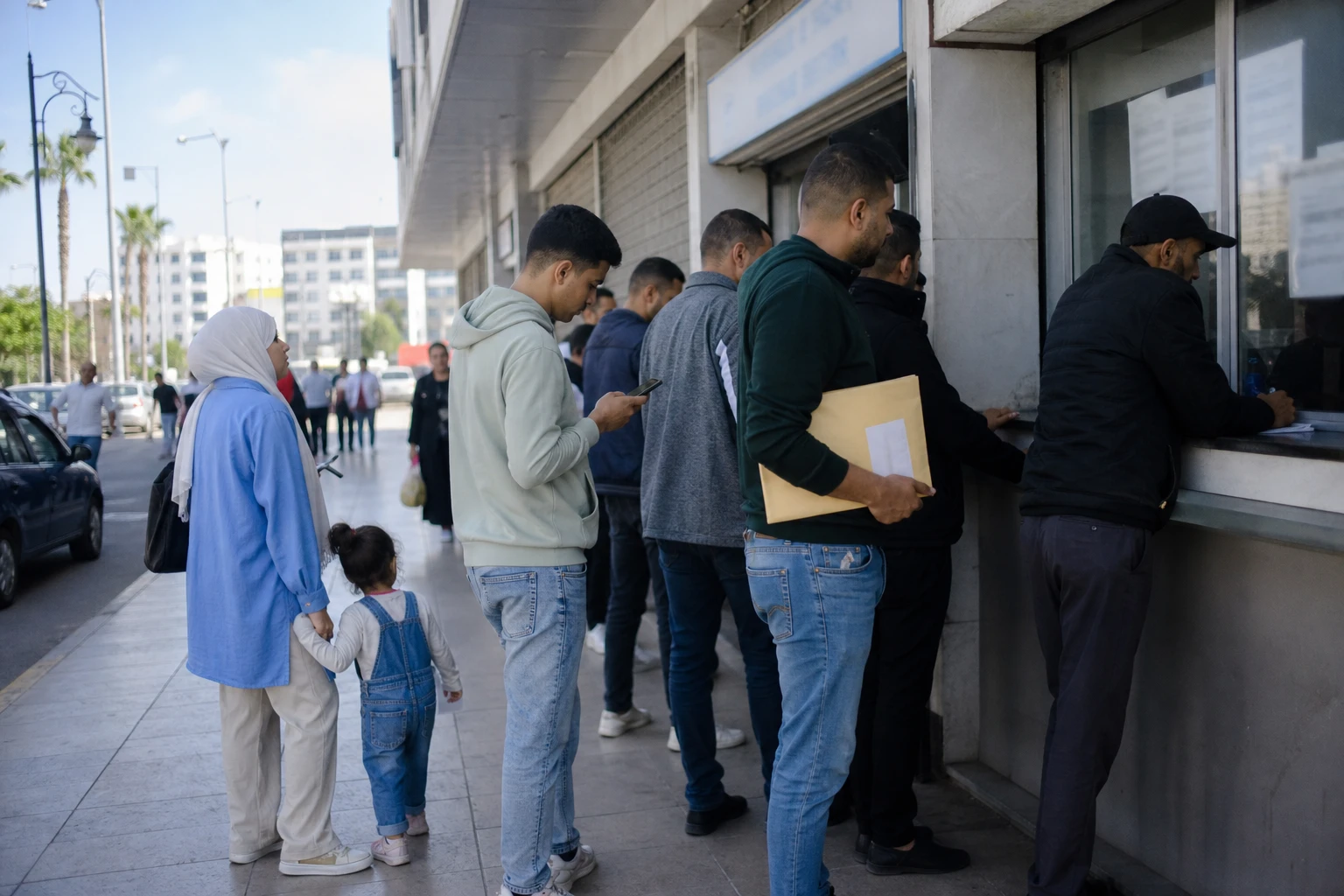
In Rabat, European funds target more than the border
When Brussels releases funds for Morocco, the debate is not limited to monitoring crossings into the Spanish enclave of Ceuta. It also concerns employment, social protection, public services and the Kingdom’s ability to retain a young population seeking opportunities, especially in areas near the northern border.
The issue is sensitive, because Morocco remains at the heart of a Euro-Mediterranean region through which goods, capital, students and workers move, as well as migration pressures. The European Union has a longstanding partnership with Rabat, based on the Association Agreement that entered into force in 2000, was revised in 2015, and on cooperation now funded through the EU’s NDICI-Global Europe instrument.
What the 2026 package actually provides
The Commission’s implementing decision, dated 29 July 2026 and published on 4 August 2026, confirms a specific measure in support of the Kingdom of Morocco for 2026. The total amount is €148 million. The largest share, €112 million, funds support for economic and social resilience. The other two strands are allocated €20 million for the EU-Morocco digital partnership and €16 million for the “Morocco: Active and Creative Youth” programme.
The main €112 million programme is not a border-policing budget. The document classifies it under the priorities of “social inclusion and human development”, “gender equality” and “human rights, democracy and governance”. It also covers social protection, public services, modernisation of the welfare state and improvements to public governance. In budgetary terms, the European contribution is €112 million, including €80 million in budget support and €32 million in complementary support.
The digital strand is intended to support digital transformation, digital governance, skills and digital services. The youth programme targets projects related to creativity, culture and youth participation. In the annex devoted to this third strand, monitoring is to be led under the chairmanship of Morocco’s Ministry of Youth, Culture and Communication, alongside public-sector stakeholders and, if necessary, the private sector and civil society.
Moroccan social policy and migration pressure on Ceuta
The decision forms part of a trajectory already visible in Rabat. In its 2026 finance law, the Moroccan government presents the consolidation of the “welfare state” as a priority. Official documents refer to the expansion of social protection, direct social assistance and the reduction of regional disparities. The Moroccan authorities are therefore seeking to combine a social safety net, administrative reform and employment support.
The timing of the European decision is not neutral. In late July 2026, the Spanish enclave of Ceuta saw a mass arrival of migrants from Morocco. International media reported tens of thousands of crossings, while the Spanish and Moroccan authorities gave different figures, making caution over the exact numbers essential. The most robust sources nevertheless agree on one point: the pressure was sudden, then partly contained through returns and arrests on the Moroccan side.
According to the Associated Press, Moroccan authorities stepped up security around Ceuta and Melilla in response to new calls circulating on social media. On 16 August 2026, they announced the arrest of nearly 300 people in an attempted crossing, including migrants from sub-Saharan Africa and Moroccans suspected of facilitating it. This episode shows that the response does not rely solely on controls, but also on addressing social causes and networks encouraging crossings.
For ordinary Moroccans, the issue is tangible. In the country’s north, the border with Ceuta is more than a diplomatic matter. It affects the local economy, small-scale transporters, families, young people without stable jobs and municipalities whose livelihoods depend as much on informal trade as on legal activity. At national level, Brussels is therefore betting on a familiar but delicate equation: reducing social vulnerability to lessen the incentive to leave, without promising that a budget programme will be enough to eliminate migration pressure.
A Moroccan perspective on a Euro-Mediterranean issue
Morocco holds a distinctive place in European neighbourhood policy. The European Union says it allocated around €1.15 billion in bilateral funding to the country between 2021 and 2025, while pledging more than €1.1 billion in grants, guarantees and financing through Global Gateway, with €5.5 billion in investment expected to be mobilised. The Kingdom is therefore not treated as a mere migration transit point, but as an economic and institutional partner.
This episode also matters for North Africa. It shows how quickly a Mediterranean border can come under strain when rumours, youth unemployment, smuggling networks and diplomatic tensions converge. Above all, it is a reminder that migration cannot be addressed through closure alone. Employment, education, social protection and legal mobility policies are needed. These are precisely the kinds of tools the EU is now emphasising in its Pact for the Mediterranean, launched in late 2025 and set out in its action plan in April 2026, which also covers Morocco.
One milestone remains to be watched: the effective implementation of the three programmes for 2026. That will show whether the €148 million package serves mainly as a political signal, or whether it drives visible reforms in public services, digital technology and youth policy in Morocco.



