Algeria
 Egypt
 Libya
 Morocco
 Sudan
 Tunisia
 Benin
 Burkina Faso
 Cabo Verde
 Côte d'Ivoire
 Ghana
 Guinea
 Guinea-Bissau
 Liberia
 Mali
 Mauritania
 Niger
 Nigeria
 Sierra Leone
 The Gambia
 Togo
 Cameroon
 Central African Republic
 Chad
 DR Congo
 Equatorial Guinea
 Gabon
 Republic of the Congo
 São Tomé and Príncipe
 Burundi
 Comoros
 Djibouti
 Eritrea
 Ethiopia
 Kenya
 Madagascar
 Malawi
 Mauritius
 Mozambique
 Rwanda
 Seychelles
 Somalia
 South Sudan
 Tanzania
 Uganda
 Angola
 Botswana
 Eswatini
 Lesotho
 Namibia
 South Africa
 Zambia
 Zimbabwe
In Dakar, the price at the pump is back on household budgets
Whenever fuel prices move, the same question resurfaces in Dakar’s neighbourhoods: who pays for the adjustment, and for how long can households absorb it? In an economy where urban transport, deliveries, artisanal fishing and part of the informal trade depend heavily on diesel and petrol, a change of a few dozen CFA francs quickly affects daily life.
Senegal is also operating in a tense regional environment. Across the Economic Community of West African States (ECOWAS), countries remain exposed to shocks in the global energy market, while Dakar seeks to preserve its budgetary room for manoeuvre and social stability. The issue is all the more sensitive because the country has only just emerged from a round of price cuts introduced in December 2025, after months in which the authorities had defended a policy of keeping prices down.
What the announced adjustment changes
Since Saturday, petrol has been selling at 990 CFA francs per litre and diesel at 755 CFA francs, according to information published in Dakar. The government attributes the decision to a surge in oil prices linked to tensions in the Middle East. For now, the official argument is clear: the state says it wants to protect supplies and limit losses in the distribution system, even if the cost is subsequently passed on to consumers and transport operators.
These price levels have not come out of nowhere. Official Senegalese documents show that a 100 CFA franc increase had already been introduced in 2023, taking petrol to 990 CFA francs and diesel to 755 CFA francs. By contrast, on 6 December 2025, the Energy Sector Regulatory Commission formalised a cut of 70 francs for petrol, bringing it down to 920 CFA francs, and 75 francs for diesel, reducing it to 680 CFA francs. The new adjustment therefore returns prices at the pump to a level that had already served as a benchmark in the price structure.
In practice, the increase does not affect everyone in the same way. Households using rapid transit buses, urban taxis or motorcycle taxis feel it first in their fares. Small traders then see it in the cost of delivered goods. Fishermen keep a close eye on diesel prices, as fuel is directly involved in going out to sea and affects the price of fish at the landing site. In Dakar, the increase therefore spreads well beyond the petrol station, affecting the entire chain of transport and supply.
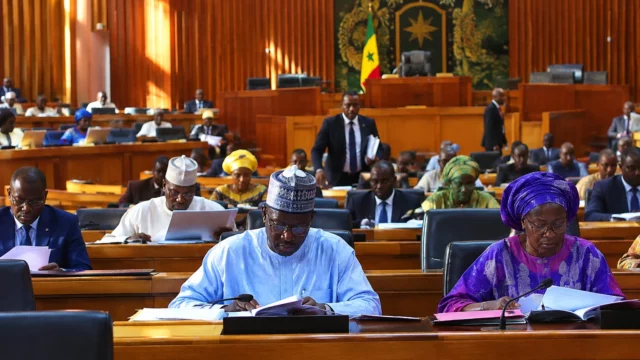
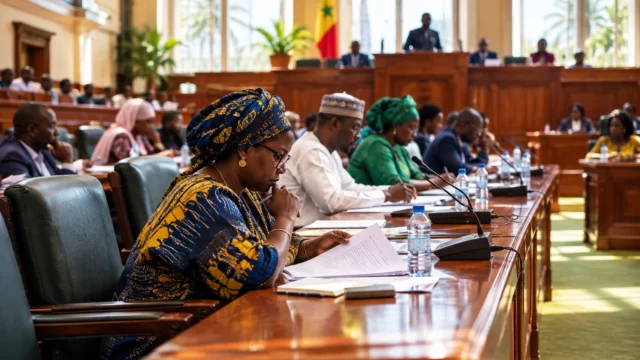
The government, for its part, is walking a narrow line. In May 2026, Prime Minister Ousmane Sonko told the National Assembly that, in his view, Senegal was the only country not to have raised fuel prices amid global pressure on hydrocarbons. A few months later, however, the executive had to choose between protecting purchasing power and the cost of the implicit subsidy. This tension sums up a classic dilemma: either the state cushions the shocks and increases its spending, or it allows market movements to feed through more quickly into domestic prices.
A budgetary, social and industrial issue
In Senegal, the question of fuel points to a broader pillar: energy sovereignty. The country has its own Société africaine de raffinage, which supplies the domestic market with several petroleum products, but remains exposed to international fluctuations. The authorities have also published a road map for the gradual removal of energy subsidies, a sign that the debate goes beyond a simple short-term response. In other words, every increase at the pump highlights the fragility of a model still heavily dependent on imports and government policy choices.
The issue is sensitive for public finances. Keeping prices artificially low is costly for the state. Conversely, raising tariffs without support measures puts pressure on the cost of living, particularly in a capital where transport expenses take up a significant share of low-income workers’ earnings. This is precisely why Senegal’s public authorities have alternated between adjustments, targeted cuts and warnings about budgetary prudence. The course of recent months shows an unstable balance between social protection, financial sustainability and the credibility of energy policy.
In the regions, the impact can be harsher than in Dakar. Markets across the country depend on road convoys arriving from the capital or travelling along major routes. When the price per litre rises, the cost of transporting goods follows, then retail prices. In a country where the informal sector plays a major role, the adjustment is passed on quickly, but without an automatic mechanism for indexing incomes. It is this gap that is fuelling concern.
What Dakar will need to monitor in the coming weeks
What happens next will depend on how long tensions in the global crude market last, as well as on the support measures the executive is willing to activate. A further rise in international prices would make the equation even more difficult, particularly as Senegal must already contend with economic reforms, relations with financial partners and the monitoring of its domestic agenda. Fuel will therefore be more than a petrol station issue. It will remain a test of governance, budgetary transparency and the protection of purchasing power in the country’s largest urban economy.
Across the continent, Senegal’s case illustrates a reality shared by many African countries: fluctuations in the oil market quickly become a matter of public debate, social tension and economic policy choices. For ECOWAS and the African Union alike, the challenge is the same everywhere: to secure supplies, manage subsidies and accelerate the energy transition without disrupting everyday economic activity. Senegal finds itself at the intersection of these three imperatives.