Algeria
 Egypt
 Libya
 Morocco
 Sudan
 Tunisia
 Benin
 Burkina Faso
 Cabo Verde
 Ghana
 Guinea
 Guinea-Bissau
 Liberia
 Mali
 Mauritania
 Niger
 Nigeria
 Senegal
 Sierra Leone
 The Gambia
 Togo
 Cameroon
 Central African Republic
 Chad
 DR Congo
 Equatorial Guinea
 Gabon
 Republic of the Congo
 São Tomé and Príncipe
 Burundi
 Comoros
 Djibouti
 Eritrea
 Ethiopia
 Kenya
 Madagascar
 Malawi
 Mauritius
 Mozambique
 Rwanda
 Seychelles
 Somalia
 South Sudan
 Tanzania
 Uganda
 Angola
 Botswana
 Eswatini
 Lesotho
 Namibia
 South Africa
 Zambia
 Zimbabwe
As disease weakens cocoa, uprooting can no longer be the only response
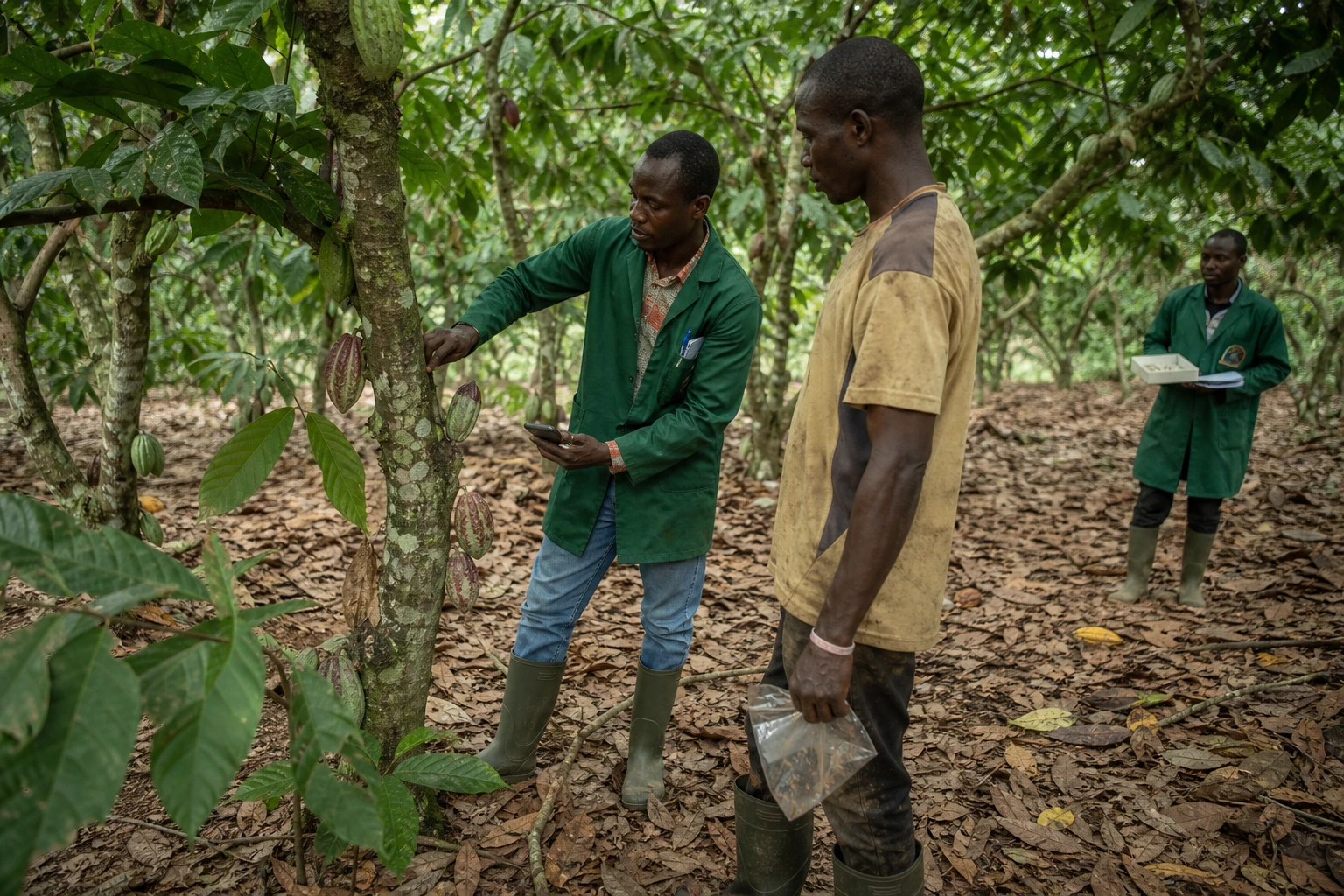
In cocoa groves, every diseased tree raises the same question for Ivorian farmers: should they cut it down, replant, or wait? In Côte d’Ivoire, the world’s leading cocoa producer, this dilemma weighs on thousands of farms, family incomes and a sector that remains central to the national economy. Research at Nangui Abrogoua University in Abidjan is seeking to move beyond an approach based entirely on uprooting in response to swollen shoot, a viral disease transmitted by mealybugs.
The issue extends beyond the laboratory. Ivorian cocoa is overseen by the Coffee and Cocoa Council, the public body responsible for regulating the sector, while cooperation with Ghana has grown in recent years. In April 2026, a regional workshop held in Abidjan with the FAO and support from the European Union put the fight against swollen shoot at the heart of a joint strategy between Abidjan and Accra.
Vital Plus, a scientific lead progressing with caution
The biosolution developed by Professor Mamadou Doumbia’s team has a simple name: Vital Plus. According to Nangui Abrogoua University, the project is the result of 20 years of research and laboratory and field trials. The team says it has developed a completely natural solution designed to act both on the insect vector and on the cocoa tree’s ability to defend itself.
This approach does not start from scratch. Côte d’Ivoire’s ministry responsible for higher education and research says a framework agreement is being prepared between the university and the CNRA, the National Centre for Agronomic Research, to assess the biosolution rigorously. In other words, the scientific promise must still undergo institutional validation before any wider rollout.
The initial results reported by the researchers are encouraging, but they must be considered methodically. The university says trials have been conducted across several hundred hectares, with high success rates after several months of treatment. These figures appear in the project’s presentation, but still require independent confirmation in the field, since the fight against swollen shoot depends on specific plots, seasons and agronomic conditions.
Why the disease has become a national and regional issue
Swollen shoot is no marginal threat. The FAO says it has a lasting impact on cocoa production in West Africa, the world’s main cocoa-growing region. Cirad, for its part, notes that the disease particularly affects vast plantations established in full sun since the 1960s, especially in Côte d’Ivoire’s Centre-West and South-West. Diseased trees respond poorly to conventional replanting, making it harder for farms to recover.
The disease is not new to Côte d’Ivoire. The Coffee and Cocoa Council says the first outbreaks were reported in 1943 and that a 2016 interministerial order already sets out the procedure for uprooting infected plants and providing replanting assistance. The country then launched a programme to intensify the fight in 2018. The new biological approach therefore enters a landscape in which the state has long favoured drastic sanitary measures, often costly for producers.
For farmers, the stakes are immediate. A felled tree means lost harvests, but also a gap in a family system that depends on cocoa for daily expenses, schooling and healthcare. The research minister himself has pointed out that the disease can cut cocoa tree production by up to 40%. In this context, a curative solution, if confirmed, could ease the economic and social burden of sanitary felling.
The implications are regional too. The FAO notes that the Coffee and Cocoa Council and the Ghana Cocoa Board have worked together in Abidjan to develop a coordinated response. Swollen shoot does not respect borders: in a region where cocoa value chains are closely intertwined, a strategy pursued by just one country is unlikely to be enough.
What the innovation could change for Côte d’Ivoire’s cocoa sector
If Vital Plus proves effective, the first change would be technical. The sector would no longer be limited to the “detection, uprooting, replanting” model. It would have an additional tool to save trees already affected, potentially reducing losses and slowing the destruction of mature groves. This matters in a country where production stands at around 1.3 million tonnes and the 2025-2026 season opened with a farmgate price set at 2,800 CFA francs per kilo.
But innovation will not replace monitoring. The FAO is already working with Ivorian and Ghanaian institutions on a surveillance system for swollen shoot. Cirad, for its part, highlights other measures, such as agroforestry and diversifying agricultural landscapes, which reduce plantations’ vulnerability. In short, the biological solution would form part of a broader package of responses, rather than a one-size-fits-all remedy.
For the Ivorian state, the benefits are strategic. Cocoa remains a pillar of export revenues, but is also a sector exposed to sustainability standards, traceability requirements and reforestation demands. In this context, supporting local research strengthens the country’s scientific sovereignty and limits dependence on imported solutions, while lending greater credibility to Ivorian applied research.
The next step will therefore be decisive: a joint assessment with the CNRA, validation protocols, and then possible wider deployment. That is where the true measure of this advance will be determined. In West Africa, the battle against swollen shoot has become a test of regional coordination, agricultural research and protection of farmers’ incomes. Côte d’Ivoire has a central role to play, with Yamoussoukro as its political capital, but Abidjan as the nerve centre of a sector whose outlook extends well beyond its borders.