
 Algeria
 Egypt
 Libya
 Sudan
 Tunisia
 Benin
 Burkina Faso
 Cabo Verde
 Côte d'Ivoire
 Ghana
 Guinea
 Guinea-Bissau
 Liberia
 Mali
 Mauritania
 Niger
 Nigeria
 Senegal
 Sierra Leone
 The Gambia
 Togo
 Cameroon
 Central African Republic
 Chad
 DR Congo
 Equatorial Guinea
 Gabon
 Republic of the Congo
 São Tomé and Príncipe
 Burundi
 Comoros
 Djibouti
 Eritrea
 Ethiopia
 Kenya
 Madagascar
 Malawi
 Mauritius
 Mozambique
 Rwanda
 Seychelles
 Somalia
 South Sudan
 Tanzania
 Uganda
 Angola
 Botswana
 Eswatini
 Lesotho
 Namibia
 South Africa
 Zambia
 Zimbabwe
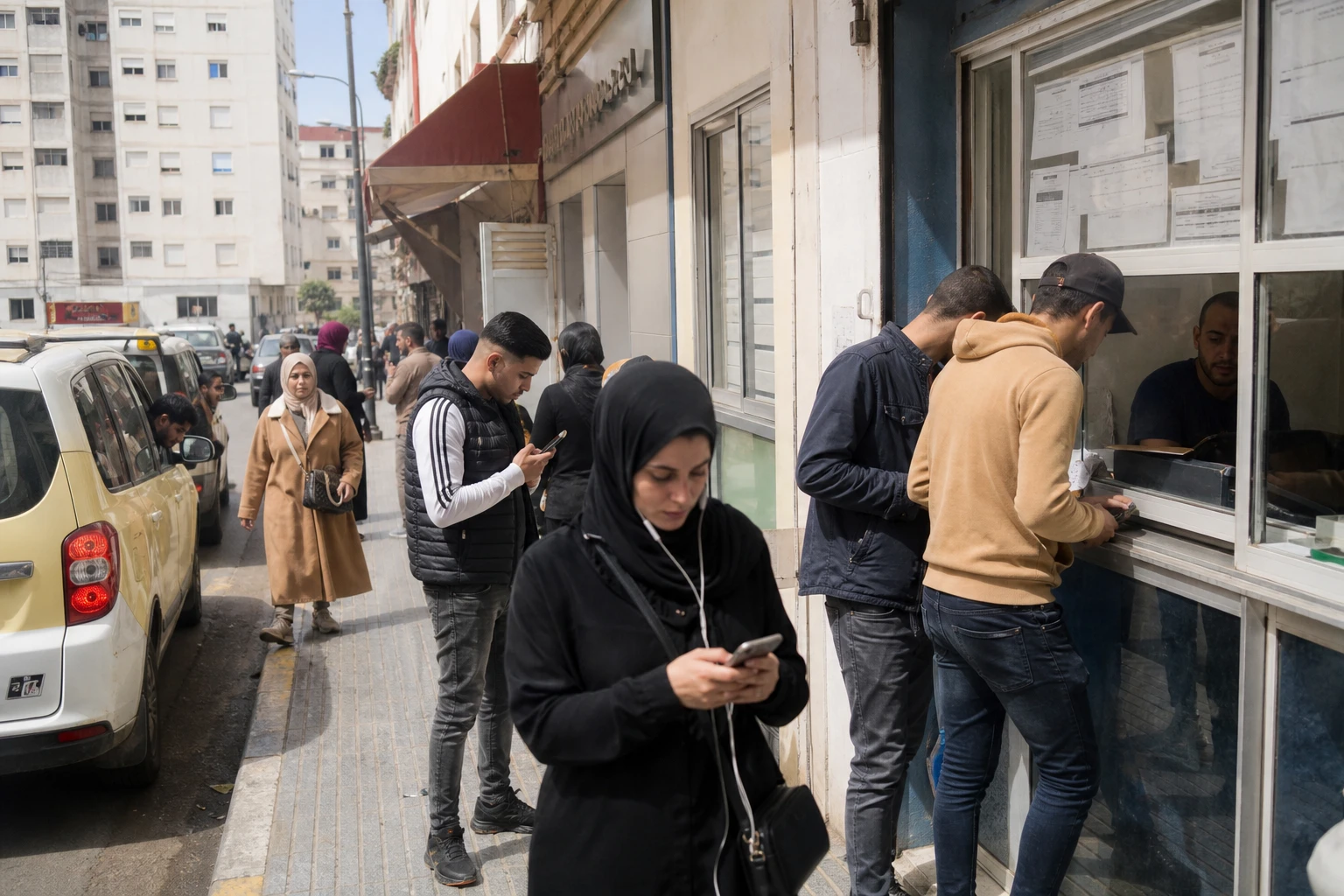
Ceuta, a flashpoint on Morocco’s northern border
In Fnideq and Ceuta alike, the border does more than divide two territories. It also shapes daily life, local economies and relations between Rabat and Madrid. When crossings become tense, families, traders, young people without stable jobs and authorities on both sides bear the impact.
Ceuta is a Spanish enclave on Morocco’s northern coast. Its position is shaped by geography, but also by political decisions taken in Rabat, Madrid and Brussels. For years, this stretch of coastline has been a focal point for migration, trade and diplomatic tensions that far exceed its size.
The migration surge in late July 2026 brought this into sharp focus. Thousands of people, most of them from northern Morocco, tried to reach Ceuta by swimming or through the Tarajal crossing, after online rumours suggested that passage would be easier. Spanish authorities described a massive influx, while several media outlets confirmed the scale of the pressure on local services. At the same time, several sources said that most of those who arrived had subsequently been taken into care or turned back.
This is not a new phenomenon. In May 2021, Ceuta had already seen the sudden arrival of thousands of people from Morocco, prompting a strong political response in Spain and the European Union. The episode was a reminder of a simple fact: managing the enclave depends on close co-operation between the two neighbours, particularly on controlling flows, returns and the fight against smuggling networks.
A border shaping politics, the economy and the balance of power
For Morocco, Ceuta is no marginal issue. The city directly borders the Tangier-Tetouan-Al Hoceima region, one of the areas most exposed to cross-border movement. It also affects the image of a Morocco that wants to present itself as a logistics, industrial and commercial hub between Africa and Europe.
In recent years, the kingdom has also strengthened the formal organisation of its operations in the north. Operation Marhaba 2026, launched by the Mohammed V Foundation for Solidarity, mobilised sites at several ports, airports and border crossings, including Bab Sebta. The initiative serves Moroccans living abroad, but it also shows that the northern border is now viewed as an area to be managed, not merely a line of control.
On the economic front, the gradual closure of informal trading routes has profoundly changed the north of the country. Small-scale trade, daily cross-border trips and smuggling long provided a livelihood for some people in the Fnideq, Tetouan and Tangier area. Their decline has eroded a longstanding source of income, without formal employment fully absorbing the available workforce. This is where some of the social fragility seen during border crises takes root.
Ceuta is therefore a barometer. When tensions rise, the pressure first falls on Moroccan border towns, the families of young migrants and Spanish reception services. It then spreads to Madrid, where migration fuels domestic political debate, and on to Brussels, where the enclave is a reminder that Spain’s border is also a European border.
Morocco faces a twofold challenge. On the one hand, it must preserve useful security co-operation with Spain and maintain its image as a reliable partner. On the other, it must address a wider social reality: youth unemployment, a still-powerful informal economy and high expectations around the development of the north. Ceuta is therefore not merely a question of sovereignty or border policing. It is also a mirror reflecting social and territorial imbalances.
What to watch next
What happens next will depend on three factors. First, whether Rabat and Madrid maintain an operational channel for co-operation. Second, the ability of Moroccan authorities to contain networks exploiting crossings. Finally, the response of the European Union, which sees Ceuta as an outpost of its Mediterranean migration policy.
Ultimately, the episode is a reminder across Africa that coastal borders are never just lines on a map. They are spaces for movement, work and negotiation, and sometimes pressure. Ceuta brings all of this together. That is why every crisis affecting it quickly goes beyond the Spanish-Moroccan context alone.



