Algeria
 Egypt
 Libya
 Morocco
 Sudan
 Tunisia
 Benin
 Burkina Faso
 Cabo Verde
 Côte d'Ivoire
 Ghana
 Guinea
 Guinea-Bissau
 Liberia
 Mali
 Mauritania
 Niger
 Nigeria
 Senegal
 Sierra Leone
 The Gambia
 Togo
 Cameroon
 Central African Republic
 Chad
 DR Congo
 Equatorial Guinea
 Gabon
 Republic of the Congo
 São Tomé and Príncipe
 Burundi
 Comoros
 Djibouti
 Eritrea
 Ethiopia
 Kenya
 Madagascar
 Malawi
 Mauritius
 Mozambique
 Seychelles
 Somalia
 South Sudan
 Tanzania
 Uganda
 Angola
 Botswana
 Eswatini
 Lesotho
 Namibia
 South Africa
 Zambia
 Zimbabwe
Kigali at the centre of a new migration equation
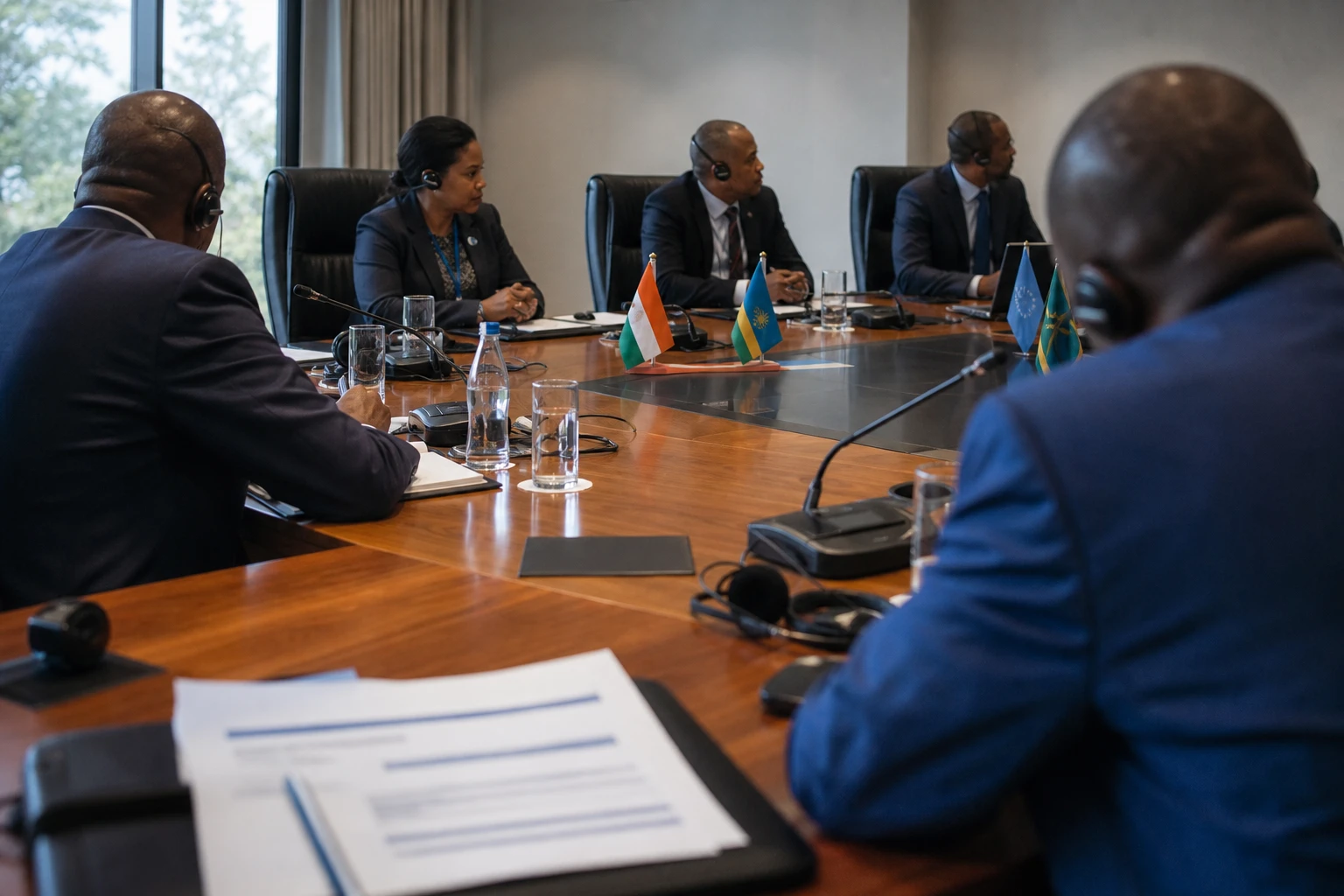
In European migration negotiations, Rwanda often reappears as a transit country, a testing ground or a symbol. For Kigali, the stakes are not merely diplomatic. They also concern its ability to turn sensitive cooperation into a source of influence, while avoiding being confined to the role of a destination for cases Europe wants to move away from its borders.
The talks with Italy are part of a broader sequence. For several months, a number of European capitals have been seeking formulas for “return hubs” — centres set up outside the European Union to handle certain cases involving people whose claims have been rejected or who are in an irregular situation. The European Commission and the Council of the EU have, in parallel, made progress on a reform of returns. But the debate remains politically charged, as it brings together the right to asylum, border controls and international responsibility.
Rwanda is not entering this debate on uncharted ground. Since September 2019, the country has hosted the Gashora emergency transit mechanism, near Bugesera, set up with the UNHCR and the African Union for people evacuated from Libya. The scheme, also funded with European support, is now a point of reference in discussions about outsourcing certain migration procedures. Kigali therefore already has the institutional experience sought by several European governments.
There is also another major precedent. Rwanda signed a migration partnership with the United Kingdom, which London ultimately abandoned in 2024. That history still weighs on public debate in Europe, as it exposed the legal, political and budgetary limits of such arrangements. Italy, for its part, has advocated a tougher line on returns and offshore centres for more than a year, at a time when migration pressure remains a central issue in its domestic politics.
What Kigali has confirmed, and what remains open
On Thursday 6 August, Rwandan government spokesperson Yolande Makolo confirmed on national radio that discussions were under way with Italy. She said the talks covered Kigali’s experience, the time taken to examine asylum cases and arrangements for departures to other countries. In other words, no agreement has yet been reached; the proposal is being assessed for its political and administrative feasibility.
For Italy, the idea is part of a broader move to toughen European return policies. Rome has promoted the idea in Brussels of offshore migration centres outside the Schengen area. Its supporters make a simple argument: process cases more quickly and move people whose claims have been rejected away from European centres. Critics, however, point out that transferring procedures to a third country neither addresses the causes of migration nor shortens proceedings or removes legal risks.
At its core, Kigali is drawing on a reputation carefully built through hosting refugees and temporarily accommodating people evacuated from crisis zones. Rwanda has already presented itself as a partner capable of managing complex schemes alongside international institutions. But this stance also comes at a symbolic cost. The more Rwanda becomes an alternative solution in European debates, the more it must ensure that its reception policy is not seen solely through the lens of European migration control.
The sensitive issue is the boundary between cooperation and subcontracting. A transit centre is more than simple accommodation. It entails access to legal rights, legal assistance, procedural safeguards and oversight of reception conditions. In July, the Council of Europe also stressed that these “return hubs” must strictly comply with international human rights law. This is precisely where the credibility of any potential Italian-Rwandan agreement will be at stake.
What is at stake for Rwanda, Italy and the continent
For Rwanda, the stakes are twofold. On the one hand, migration cooperation could strengthen its position in international discussions, in Brussels as well as in African forums. On the other, it exposes Kigali to recurring criticism over the country’s actual role in these arrangements: a sovereign partner or a tool of adjustment in a European deterrence policy. This tension is political, but also practical, as it affects reception capacity, public resources and the country’s international image.
For Italy, the calculation is as much domestic as European. The government is seeking visible results on returns and on controlling irregular arrivals. But recent experience shows that offshore schemes are slow to set up, challenged in court and vulnerable to changes of government. The British case proved this. Rome continues to defend the Albanian model as a test case, even as criticism of its effectiveness remains widespread.
Across Africa, this issue goes beyond Rwanda alone. Several countries on the continent are regularly mentioned in European discussions about returns and offshore centres, from Uganda to Ghana, sometimes in bilateral arrangements and sometimes in broader projects linked to the European Union. This raises a fundamental question: how can countries cooperate on mobility without reducing Africa to a place where the Global North offloads its migration policies? The question also concerns the African Union, the EAC and states seeking to retain control over their sovereign priorities on human mobility.
What happens next will depend on the two capitals’ ability to turn general discussions into a precise legal framework. Three points will then need scrutiny: the status of the people concerned, the role of international institutions such as the UNHCR, and the actual duration of proceedings. Without these safeguards, an agreement of this kind risks becoming a mere symbol of toughness. With them, it would belong to a more consequential category: precedents that reshape how asylum and returns are handled in Europe and East Africa alike.