
 Algeria
 Egypt
 Libya
 Sudan
 Tunisia
 Benin
 Burkina Faso
 Cabo Verde
 Côte d'Ivoire
 Ghana
 Guinea
 Guinea-Bissau
 Liberia
 Mali
 Mauritania
 Niger
 Nigeria
 Senegal
 Sierra Leone
 The Gambia
 Togo
 Cameroon
 Central African Republic
 Chad
 DR Congo
 Equatorial Guinea
 Gabon
 Republic of the Congo
 São Tomé and Príncipe
 Burundi
 Comoros
 Djibouti
 Eritrea
 Ethiopia
 Kenya
 Madagascar
 Malawi
 Mauritius
 Mozambique
 Rwanda
 Seychelles
 Somalia
 South Sudan
 Tanzania
 Uganda
 Angola
 Botswana
 Eswatini
 Lesotho
 Namibia
 South Africa
 Zambia
 Zimbabwe
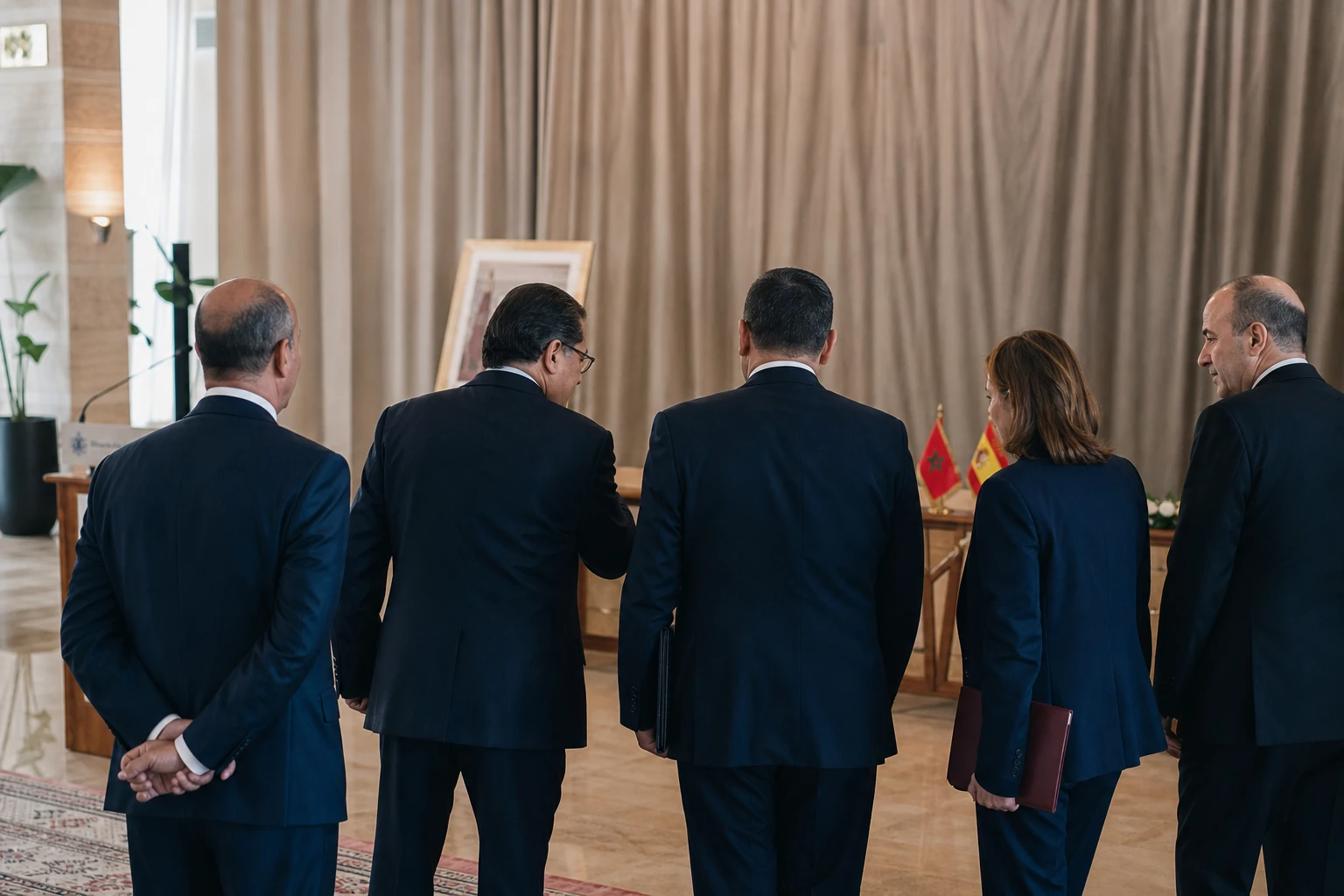
In Madrid, a colonial question returns through the paperwork
In today’s Spain, the Western Sahara question is no longer confined to diplomatic circles. It is also playing out at administrative counters, in Parliament and in the everyday lives of thousands of Sahrawi families living between Algeria, Spain and the diaspora. The debate over Spanish nationality is bringing to the fore a history of abrupt departure, suspended rights and responsibilities still disputed 50 years later.
This episode is unfolding against a backdrop of strained relations between Madrid and Rabat. In 2022, Spain described Morocco’s autonomy plan as the « most serious, realistic and credible basis » for Western Sahara, marking a major shift in its diplomacy. Since then, every sensitive issue — migration, security, the enclaves of Ceuta and Melilla, police cooperation — has reminded Madrid of the weight of its Moroccan neighbour.
A Sahrawi MP at the heart of a longstanding dispute
The name of Teslem Andala Ubbi, known as Tesh Sidi, has come to the fore in this debate. Born on 30 May 1994, she was elected in Madrid under the Sumar banner and is a computer engineer, having studied at the University of Alicante and then in Madrid, according to the Congress’s official profile. She is also the first Sahrawi woman to sit in Spain’s Congress of Deputies.
Her story says much about the Sahrawi situation. The United Nations still lists Western Sahara as a non-self-governing territory and notes that Spain informed the UN on 26 February 1976 that it was ending its presence in the territory. In other words, the question of decolonisation has never been fully settled.
For Tesh Sidi, this is not just a matter of memory. It is also a question of status. Sahrawis born under Spanish administration have long lived in a legal grey area. Their situation has led to years of statelessness, incomplete travel documents and interminable administrative procedures.
Bill advances, but Madrid still treads carefully with Rabat
On 23 July 2026, the Congress’s Justice Committee approved Sumar’s bill on Spanish nationality for Sahrawis. The text was adopted by 19 votes to three, with 15 abstentions, ahead of consideration in plenary and then in the Senate. The Spanish Parliament has therefore cleared a hurdle, without closing the matter.
The proposed mechanism is precise. The bill applies to Sahrawis born when the territory was administered by Spain, as well as some of their descendants. To prove eligibility, applicants could submit old Spanish documents, extracts from the UN census linked to the referendum that was never held, or various civil records issued at the time. The text aims to remedy the effects of a longstanding legal vacuum, not to create an abstract privilege.
The debate has also revealed the Spanish majority’s caution. According to the Spanish press, attempts were made to replace the expression « Sahrawi people » with more neutral wording, to avoid giving the text a political interpretation. This is where diplomacy meets the law: referring to a people, or simply to a population, does not mean the same thing in a sovereignty dispute.
This restraint is linked to Rabat. Morocco remains a key partner for Madrid on security, the fight against migrant-smuggling networks and migration control. But the episodes in Ceuta have shown how fragile this balance is. In May 2021, Reuters had already reported the arrival of thousands of people in Ceuta after diplomatic tensions between the two countries, while Spanish officials at the time spoke of « blackmail ».
Migration, power politics and Africa-wide implications
The Sahrawi issue therefore goes far beyond the question of nationality. It touches on the balance of power between a former colonial power, a regional power such as Morocco, and a population dispersed among refugee camps, Spain and the diaspora. It also involves the European Union, which outsources part of its border control to Morocco while saying little about the political cost of this dependence.
For Morocco, Western Sahara remains a central sovereignty issue. For Spain, the challenge is to avoid another bilateral crisis while addressing a historical debt. For Sahrawis, the bill under discussion could open up a practical administrative route, without in itself repairing exile, family fragmentation or the absence of a self-determination referendum.
This is where Tesh Sidi occupies a distinctive position. She is not speaking only on behalf of a wounded memory. She is using the tools of the Spanish Parliament to force political clarity. In this respect, her struggle goes beyond Spain. It is a reminder that in North Africa, colonial legacies continue to shape diplomacy, borders, civil status and relations between states.
What happens next will depend on the parliamentary stages still to come in Madrid. The bill must still be debated in plenary and then sent to the Senate. Meanwhile, relations between Rabat and Madrid will remain under close scrutiny, as every advance on Western Sahara can still affect migration and security cooperation.
In a political landscape often reduced to diplomatic posturing, this case serves as a simple reminder: the words of a law can reopen a history that states would have preferred to leave in the shadows. And when that history concerns Western Sahara, it involves Madrid, Rabat and the whole of the North African neighbourhood.



