Algeria
 Egypt
 Libya
 Morocco
 Sudan
 Tunisia
 Benin
 Burkina Faso
 Cabo Verde
 Côte d'Ivoire
 Ghana
 Guinea
 Guinea-Bissau
 Liberia
 Mali
 Mauritania
 Niger
 Nigeria
 Senegal
 Sierra Leone
 The Gambia
 Togo
 Cameroon
 Central African Republic
 Chad
 DR Congo
 Equatorial Guinea
 Gabon
 Republic of the Congo
 São Tomé and Príncipe
 Burundi
 Comoros
 Djibouti
 Eritrea
 Ethiopia
 Kenya
 Madagascar
 Malawi
 Mauritius
 Mozambique
 Rwanda
 Seychelles
 Somalia
 South Sudan
 Tanzania
 Uganda
 Angola
 Botswana
 Eswatini
 Lesotho
 Namibia
 Zambia
 Zimbabwe
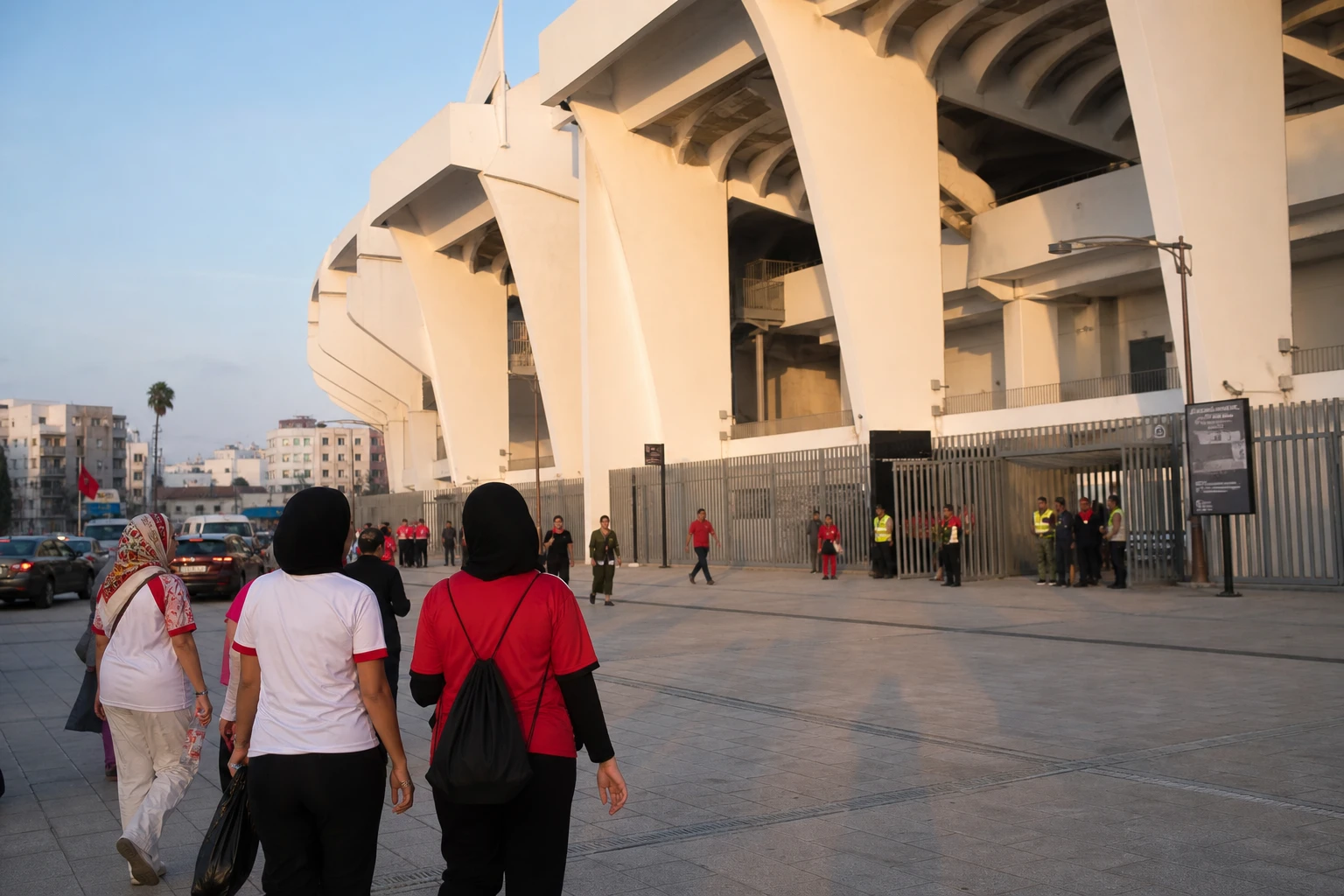
Group still wide open before the final turn
In Casablanca, African women’s football often offers what calculations cannot: tension, surprises and a hierarchy that wavers at just the right moment. In Group B of the 2026 Women’s Africa Cup of Nations, no one has packed their bags yet. All four teams still have a door ajar to the quarter-finals, on the eve of an evening that could reshuffle everything.
This final round of group matches is being played in Morocco, hosts of an edition scheduled from 26 July to 16 August 2026. The finals bring together 16 teams split into four groups, and Group B is one of the tightest. The CAF has scheduled two fixtures for 4 August: Burkina Faso-South Africa at Moulay Rachid Stadium, and Tanzania-Côte d’Ivoire at Larbi Zaouli Stadium, both in Casablanca.
The setting matters. Beyond the sporting result alone, this matchday gauges the depth of women’s football in four countries at different stages of development. It pits the defending champions against a team returning to the competition after a long absence, a rising East African side and Burkina Faso, still looking to turn promise into consistency.
Casablanca, the stage for a four-way battle
The CAF’s official schedule leaves little room for interpretation. On 4 August, both Group B matches will be played simultaneously, at 21:00 local time in Casablanca, at the Moulay Rachid and Larbi Zaouli grounds. The format is clear: at this stage, every point can count double, affecting both the final standings and the subsequent quarter-final pairings.
Côte d’Ivoire have returned to the tournament after a 12-year absence, giving their presence particular significance. The Elephants’ return to the finals says something about the rebuilding work undertaken around the team. South Africa, meanwhile, arrive with a heavier burden of expectation: Banyana Banyana remain the continent’s benchmark, backed by their continental title and a recent cycle in which the team has confirmed its place among Africa’s leading sides.
Tanzania, for their part, are moving forward with the energy of a team on the rise. The Tanzanian federation prepared for the competition with training camps, friendly matches and a streamlined coaching setup, a sign of gradual development. Burkina Faso, meanwhile, are making their second appearance at this level after returning to the 2026 Women’s AFCON. For the Étalons Dames, every match in these finals is a demonstration of continuity, not just a flash of brilliance.
What each team is really playing for
Burkina Faso have already reached one turning point: their first victory in the Women’s AFCON finals, secured against Tanzania according to the course of the tournament. The challenge now is to show that this first success will not be a one-off. A win against South Africa would open the way to the quarter-finals and could even secure top spot in the group, depending on the other result. In a country where women’s football is still seeking greater visibility, this kind of performance carries as much weight in people’s minds as it does in the technical assessments.
South Africa are playing for reputation as much as qualification. The team are used to making their mark at major tournaments, and their coaching staff have never hidden their ambition to stay at the top. But the group stage has eroded their safety margin. If the South Africans want to extend their campaign, they must win. A draw is no longer enough to keep their fate in their own hands. For the defending champions, this kind of evening reveals less about the quality of a squad than its ability to hold firm under pressure.
Tanzania face Côte d’Ivoire with an even greater ambition: to make history. The Twiga Stars have never reached the Women’s AFCON quarter-finals. Their victory over South Africa changed their standing in the group and gave them unexpected influence. But they must contend with a significant absence: Hasnath Ubamba is suspended after being sent off against Burkina Faso, forcing the coaching staff to rethink their attacking setup.
Côte d’Ivoire, by contrast, go into the match with stronger arguments than they had at the outset. The Elephants made a convincing start to the competition, followed by a useful draw against South Africa. Their return to the tournament after 12 years of waiting comes with a simple objective: turn progress into qualification. A win would be enough to secure a place in the quarter-finals. A draw could also suffice, but only if Burkina Faso do not win the other match.
An evening of calculations, but also of trajectories
Group B is about much more than arithmetic. It also tells the story of the geography of African women’s football. Southern Africa, represented by South Africa, remains a point of reference. West Africa is seeking to strengthen its emerging generation through Côte d’Ivoire and Burkina Faso. East Africa, led by Tanzania, continues to expand its competitive footprint. Host nation Morocco provides a shared stage for these uneven but very real advances.
The tournament also shows a simple reality: in women’s football, consistency now matters as much as prestige. Teams that organise their preparation, hold more training camps and play more international matches gain an advantage. Federations that invest in continuity often reap more than a good performance. They build cycles. That is precisely what can be seen here, to varying degrees, in Tanzania, Burkina Faso, Côte d’Ivoire and South Africa.
The immediate next steps will therefore play out in Casablanca, in a very short timeframe and with no safety net. The quarter-finals begin as early as 8 August, leaving little time to recover from a misstep. For the Group B teams, the evening of 4 August will not just determine who continues in the tournament. It will also show which team has best turned its preparation, ambitions and playing identity into a tangible result.