Algeria
 Egypt
 Libya
 Morocco
 Sudan
 Tunisia
 Benin
 Burkina Faso
 Cabo Verde
 Ghana
 Guinea
 Guinea-Bissau
 Liberia
 Mali
 Mauritania
 Niger
 Nigeria
 Senegal
 Sierra Leone
 The Gambia
 Togo
 Cameroon
 Central African Republic
 Chad
 DR Congo
 Equatorial Guinea
 Gabon
 Republic of the Congo
 São Tomé and Príncipe
 Burundi
 Comoros
 Djibouti
 Eritrea
 Ethiopia
 Kenya
 Madagascar
 Malawi
 Mauritius
 Mozambique
 Rwanda
 Seychelles
 Somalia
 South Sudan
 Tanzania
 Uganda
 Angola
 Botswana
 Eswatini
 Lesotho
 Namibia
 South Africa
 Zambia
 Zimbabwe
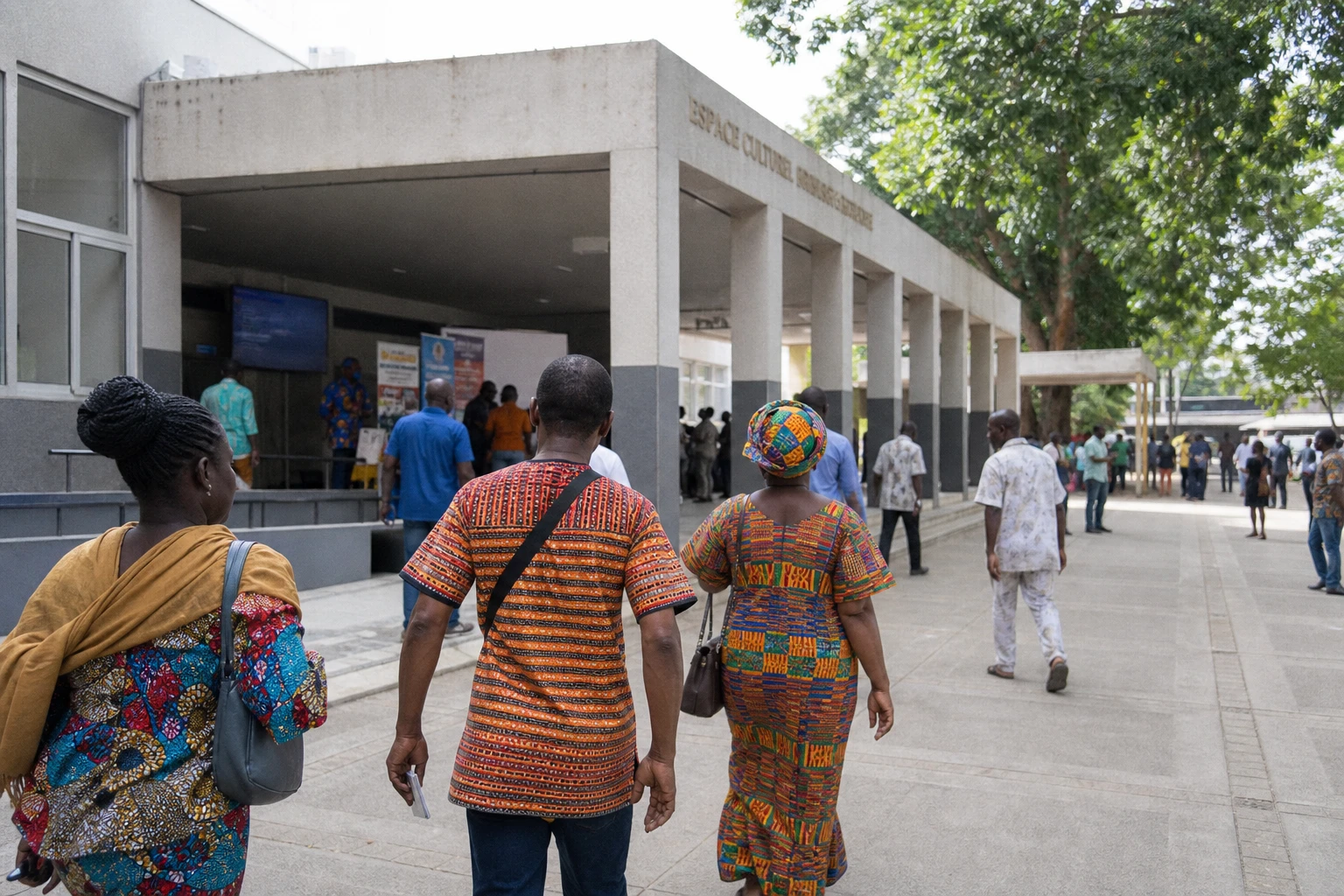
In Blokoss, a festival shows how a community passes on its heritage
In a city expanding rapidly, rituals that sustain collective memory take on particular significance. In Blokoss, Abidjan, the Generation Festival recalls that, among the Atchan, age is not merely a civil status: it is also a social order, a responsibility and a way of passing on the baton.
This ceremony is not decorative folklore. It is part of an ancient system of age groups, also known as a generation festival or Fatchué, in which successive cohorts take on specific roles in village life. Ivorian technical documents describe this form of organisation as a mechanism for managing power, community life and village affairs, based on alternation between generations.
Atchan heritage at the heart of Abidjan, between continuity and urban pressure
Côte d’Ivoire’s political capital is Yamoussoukro, while Abidjan remains its economic capital and de facto main administrative centre. It is in this rapidly densifying Greater Abidjan that Atchan villages must preserve their cultural landmarks, often caught between urban expansion, contested land and demographic change.
The Atchan people, also known as Ébrié, hold a strong symbolic place in the history of the lagoon and Abidjan. The texts consulted recall that their organisation is based on generations succeeding one another according to codified rules. This system of transmission is not confined to ceremonies. It also shapes speech, chieftaincy, solidarity and the way social change is accommodated.
This significance has been brought into focus in recent years by the return of the Djidji Ayokwè talking drum, a cultural symbol of the Atchan people, which Ivorian authorities announced as a major heritage repatriation after more than a century away. The move reinforced the idea that culture is not a peripheral issue in Côte d’Ivoire: it touches on symbolic sovereignty, memory and transmission.
What the Generation Festival represents
In Blokoss, the Generation Festival stages the passing of the baton between age groups. Participants are not simply celebrating a periodic return to tradition. They are affirming a collective order in which each generation has a time to learn, serve, lead and then make way. In several accounts of the festival among the Atchan, this sequence marks a generation’s initiatory maturity and its capacity to take part in community governance.
This framework gives a different meaning to a festival often viewed from outside as a simple heritage display. In reality, it plays a role in social regulation. It reminds younger people that they will enter a cycle of obligations. It also reminds elders that continuity depends on clear, comprehensible and accepted transmission. In an urban environment, this message carries considerable weight. The more the city expands, the more the community must explain its codes to prevent them from being diluted.
Abidjan is a telling case. Rapid urbanisation is putting pressure on historic villages, customary lands and places of memory. New patterns of mobility, the arrival of people from other regions of the country and the ECOWAS area, as well as infrastructure needs, are making coexistence more complex. In this context, generation festivals also serve as an anchor. They say who is here, who is passing on the heritage, and under what rules the community wants to continue to exist.
A local issue with regional and pan-African significance
The Generation Festival extends beyond the village setting. Across West Africa, many societies have retained systems of age groups, confraternities, chieftaincies or initiation cycles that organise the transfer of responsibilities. The Atchan example shows that a tradition can survive in a city without becoming a fixed artefact. It can remain useful, provided it is recognised as a living social institution.
This reality is also relevant to public policy. Côte d’Ivoire has recently shown, through several official acts, that it continues to treat cultural heritage as a matter for the state. The return of the Djidji Ayokwè, the involvement of public figures in heritage issues and the role given to chieftaincies in some consultation forums point in the same direction: culture is not only a matter of memory, but also of social cohesion and land-use planning.
The stakes for the region are clear. In West Africa’s major capitals, urban communities need points of reference that are neither folklorised nor reduced to picture postcards. The Blokoss Generation Festival shows that tradition can help organise a city, not merely adorn it. It also demonstrates that, amid major demographic shifts, cultural transmission remains a tool for social stability. This kind of ceremony therefore deserves to be understood as a social phenomenon in its own right, not simply as a local event.