
 Algeria
 Egypt
 Libya
 Morocco
 Sudan
 Tunisia
 Benin
 Burkina Faso
 Cabo Verde
 Côte d'Ivoire
 Ghana
 Guinea
 Guinea-Bissau
 Liberia
 Mali
 Mauritania
 Niger
 Nigeria
 Senegal
 Sierra Leone
 The Gambia
 Togo
 Cameroon
 Central African Republic
 Chad
 Equatorial Guinea
 Gabon
 Republic of the Congo
 São Tomé and Príncipe
 Burundi
 Comoros
 Djibouti
 Eritrea
 Ethiopia
 Kenya
 Madagascar
 Malawi
 Mauritius
 Mozambique
 Rwanda
 Seychelles
 Somalia
 South Sudan
 Tanzania
 Uganda
 Angola
 Botswana
 Eswatini
 Lesotho
 Namibia
 South Africa
 Zambia
 Zimbabwe
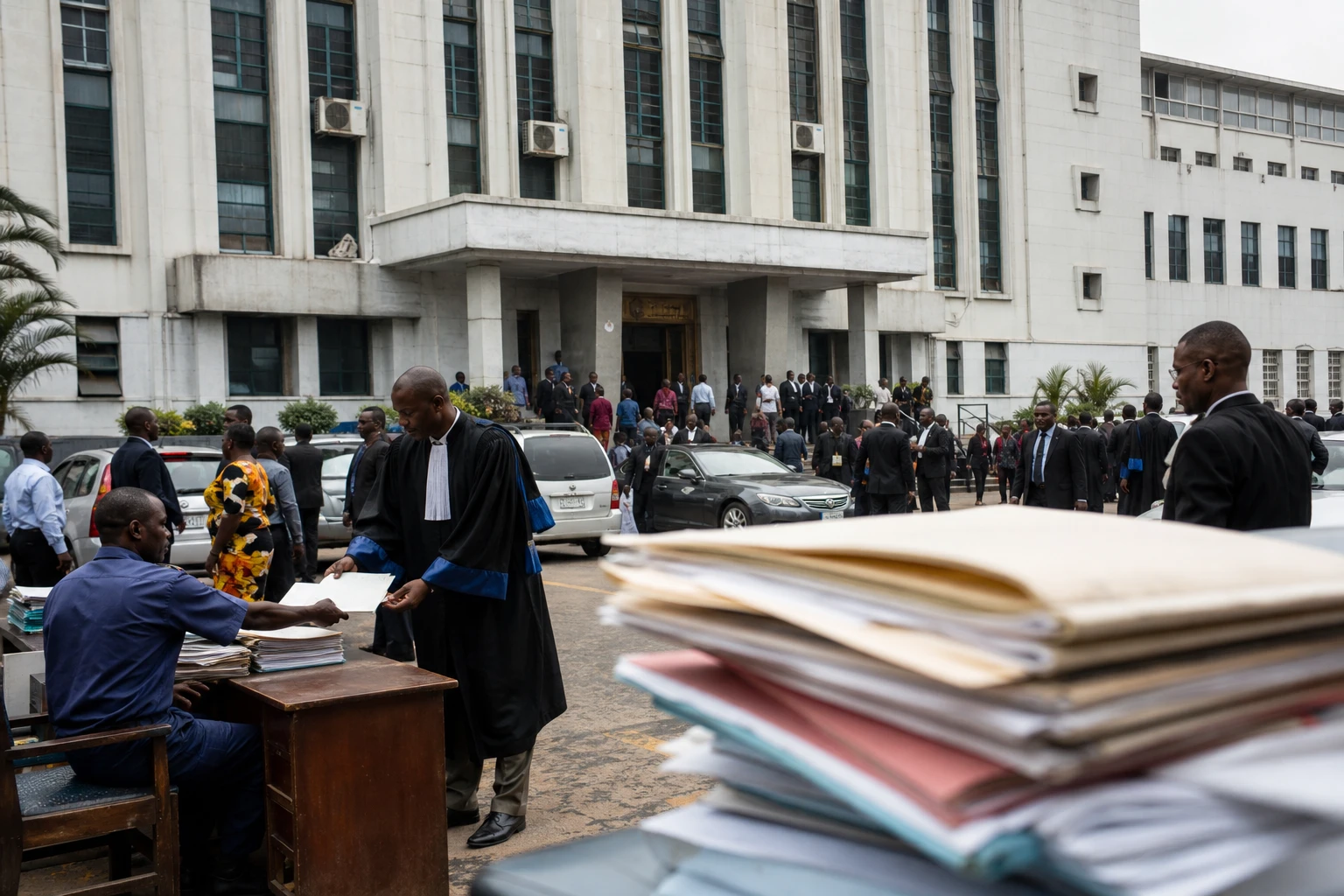
In Kinshasa, a victims’ reparations case has become a test of credibility for Congolese justice
In the Democratic Republic of the Congo, funds intended for victims are about more than public accounting. They also concern memory, reparations and trust in the state. When a former justice minister appears before the Court of Cassation, the entire chain of responsibility comes under scrutiny.
The case is part of a broader context: DR Congo has established reparations mechanisms for victims of mass violence and illicit activities linked to war, including FRIVAO, created to compensate Congolese people affected by abuses committed in the east of the country. FONAREV, another public instrument for restorative justice, likewise reflects the view that reparations are a national process, not simply a budget line.
What the justice system accuses Constant Mutamba of
On 27 July 2026, Constant Mutamba left a hearing before the Court of Cassation in Kinshasa, denouncing procedural irregularities and a violation of his rights. He therefore did not take part in the remainder of the proceedings in a case concerning the alleged embezzlement of funds linked to compensation for victims of Uganda’s illicit activities in DR Congo.
The allegations concern disbursements said to have been irregularly made in the management of these resources. The amounts cited in the proceedings include $14.299 million intended for the rehabilitation of the Tshopo hydroelectric power station, $4 million paid to the Congolese Institute for Nature Conservation, $200,000 for the Tshopo Provincial Assembly, $1.024 million for Divo SARL and $715,864 for Tropic Architecture. These figures were cited in Congolese coverage of the court case.
The trial opened on 13 July 2026 and was adjourned until 27 July to allow the parties to prepare their arguments. Several Congolese media outlets subsequently confirmed that the case had resumed before the high court, with the central question being how funds intended for victims had been used.
The prosecution’s submissions and closing arguments were due to follow the hearing. According to accounts carried by the local press, the former minister faces up to 20 years in prison. A separate previous case involving another corruption matter had already led to a distinct conviction in 2025, with a sentence of three years’ hard labour, according to the Associated Press. The two proceedings, however, concern different facts and must be distinguished.
FRIVAO, war reparations and the battle for transparency
The case centres on FRIVAO, the Fund for the Reparations and Indemnification of Victims of Uganda’s Illicit Activities in DR Congo. The mechanism was created to manage reparations owed to Congolese people who fell victim to crimes linked to the period of conflict in the east of the country. Its legal framework is set out in the Congolese Official Gazette, which governs the fund and its reparations mission.
In mid-2026, several Congolese officials publicly stressed the need to put the fund’s management in order. The justice minister spoke of an essential overhaul, while the Congolese press reported figures indicating that only $28 million of the $195 million intended for victims had actually been paid out, according to a statement made in the Senate in May 2026. This gap between the sums raised and the amounts actually paid is fuelling suspicions about the mechanism’s governance.
The debate is sensitive because it goes beyond Constant Mutamba himself. In DR Congo, reparations funds sit at the intersection of transitional justice, the fight against impunity and institutional reconstruction. FONAREV, for its part, is also carrying out victim-identification operations and expanding its presence across the country, showing that reparations are not an abstract concept but an administrative, judicial and social undertaking.
For victims, the stakes go beyond political controversy
In Kinshasa as in Kisangani, the FRIVAO case is a reminder of a simple reality: when a fund intended for victims is contested, it is the beneficiaries who first pay the price of delays, suspensions and doubts. Victims are waiting for compensation, but also for a clear, traceable and credible process. Without this, reparations risk becoming a promise stalled in administrative channels.
For the former minister, the stakes are judicial and political. For the state apparatus, they are institutional. And for the public, they are symbolic: if the mechanisms meant to repair past crimes themselves become suspect, trust in justice erodes further. This is particularly sensitive in DR Congo, where calls for accountability span both the fight against corruption and cases related to armed violence in the east.
The Congolese capital is thus at the centre of a delicate balance between criminal justice, victims’ reparations and the stability of public administration. The Court of Cassation, the country’s highest court in criminal matters, must rule on the law in a case being closely watched by judges, victims, civil society groups and international partners. The message it sends will matter as much as the verdict itself.
A Congolese case, but an African question
Beyond DR Congo, this case speaks to several African countries facing the same challenge: turning reparations promised after conflict or mass violations into concrete, accountable and credible mechanisms. The question is not only how to punish individual wrongdoing. It is also how states protect sensitive funds, monitor disbursements and give victims a meaningful role in public governance.
In the Great Lakes region, where the effects of war remain visible in the eastern provinces, this kind of case has implications well beyond Kinshasa. It concerns DR Congo’s ability to show that a reparations mechanism can function without being captured by private, administrative or political interests. What happens next will depend on the work of the Court of Cassation, but also on how the Congolese state strengthens its tools for restorative justice.



