Algeria
 Egypt
 Libya
 Morocco
 Sudan
 Tunisia
 Benin
 Burkina Faso
 Cabo Verde
 Côte d'Ivoire
 Ghana
 Guinea
 Guinea-Bissau
 Liberia
 Mali
 Mauritania
 Niger
 Nigeria
 Senegal
 Sierra Leone
 The Gambia
 Togo
 Cameroon
 Central African Republic
 Chad
 DR Congo
 Equatorial Guinea
 Gabon
 Republic of the Congo
 São Tomé and Príncipe
 Burundi
 Comoros
 Djibouti
 Eritrea
 Ethiopia
 Kenya
 Madagascar
 Malawi
 Mauritius
 Rwanda
 Seychelles
 Somalia
 South Sudan
 Tanzania
 Uganda
 Angola
 Botswana
 Eswatini
 Lesotho
 Namibia
 South Africa
 Zambia
 Zimbabwe
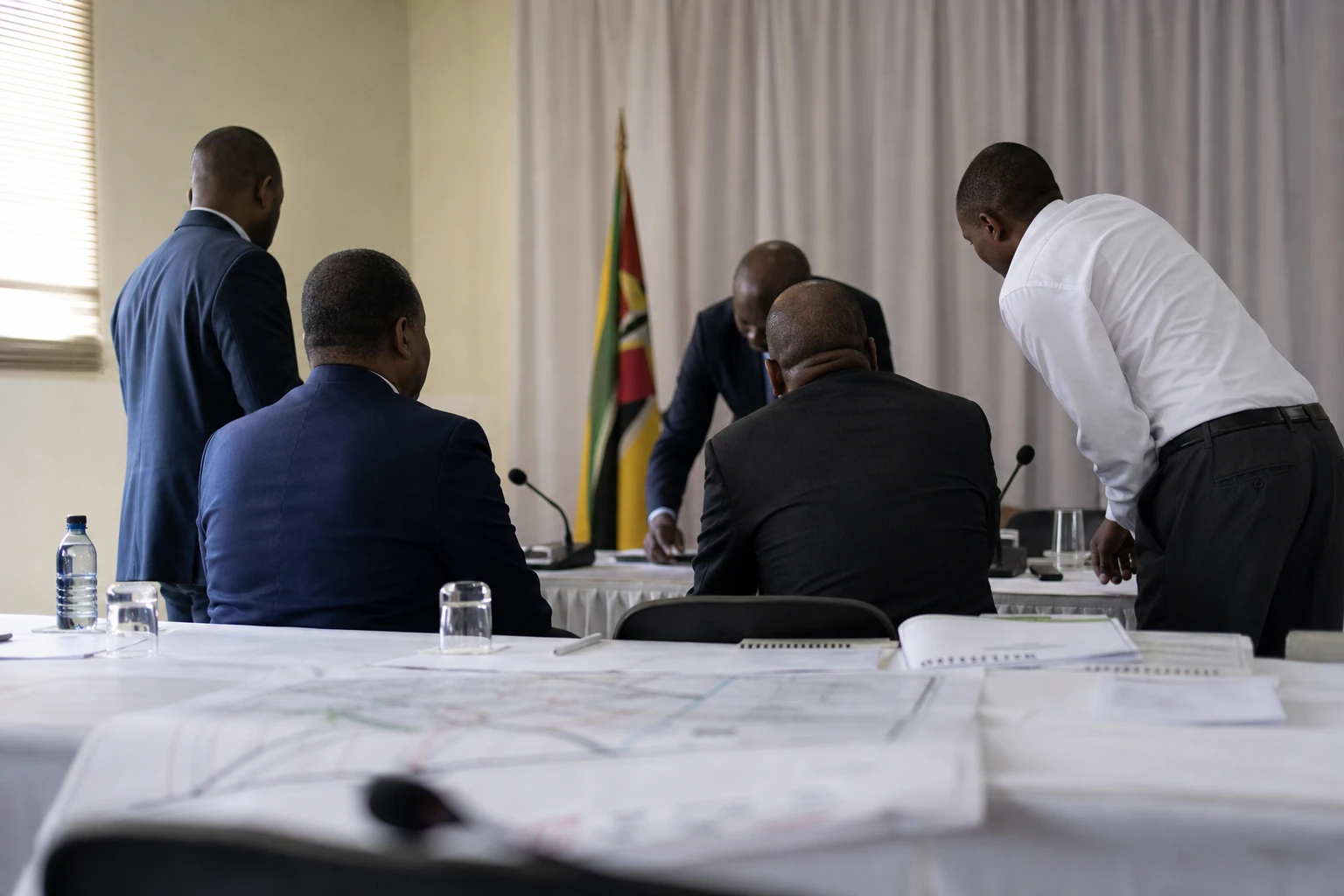
Quionga, a northern village becoming a political test
In northern Mozambique, electricity is about more than switching on lights. It also shows whether the state, businesses and communities can still build something in a province long weakened by insecurity. In Quionga, in Palma district, poles, cables and transformers now carry that promise.
The project is taking place in an area of strategic importance to Mozambique and the Southern African Development Community, SADC, which is closely monitoring the stabilisation of Cabo Delgado. The province is home both to one of the continent’s biggest gas bets and to the aftermath of an insurgency that has displaced hundreds of thousands of people since 2017. In this context, every local investment is viewed on two levels: as tangible development for residents, and as preparation for a safer environment for major industrial projects.
What ExxonMobil is funding, and what it changes on the ground
The second phase of the Quionga electrification project was launched on Wednesday 29 July, in the presence of Mozambique’s Minister of Mineral Resources and Energy, Estêvão Pale, and the governor of Cabo Delgado, Valige Tauabo, according to reports carried by local media and confirmed by state-owned utility Electricidade de Moçambique, EDM. The financing package amounts to $1.17 million. ExxonMobil is contributing $876,000, or 75% of the total, while EDM is funding the remainder.
The technical details are specific. The project provides for 25 kilometres of power lines, four 100 kVA transformers, 6 kilometres of low-voltage network and 60 public streetlights. In total, 600 families are to be connected to the national grid. The first phase, in Palma town, had already connected 500 households in several neighbourhoods, with a stated budget of $500,000.
For residents, the stakes are straightforward: more hours of service, less dependence on generators, and greater scope for shops, workshops, schools and basic services. For a local administration still marked by displacement and destruction linked to the security crisis, the arrival of a more stable network could also restart everyday activities that insecurity had made difficult.
A social investment tied to a gas megaproject still awaiting a decision
This is not an isolated gesture. ExxonMobil is the operator of the Rovuma LNG project, being developed in Area 4 of the Rovuma Basin, off the coast of Cabo Delgado, with its partners. The company says it is continuing work on the updated development plan and is targeting a final investment decision, or FID, in the third quarter of 2026, with first liquefied natural gas production targeted for 2030. The group had previously announced more broadly that it was aiming for a 2026 decision on the Mozambican project.
In the oil and gas sector, the FID is the step that formally commits an investor to launching a major project. Until it is taken, uncertainty remains. This is precisely what makes local social initiatives important: they sustain relations with communities, strengthen local acceptance and demonstrate a presence even before major industrial infrastructure arrives.
This strategy comes as Mozambique seeks to accelerate universal access to electricity by 2030. EDM has said that the country’s electrification rate rose from about 31% in 2018 to 60% in 2024, and then to 61.4% in 2025 in another public communication by the company. The World Bank, for its part, notes that the national energy programme has already connected hundreds of thousands of households and supports the goal of universal coverage. In other words, Quionga is part of a broader national policy, not merely an isolated corporate gesture.
The sensitive issue remains trust. In a province where memories of attacks, displacement and construction stoppages are still vivid, people expect visible and lasting benefits. The authorities, meanwhile, are seeking to show that Cabo Delgado is not just a resource site, but also a territory where the state can reappear through public services. Electrification therefore serves a dual purpose: social, through its immediate uses, and political, through the gradual restoration of an institutional presence.
The regional dimension: Cabo Delgado at the heart of energy balances
The regional perspective is just as important. Mozambique occupies a distinctive position in Southern Africa. It could become a major gas supplier for the region and global markets, while seeking to meet still substantial domestic energy needs. This tension between exports and local access is playing out across several resource-rich African economies today.
The resumption of the Mozambique LNG project by TotalEnergies, announced in January 2026, has renewed attention on the entire Rovuma Basin. The return of the neighbouring project reduces some industrial uncertainty, but does not eliminate security risks or debate over how the benefits are shared. In this landscape, ExxonMobil is moving cautiously, multiplying local signals without rushing the decisive step of a final investment decision.
The issue also extends beyond Cabo Delgado. At the level of SADC and the African Union, it raises questions about the ability of states to turn gas revenues into tangible services without leaving peripheral communities behind. Quionga’s electrification is not a major showpiece project. It is an indicator. In the coming months, it will show whether Mozambique can bring security, private investment and a genuine expansion of public services together.