Algeria
 Egypt
 Libya
 Sudan
 Tunisia
 Benin
 Burkina Faso
 Cabo Verde
 Côte d'Ivoire
 Ghana
 Guinea
 Guinea-Bissau
 Liberia
 Mali
 Mauritania
 Niger
 Nigeria
 Senegal
 Sierra Leone
 The Gambia
 Togo
 Cameroon
 Central African Republic
 Chad
 DR Congo
 Equatorial Guinea
 Gabon
 Republic of the Congo
 São Tomé and Príncipe
 Burundi
 Comoros
 Djibouti
 Eritrea
 Ethiopia
 Kenya
 Madagascar
 Malawi
 Mauritius
 Mozambique
 Rwanda
 Seychelles
 Somalia
 South Sudan
 Tanzania
 Uganda
 Angola
 Botswana
 Eswatini
 Lesotho
 Namibia
 South Africa
 Zambia
 Zimbabwe
A new boost for Morocco’s automotive supply chain
In the automotive industry, the battle is no longer fought on price alone. It is also about proximity, delivery speed and the ability to secure parts close to end markets. It is in this context that Morocco is attracting new industrial projects, particularly to serve Europe from North Africa.
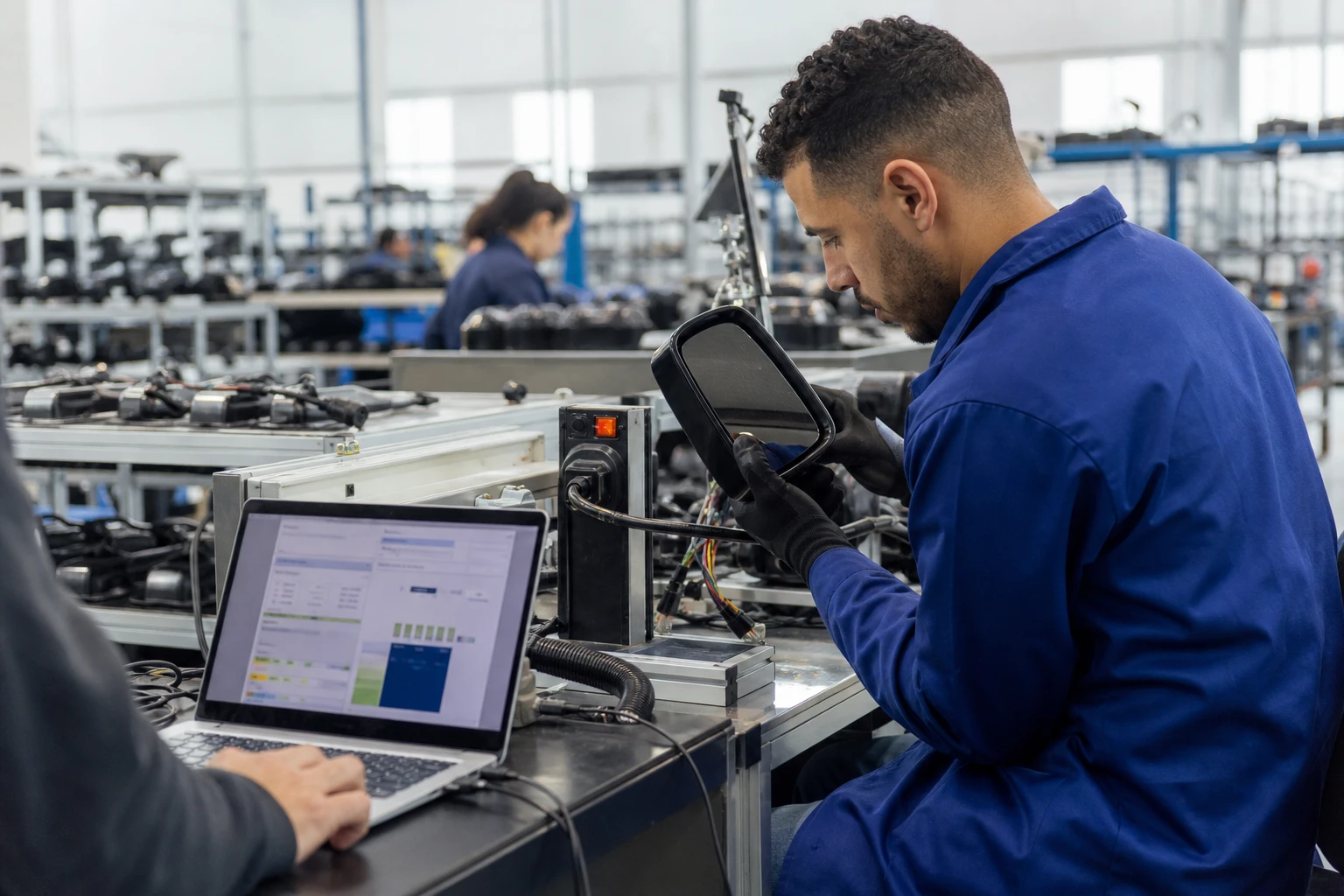
Gentex is a case in point. The US supplier wants to set up a production facility in Morocco to manufacture electrochromic rear-view mirrors and advanced electronic modules for carmakers operating in Europe. The group says it has already signed a letter of intent with the Moroccan authorities and selected a site. Production is expected to begin in 2028.
Morocco, an industrial platform between Europe and Africa
Morocco’s choice is no accident. Over more than a decade, the country has built a dense automotive ecosystem, driven by manufacturers such as Renault and Stellantis, as well as hundreds of suppliers. Morocco’s industry ministry describes the sector as one of the pillars of the national industrial strategy, with dedicated zones in Tangier, Kenitra, Casablanca, Rabat and Oujda. This network gives manufacturers seeking shorter lead times and more tightly managed logistics a tangible advantage.
This appeal is also underpinned by a solid trade framework. Morocco and the European Union have a free-trade area stemming from their association agreement, which entered into force in 2000. For suppliers, this reduces some export frictions and strengthens the case for locating production close to European supply chains. This is a decisive factor at a time when several carmakers want to shorten their supply routes and limit shocks caused by geopolitical tensions.
The latest annual report from the Foreign Exchange Office confirms the central role of the automotive industry in Morocco’s foreign trade. In 2024, sector exports rose by 6.3% to reach 157.6bn dirhams, making it the kingdom’s largest export sector for the second consecutive year. Over the same period, official statistics show that the vehicle manufacturing and wiring ecosystems drove sector growth. These figures confirm a simple fact: Morocco is no longer just an assembly site, but a structured industrial hub.
What Gentex is looking for in Rabat
Gentex is known for its automatic-dimming rear-view mirrors, as well as its in-vehicle electronics, cameras and driver-assistance systems. The group generated consolidated revenue of $2.53bn in 2025, of which $2.27bn came from its core business excluding the VOXX acquisition. In discussions with investors, its management said it had considered several locations in eastern Europe before opting for Morocco, comparing labour and social costs, geopolitical risks, inflation, customs duties, trade agreements, power reliability and public support schemes.
The message to the market is clear. Gentex wants to produce closer to its European customers to keep pace with the regionalisation of supply chains. The choice also says something about the changing balance of industrial power: suppliers are no longer setting up only where costs are lowest, but where the combination of “competitiveness and logistics” is most robust. For Morocco, this strengthens its image as a country capable of hosting higher-value production beyond traditional assembly.
For the Moroccan authorities, the benefits are twofold. First, each new investment strengthens a local network of subcontractors, technicians and industrial services. Second, it boosts the kingdom’s credibility with investors weighing up several countries in the region. At a time when industries in central and eastern Europe are also feeling the effects of trade tensions and energy uncertainty, Morocco is gaining ground through its relative stability, geographical position and external agreements.
A project with no disclosed investment sum, but already rich in lessons
Gentex has not disclosed the investment required for the plant. This is important, as the project is at this stage an industrial commitment, not yet a completed factory. But the announced timetable, with production due to begin in 2028, shows that the company is already planning for the long term. The fact that it says it has secured the backing of the Moroccan authorities suggests that the project is part of the investment-attraction policy Rabat has pursued for several years.
The announcement concerns more than Morocco’s automotive industry. It is also relevant to North Africa as a whole, where governments are seeking to attract more industrial activity linked to European supply chains. Morocco, a member of the Arab Maghreb Union, is visibly ahead in this respect. Its automotive experience, logistics framework and trade agreements are now a point of reference for the region’s other economies.
At continental level, the signal is also clear. Africa is not simply a low-cost base. It can also become a regionalised production space, capable of taking on technical, connected and export-oriented activities. This is particularly true in industries where proximity to markets matters as much as price. If the Gentex project goes ahead as announced, it will confirm a trend already established in Tangier, Kenitra and Casablanca: Morocco wants to remain an industrial gateway to Europe while strengthening its own production and innovation capabilities.