Algeria
 Egypt
 Libya
 Morocco
 Sudan
 Tunisia
 Benin
 Burkina Faso
 Cabo Verde
 Côte d'Ivoire
 Ghana
 Guinea
 Guinea-Bissau
 Liberia
 Mali
 Mauritania
 Niger
 Nigeria
 Senegal
 Sierra Leone
 The Gambia
 Togo
 Cameroon
 Chad
 DR Congo
 Equatorial Guinea
 Gabon
 Republic of the Congo
 São Tomé and Príncipe
 Burundi
 Comoros
 Djibouti
 Eritrea
 Ethiopia
 Kenya
 Madagascar
 Malawi
 Mauritius
 Mozambique
 Rwanda
 Seychelles
 Somalia
 South Sudan
 Tanzania
 Uganda
 Angola
 Botswana
 Eswatini
 Lesotho
 Namibia
 South Africa
 Zambia
 Zimbabwe

A bank looking to Bangui, but already thinking about all of Central Africa
In Bangui, banks setting up shop are not just looking for deposits. They are also testing a still-narrow market, where businesses lack access to credit, competition remains limited and each new player can change the flow of money through the real economy. In the Central African Republic, this matters all the more because the banking sector remains modest in size and concentrated among a handful of institutions, mostly subsidiaries of regional groups.
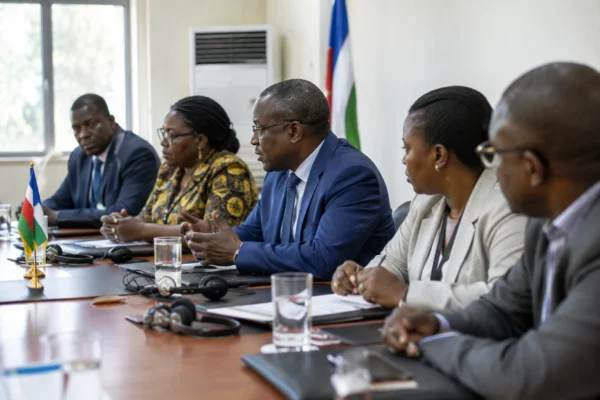
Coris Bank International’s plan is set against this backdrop. On 30 July 2026, a delegation from the group met the CEMAC commissioner for the Common Market in Bangui to discuss the outlines of a planned entry into the Central African Republic. The move comes within a common monetary area where banking regulation is overseen at sub-regional level, with COBAC at the forefront. Since 1 January 2025, the regulation on the single licence for credit institutions has been in force, making it easier to open branches in another member state after authorisation from the supervisor.
Single-licence reform changes the regional equation
In CEMAC, the single licence is not a technical detail. It is a lever for financial integration. An institution already authorised in one member country can, subject to conditions, expand more quickly into another country in the bloc. The reform adopted in late 2024 and implemented from 1 January 2025 was specifically designed to address delays under the previous system and clarify authorisation procedures. It creates a clearer framework for African banking groups seeking to cover several markets from a regional base.
Coris Bank is well placed to benefit. The group took its first step in Central Africa with the acquisition of Société Générale Tchad, completed on 31 January 2024 and subsequently renamed Coris Bank International Tchad. The group itself described the deal as its official entry into Central Africa. In the same vein, it established its Cameroonian subsidiary, Coris Bank International Cameroun, in early July 2026, with capital of CFAF 26 billion, and is awaiting final regulatory approval. In Gabon, the bank also obtained authorisations in early 2026, before announcing plans for a permanent presence and the future construction of a headquarters in Libreville.
What the Central African Republic hopes to gain from the arrival
For the Central African Republic, the announced arrival of a new player is about more than a logo on a façade. The first issue is financing. In the first quarter of 2026, banks operating in the country granted 3,114 new loans to the economy, for a total of CFAF 41.4 billion. Businesses accounted for 87.64% of this new financing. SMEs alone represented 40.85% of the total. These figures point to a market with activity, but one that is still narrow, where access to credit remains crucial for formal-sector operators.
The market is also highly concentrated. During the reference period, BGFIBANK-CA retained first place, with 65.72% of the credit market, well ahead of BSIC, Ecobank and BPMC. In this context, the arrival of another group could broaden the range of services, but could also prompt incumbent banks to review their lending terms, processing times and appetite for SMEs. This is particularly important in Bangui, where banking activity is denser than in inland regions, which are often less well served by physical networks.
A new presence could also matter for transfers, services to traders and transactions by businesses already operating across CEMAC. The regional market is not just a banking one; it is also administrative, with common rules, smoother exchanges and an integration drive led by CEMAC. For Central African economic operators, this could reduce some of the friction associated with payments, intra-community trade and import financing. But the actual impact will depend on the speed of implementation, the costs charged and the new bank’s ability to expand beyond Bangui.
A test of banking competition in Central Africa
This story extends well beyond the Central African Republic. It says something about the evolution of African banking capital. Groups from West Africa are seeking a deeper foothold in Central Africa, while CEMAC regulators are trying to harmonise their rules to attract capital without easing prudential oversight. The trend is visible in Chad, Cameroon, Gabon and now Bangui. It confirms that in Central Africa, banking is becoming as much a tool of regional integration as a balance-sheet business.
However, it is important not to get carried away by the announcement. A branch alone is not enough to transform a market. It also needs strong local governance, trained teams, a risk policy suited to the realities of the Central African Republic and a network that is not confined to the capital. That is where the difference between a symbolic presence and a lasting contribution to the economy will be made. The country, for its part, has an interest in seeing more intermediaries emerge that can finance businesses, agricultural value chains, trade and services.
In the coming weeks and months, the key signal to watch will be the move from proposal to effective authorisation. In CEMAC, banking supervision remains strict, and the single licence does not remove checks or capital, compliance and governance requirements. For Bangui, the challenge is simple: attract banks that genuinely finance the economy rather than remaining confined to the most profitable segments. For Coris Bank, the challenge is equally clear: turn a regional strategy into a useful, credible and lasting presence in the Central African Republic.