Algeria
 Egypt
 Libya
 Morocco
 Sudan
 Tunisia
 Benin
 Burkina Faso
 Cabo Verde
 Côte d'Ivoire
 Ghana
 Guinea
 Guinea-Bissau
 Liberia
 Mali
 Mauritania
 Niger
 Nigeria
 Senegal
 Sierra Leone
 The Gambia
 Togo
 Cameroon
 Central African Republic
 Chad
 DR Congo
 Equatorial Guinea
 Gabon
 Republic of the Congo
 São Tomé and Príncipe
 Burundi
 Comoros
 Djibouti
 Eritrea
 Ethiopia
 Kenya
 Madagascar
 Malawi
 Mauritius
 Mozambique
 Rwanda
 Seychelles
 Somalia
 South Sudan
 Tanzania
 Angola
 Botswana
 Eswatini
 Lesotho
 Namibia
 South Africa
 Zambia
 Zimbabwe
A reopening that goes beyond the case of a media group
In Kampala, the resumption of Nation Media Group Uganda’s broadcasts does not simply mark the end of a stand-off. Above all, it shows how fragile public space remains in Uganda when it touches on power, the military and political succession. At the end of June, the closure of the group’s offices and studios sent a warning well beyond the media sector. The reopening announced on 28 July 2026 shows that a compromise has been reached, but it does not make the underlying question disappear: who sets the limits of public debate in a country where the balance between civilian power and the security apparatus remains heavily skewed?
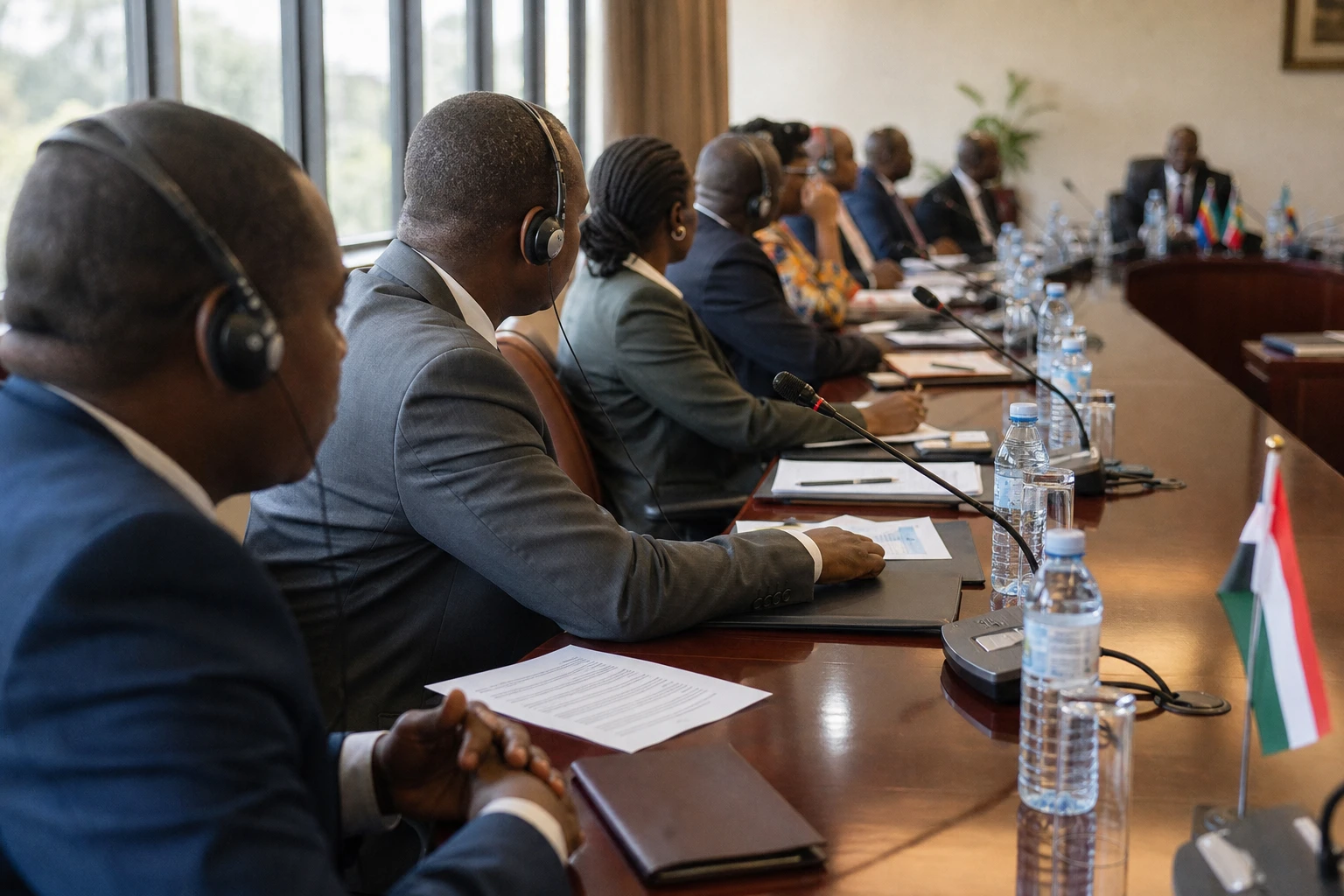
The case is set in a specific regional context. Uganda is a member of the East African Community, or EAC, a bloc of eight states headquartered in Arusha, Tanzania, which is built around economic, political and institutional integration. Kampala even hosts several of the community’s bodies. In this context, tensions over press freedom affect more than Ugandan newsrooms. They also touch on the credibility of a state seeking influence in a region through which information, capital, journalists and political influences flow.
What happened between the end of June and 28 July
According to corroborated reports, Nation Media Group announced that it had resumed operations in Uganda after an interruption imposed at the end of June by the chief of the armed forces, General Muhoozi Kainerugaba, the son of President Yoweri Museveni. Television, radio, print and the group’s digital platforms are gradually resuming operations as operational equipment is reinstalled. The group said the reopening followed an agreement with the presidency. Its main shareholder, Tanzanian Rostam Azizi, welcomed the decision and thanked both Museveni and Kainerugaba for their role in the discussions.
The closure had been abrupt. During the night of 27 to 28 June, soldiers entered Nation Media Group’s premises in Kampala and barred access to the offices and studios, including those of NTV Uganda and the Daily Monitor. Kainerugaba publicly claimed responsibility for the decision on X, saying he did not believe in press freedom in the country and accusing the group’s media outlets of regularly attacking him. The operation prompted immediate reactions from organisations defending journalists, which saw it as an unprecedented attack on a major private network in the country.
Another element adds to the case’s political significance: Uganda’s Ministry of Information and Communications Technology and National Guidance had said at the time that Museveni had ordered a “security investigation”. This official framing cast the measure as an act of state, not merely a dispute between a military official and a media company. In practice, however, what emerges is the balance of power within the regime. The president’s son, already seen as a possible successor, is at the centre of an episode in which security, political loyalty and control of the public narrative converge.
A press under pressure, despite returning to the air
The resumption of operations should not obscure the broader climate. RSF ranks Uganda 143rd out of 180 in its 2026 World Press Freedom Index. The organisation notes that the Constitution guarantees press freedom, but that several laws, particularly those concerning computer misuse, counter-terrorism and public order, restrict journalistic work. RSF also says critical journalists face violence, arrests, equipment confiscations and recurring political pressure.
Nation Media Uganda occupies a distinctive position in the country. The group controls major publications and broadcasters, including NTV Uganda and the Daily Monitor. Its temporary shutdown therefore affected far more than a single company. It disrupted part of the flow of information in Kampala, as well as in secondary cities and in areas where radio remains the most widely followed medium. For professionals in the sector, the episode is a reminder that a powerful private media outlet is not necessarily protected when issues touch on the security of those in power. For readers and listeners, it reduces the diversity of sources just as Uganda emerges from a tense electoral period.
The episode also has an economic dimension. The group’s media outlets support direct and indirect jobs, from advertising sales houses to technical teams. Their closure disrupted the group’s internal organisation and access to commercial information. In a country where the formal sector coexists with a vast informal economy, radio and television remain crucial channels for local advertisers, urban markets and small businesses. The gradual resumption announced on 28 July is therefore an economic restart as well as an editorial one.
What the case says about Uganda and the region
At its core, the case confirms that the media question in Uganda is inseparable from the institutional one. Museveni has led the country since 1986, and the events of June and July 2026 showed just how central a political actor the army remains. In the Great Lakes region, where several states face tensions between security, pluralism and competition for power, the Ugandan case serves as a barometer. It shows that restrictions can be lifted quickly, but that the symbolic cost to the press is lasting.
For the EAC and the African Union alike, the issue is clear: regional integration cannot be limited to roads, customs or value chains. It also requires minimum safeguards for information, criticism and the circulation of facts. In Uganda, the reopening of Nation Media Group eases an immediate crisis. It resolves neither Muhoozi Kainerugaba’s growing role in political life, nor the pressure on newsrooms, nor the structural vulnerability of a public sphere in which national security is often used as a language of political discipline. The case will therefore bear watching, particularly as the next decisions are made on the balance between civilian power, the military and the media.