Algeria
 Egypt
 Libya
 Morocco
 Sudan
 Tunisia
 Benin
 Burkina Faso
 Cabo Verde
 Côte d'Ivoire
 Ghana
 Guinea-Bissau
 Liberia
 Mali
 Mauritania
 Niger
 Nigeria
 Senegal
 Sierra Leone
 The Gambia
 Togo
 Cameroon
 Central African Republic
 Chad
 DR Congo
 Equatorial Guinea
 Gabon
 Republic of the Congo
 São Tomé and Príncipe
 Burundi
 Comoros
 Djibouti
 Eritrea
 Ethiopia
 Kenya
 Madagascar
 Malawi
 Mauritius
 Mozambique
 Rwanda
 Seychelles
 Somalia
 South Sudan
 Tanzania
 Uganda
 Angola
 Botswana
 Eswatini
 Lesotho
 Namibia
 South Africa
 Zambia
 Zimbabwe
Conakry seeks to clear its streets without disrupting daily life
In a capital where every journey can become a trial, the question is not simply how to travel faster. It is also how to make journeys more predictable, safer and more affordable for Conakry’s residents. Against this backdrop, Guinea is pursuing a gradual renewal of its urban transport services, with the stated aim of easing pressure on already congested roads and better connecting the city’s communes.
This approach is part of a broader urban transformation. Conakry accounts for a significant share of national activity, while Guinea remains a member of ECOWAS, the West African organisation that places transport at the heart of regional integration. In recent planning documents, the authorities and their partners describe a metropolis expected to continue growing rapidly through to 2040, with rising needs for mobility, roads and public services.
A phased programme underpinned by broader reform
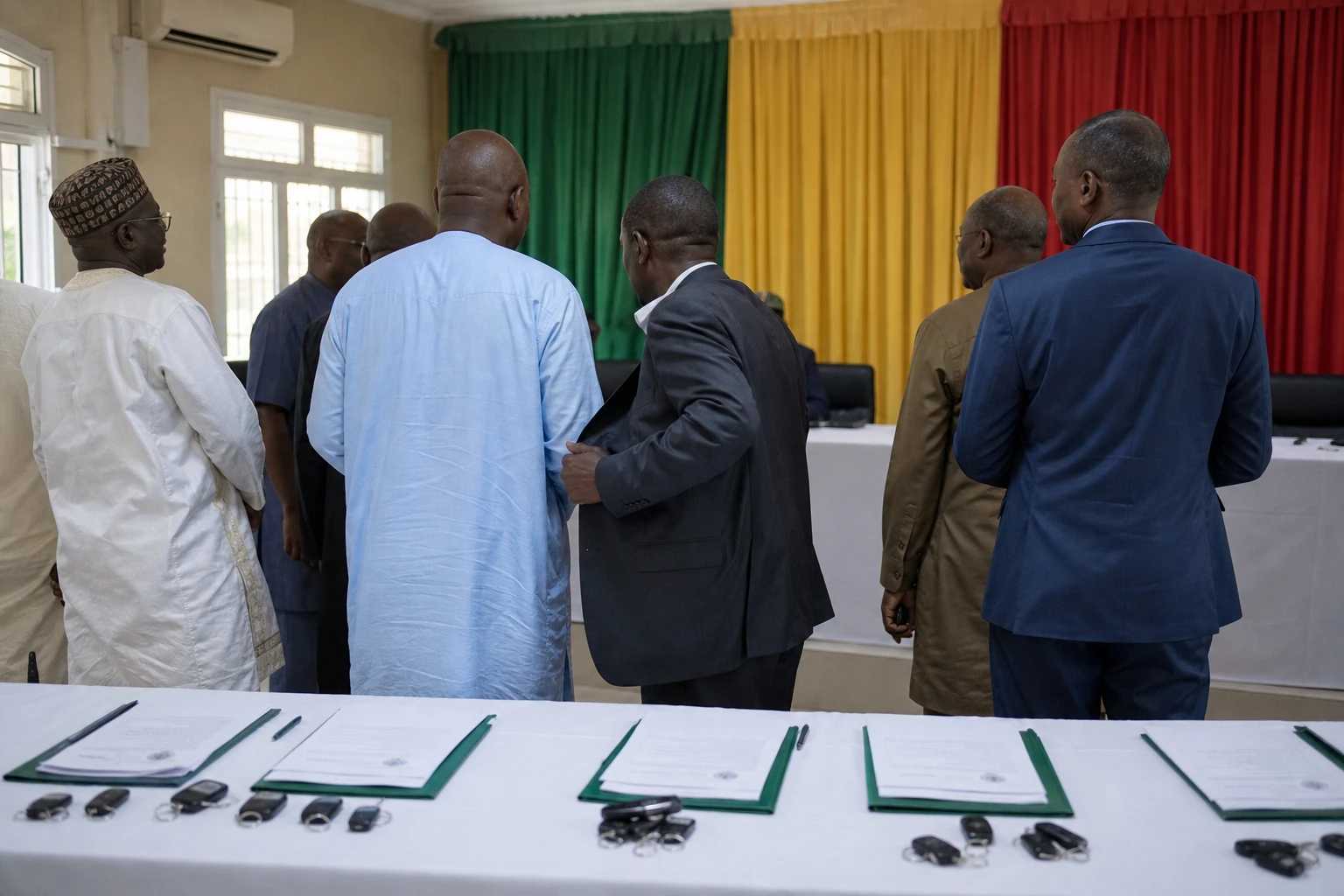
The Guinean government has announced the acquisition of 2,000 taxis to modernise Conakry’s fleet. The launch was presented by Ousmane Gaoual Diallo, Minister of Transport and government spokesperson, at a ceremony in Conakry. An initial batch of 300 vehicles is already available and is to be gradually put into service.
The initiative is not limited to taxis. The authorities have also announced the arrival of 200 public transport buses, with an initial batch of 50 buses already acquired and due to be deployed shortly. The stated aim is twofold: to improve public transport provision and replace a fleet that has become too old to meet demand in a rapidly expanding capital.
The plan is part of a reform launched in 2024. The Ministry of Transport noted that the Conakry Urban Transport Organising Authority (AOTUC) was established in January 2023 to improve coordination of mobility in the Guinean capital. The authorities are also working to establish a new company to replace SOTRAGUI, whose performance has deteriorated over the years.
This institutional shift matters. It means the public response is no longer limited to buying vehicles, but involves an attempt to reorganise the entire chain: planning, operations, maintenance, financing and traffic. In practice, this is often where urban transport projects succeed or stall.
What the arrival of new taxis means for Guineans
For passengers, the stakes are tangible. In Conakry, waiting times, higher journey costs and congestion affect travel to markets, government offices, schools and employment areas. A newer fleet could make taxis more readily available, but it will not by itself solve traffic jams without better management of routes, stops and connections.
For drivers and young entrepreneurs, the programme also offers the prospect of work. The authorities present the initiative as a source of employment, particularly through more structured access to vehicles and financing. But that promise depends on clear rules covering entry costs, repayment terms, maintenance, insurance and administrative oversight. Without them, a new fleet could quickly fall prey to the same weaknesses as an old one.
The environmental dimension is also significant. As African cities grow, transport is increasingly a question of air quality, fuel consumption and wear on infrastructure. Newer vehicles can reduce some emissions and breakdowns, but only if maintenance is maintained and mobility policy also prioritises public transport, walking and effective connections.
The impact will not be the same everywhere in the capital. Central neighbourhoods, often better served, could see swift gains. Peripheral communes and poorly connected areas, however, will remain dependent on the quality of the network, passable roads and regular services. Urban mobility in Conakry is therefore as much a matter of territorial equality as of transport.
A Guinean response to a West African challenge
Guinea’s experience is part of a familiar regional trend. In several West African capitals, urban growth has outpaced the capacity of public transport networks. ECOWAS also says transport is one of the pillars of regional economic integration, alongside trade, energy and telecommunications. Modernising Conakry therefore has a subregional dimension too, as the capital serves as a hub for trade, services and domestic travel.
The decision also comes as Guinea seeks to place its infrastructure within a broader development trajectory, often summed up by the Simandou 2040 programme. Urban transport is not separate from this strategy. It shapes the movement of workers and access to ports, construction sites, government offices and residential areas. In other words, it underpins the promise of growth as much as it reflects demographic pressure.
The central question remains: how can an announcement be turned into a lasting service? The history of urban transport in Africa shows that a one-off purchase is not enough. It takes sound operators, stable financing, operational oversight and governance capable of preventing resources from being spread too thinly. Only then can the 2,000 taxis announced become more than just a figure: a genuine mobility tool for Conakry and, more broadly, a signal for Guinea’s other major cities.