Algeria
 Egypt
 Libya
 Morocco
 Sudan
 Benin
 Burkina Faso
 Cabo Verde
 Côte d'Ivoire
 Ghana
 Guinea
 Guinea-Bissau
 Liberia
 Mali
 Mauritania
 Niger
 Nigeria
 Senegal
 Sierra Leone
 The Gambia
 Togo
 Cameroon
 Central African Republic
 Chad
 DR Congo
 Equatorial Guinea
 Gabon
 Republic of the Congo
 São Tomé and Príncipe
 Burundi
 Comoros
 Djibouti
 Eritrea
 Ethiopia
 Kenya
 Madagascar
 Malawi
 Mauritius
 Mozambique
 Rwanda
 Seychelles
 Somalia
 South Sudan
 Tanzania
 Uganda
 Angola
 Botswana
 Eswatini
 Lesotho
 Namibia
 South Africa
 Zambia
 Zimbabwe

When the heat hits, livestock farms suffer first
In northern Tunisia, the heatwave did more than send temperatures soaring. It also exposed the vulnerability of farms that depend on a steady power supply, continuous ventilation and water available around the clock. When the electricity goes off at the wrong moment, the whole chain is at risk, from livestock buildings to milk that has to be thrown away for lack of refrigeration.
The shock came amid a particularly gruelling period of extreme weather for Tunisia. During July 2026, the authorities repeatedly urged livestock farmers to remain vigilant, while STEG, the national electricity and gas company, acknowledged that rolling power cuts might be used to preserve grid stability. President Kaïs Saïed himself convened the ministers concerned and officials from STEG and SONEDE, the public water company, in Carthage on 22 July to discuss prolonged outages and fires.
Heavy losses in the north-west
At El Fahs, about 60 kilometres from Tunis, a poultry farm saw its sheds emptied within hours. According to the farm’s veterinarian, nearly 90% of the birds died after a prolonged power cut. He put the number of chickens lost at between 150,000 and 200,000, explaining that the backup generator, designed to run for only two or three hours, overheated and then stopped. He also estimated the financial loss at between 1.4 million and 1.5 million Tunisian dinars. These figures come from the farm operator and have not been publicly corroborated by another independent source on site, but they illustrate the scale of the shock to the sector.
The same episode affected other livestock businesses. A dairy farm said it had to throw away the equivalent of six days’ milking, or about 1,200 litres of milk, after the cold chain was broken. The loss is twofold: an immediate financial hit, followed by health and logistical consequences, since milk cannot be salvaged once it has been exposed to heat for too long. Veterinary services had nevertheless urged poultry farmers to strengthen cooling systems, check their generators and avoid non-urgent work during the hottest hours.
As early as mid-July, the agriculture authorities had stressed the need to ensure a constant supply of clean, cool water, good ventilation and sufficient shade at livestock farms. These instructions highlight a central point: rising temperatures are becoming a production risk in their own right, not merely a seasonal constraint. In North Africa, as elsewhere, intensive agriculture is increasingly exposed to a combination of heat stress, pressure on water supplies and strain on electricity networks.
A grid under pressure, a model in need of change
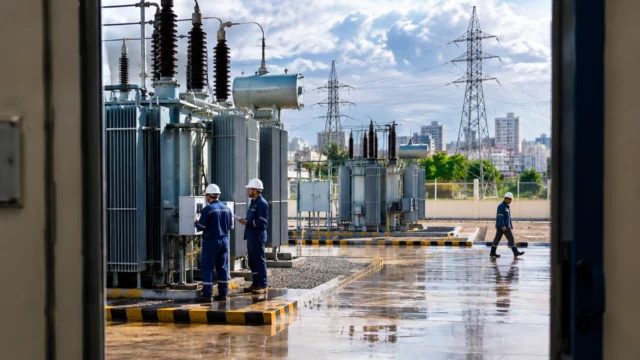
STEG attributed the power cuts to strong demand caused by the heatwave. On 15 July, its chief executive cited widespread use of air conditioning and exceptionally high electricity consumption. A few days later, the company warned that rolling outages could affect several governorates, particularly Greater Tunis, the North and the Centre. On 24 July, it also denied rumours of a nationwide blackout. In other words, the public strategy was to prevent a more serious system failure, at the cost of localised outages that were sometimes poorly received.
For urban households, these outages mean stopped refrigerators, hotter nights and damaged appliances. For farmers, they can destroy within hours production built up over months. There is a clear difference between those who can cope with a temporary interruption and those who depend on an uninterrupted supply. A poultry farm or dairy does not operate like an office. The slightest dip in the grid can trigger a cascade of losses.
The crisis has also brought the question of energy investment back to the fore. With support from Mediterranean partners, Tunisia has embarked on the Elmed electricity interconnector project with Italy, designed to strengthen power exchanges and grid resilience. But in the short term, maintenance, predictable outages and protection for sensitive sectors are what matter most. A farm cannot improvise an energy transition in the middle of a heatwave.
What the episode says about Tunisia and the region
At national level, the case reveals the convergence of three vulnerabilities: extreme heat, livestock farming’s dependence on electricity, and the difficulty of giving timely notice of outages that are genuinely compatible with economic activity. The Tunisian government and STEG are trying to avert a more serious blackout, but the cost is being shifted to producers, especially those in poultry and dairy, two sectors where margins are often tight.
The issue extends beyond Tunisia. Across North Africa, longer droughts, earlier heatwaves and pressure on power grids are forcing a rethink of agricultural and energy policies. The question is no longer simply how to produce more, but how to produce more resiliently, with better-insulated buildings, properly sized backup systems and grids capable of absorbing peak demand without sacrificing rural areas. The African Union, which is increasingly urging states to adapt to climate change, is seeing a concrete example of what awaits many countries on the continent.
In Tunisia, the July 2026 episode leaves a very simple question: how can the national grid be protected while also safeguarding activities that cannot survive a prolonged interruption? Until that question is answered fully, heatwaves will continue to translate into direct economic losses, particularly in agricultural areas near Tunis, Zaghouan and the north-west.