Algeria
 Egypt
 Libya
 Morocco
 Sudan
 Benin
 Burkina Faso
 Cabo Verde
 Côte d'Ivoire
 Ghana
 Guinea
 Guinea-Bissau
 Liberia
 Mali
 Mauritania
 Niger
 Nigeria
 Senegal
 Sierra Leone
 The Gambia
 Togo
 Cameroon
 Central African Republic
 Chad
 DR Congo
 Equatorial Guinea
 Gabon
 Republic of the Congo
 São Tomé and Príncipe
 Burundi
 Comoros
 Djibouti
 Eritrea
 Ethiopia
 Kenya
 Madagascar
 Malawi
 Mauritius
 Mozambique
 Rwanda
 Seychelles
 Somalia
 South Sudan
 Tanzania
 Uganda
 Angola
 Botswana
 Eswatini
 Lesotho
 Namibia
 South Africa
 Zambia
 Zimbabwe
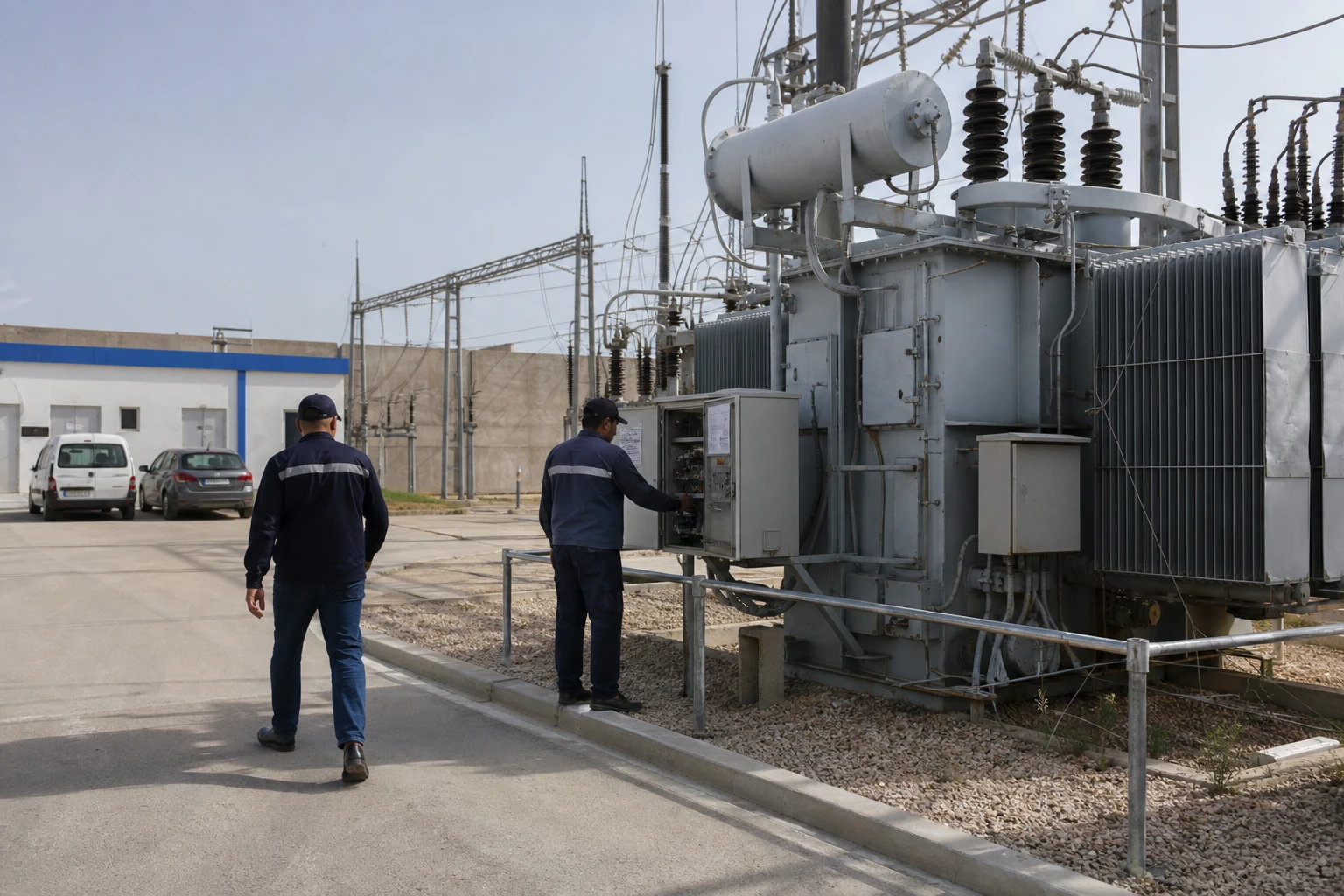
When air conditioning becomes a test for the state
In the height of summer, the question is no longer just whether electricity is available for everyday life. It is whether the grid can hold up when the whole country consumes power at the same time. In Tunisia, the July heatwave brought home this simple reality: a country that is almost entirely electrified can still experience power cuts when demand rises faster than the system’s safety margins.
On 21 July 2026, the Tunisian Company of Electricity and Gas (STEG) issued several notices of temporary interruptions in Greater Tunis, the North, the North-West, the Centre, Sfax, the South and the South-West. The following day, further notices were issued for the same areas. The series of rolling power cuts came amid a severe heatwave, with temperatures driving air-conditioning use to its peak. A meeting at Carthage Palace on 22 July 2026 also focused on water and electricity cuts and fires, a sign that pressure on essential services had become a major issue.
This pressure is no minor matter. Tunisia is among the African countries where access to electricity is close to universal. But access does not tell the whole story. It says nothing about grid stability, its ability to withstand consumption peaks, or the quality of service in low-income neighbourhoods, industrial zones or regions far from Tunis. This is where the debate shifts: it is no longer just about connections, but resilience.
A grid under strain, from gas to interconnection
Official data published by the National Observatory of Energy and Mines show that Tunisia’s system remains heavily dependent on a narrow range of sources. At the end of May 2026, domestic electricity production stood at 7,506 GWh, up 6% year on year, but STEG remained the main producer, accounting for 91% of total output. Electricity imports, mainly from Algeria, covered about 9% of national market requirements. The electricity mix remained dominated by natural gas, at 91%, compared with 9% from renewables.
This structure weighs heavily on energy sovereignty. Tunisia’s energy ministry says the country is seeking to strengthen its autonomy, but the mix remains poorly diversified. Algerian gas covers a significant share of supply, while the country also imports electricity to meet peak demand. During periods of intense heat, this arrangement becomes even more fragile, as domestic consumption surges at the same time as pressure on neighbouring grids.
The July cuts should therefore not be seen as a simple technical incident. They expose a wider equation: a highly connected system that remains too dependent on an imported fuel, with limited room for manoeuvre when demand rises. The country has a dense grid and a high electrification rate. But it still lacks sufficient domestic capacity, storage and renewable generation on the scale needed to smooth out peaks.
Solar ambitions advance, but the timetable is tight
The Tunisian government makes no secret of its ambitions. It wants to accelerate renewables and turn Tunisia into a future electricity gateway between North Africa and Europe. The ELMED project, an interconnector between Tunisia and Italy, was placed under specific monitoring by the presidency of the government in January 2026. The energy ministry says the link is intended to strengthen energy exchanges with Europe, integrate more renewable energy and improve the grid’s capacity to respond to emergencies. The project is described as a 600 MW link in its first phase, with capacity set to rise to 1,200 MW in a second stage.
Some projects are moving forward on the ground. Photovoltaic power plants have been commissioned, and other projects are under way. But the gap between official ambitions and the weight of thermal power remains significant. At the end of May 2026, renewables still accounted for just 9% of national production. In other words, the transition is already happening, but it has yet to change the system’s overall balance. As long as peak demand is met by gas, interconnections alone will not be enough to guarantee stability.
For households, the issue is immediate: appliances, food storage, water pumps, remote working and children’s sleep. For businesses, it affects production, the cold chain, workshops and delivery schedules. In industrial regions such as Sfax or the Sahel, even a brief outage can disrupt an entire working day. In Greater Tunis, it also brings an invisible cost: generators, lost time and declining confidence in public services. The bill is therefore felt at several levels, from households to the formal economy.
What Tunisia is watching, from the Maghreb to the Mediterranean
The issue extends beyond Tunisia. Across North Africa, several states are seeking to secure their supply while developing solar and wind power. Tunisia’s case illustrates a turning point: a country can have near-universal electrification and remain vulnerable if its generation depends too heavily on a single source and its grid lacks sufficient reserve capacity. It is a distinctly Maghreb issue, but also a Mediterranean one, because the planned interconnections with Europe depend on the same reality: a robust domestic system is needed before surplus power can be exported.
The coming months will therefore be decisive. Tunisia will have to show whether solar projects, grid upgrades and the ELMED interconnector can reduce dependence on gas and limit power cuts during the next heatwave peaks. The issue also matters across the continent to countries banking on green electricity exports. The message is clear: the transition is measured not only in installed megawatts, but in the ability to meet domestic demand before promising to become a regional hub.