
 Algeria
 Egypt
 Libya
 Morocco
 Sudan
 Tunisia
 Benin
 Burkina Faso
 Cabo Verde
 Côte d'Ivoire
 Ghana
 Guinea
 Guinea-Bissau
 Liberia
 Mali
 Mauritania
 Niger
 Nigeria
 Senegal
 Sierra Leone
 The Gambia
 Togo
 Cameroon
 Central African Republic
 Chad
 Equatorial Guinea
 Gabon
 Republic of the Congo
 São Tomé and Príncipe
 Burundi
 Comoros
 Djibouti
 Eritrea
 Ethiopia
 Kenya
 Madagascar
 Malawi
 Mauritius
 Mozambique
 Rwanda
 Seychelles
 Somalia
 South Sudan
 Tanzania
 Uganda
 Angola
 Botswana
 Eswatini
 Lesotho
 Namibia
 South Africa
 Zambia
 Zimbabwe
Violence strikes at the worst possible time
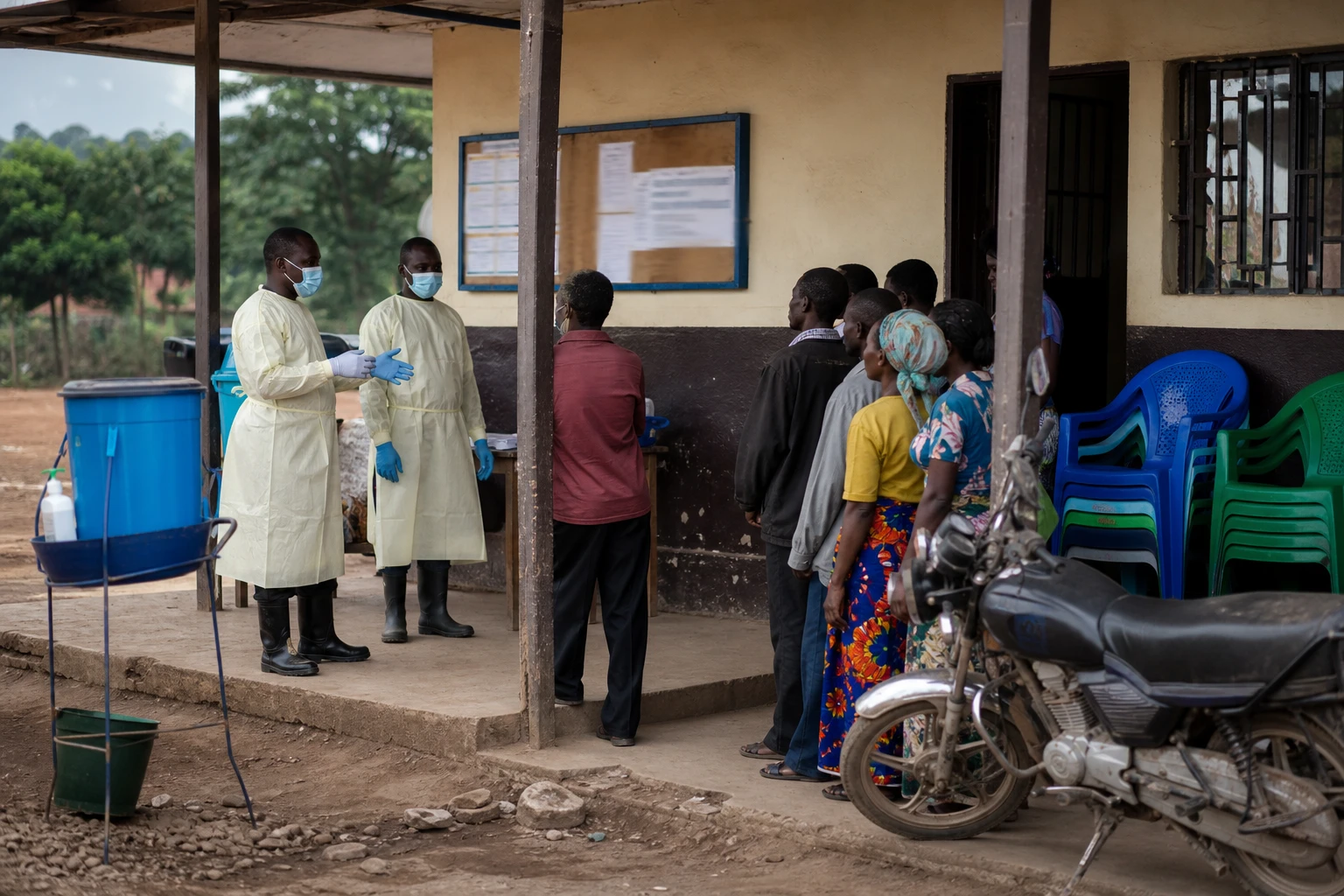
In the east of the Democratic Republic of the Congo, residents of Mambasa and Beni are under double pressure. On one side are repeated attacks by the ADF, an armed group active between Ituri and North Kivu. On the other is the response to Ebola, which is already mobilising medical teams, the authorities and local communities. The combination of emergencies is weighing on families, movement and access to healthcare.
This context gives added significance to the tolls reported in recent days. According to civil society groups cited locally, at least 32 civilians were killed in 72 hours in two attacks attributed to the ADF in Mambasa. The same sources also report abductions and forced displacement. In the Beni area, another attack attributed to the same group has again left several neighbourhoods and outlying communities in mourning.
Geography matters here as much as the names of armed groups. Mambasa is in Ituri, Beni in North Kivu. Both territories are corridors for movement, trade and people fleeing. When roads become unsafe, markets, schools, fields and health facilities are the first to suffer.
Heavy tolls, but still attributed
The available information converges on one point: the latest wave of violence is recent and intense. In Mambasa, the most recent attacks were reported in Njiapanda-Bela and Lukaya. In Beni, several incidents were reported in July, notably in Mangina and in neighbourhoods on the outskirts of the city. In some cases, the tolls remain provisional, as bodies are found later and the areas remain difficult to access.
Numbers should therefore be treated with caution. Local civil society groups speak of a heavy human toll, while Congolese media cite estimates that change as searches and witness accounts continue. This caution is not a minor point. In eastern DR Congo, insecurity often prevents immediate on-the-ground verification. Toll figures sometimes only stabilise several hours, or even several days, after events.
The ADF, which has long been present in eastern Congo, is regularly described by several international sources as affiliated with the Islamic State group. But on the ground, for residents, the debate over the label matters less than the tangible impact: deaths, disappearances, burned homes, lost harvests and fear of returning to villages. This is the reality that shapes daily life.
Ebola adds another fault line
The security crisis is compounded by the Ebola epidemic. The World Health Organization says the DRC has been facing a new outbreak of Ebola virus disease caused by the Bundibugyo strain since May 2026. The main outbreak is in Ituri, with spread into North Kivu and other eastern provinces. The Congolese government has also convened its national response task force in Kinshasa to coordinate the response.
The figures have also grown. As of 16 July, the WHO African Region reported 2,073 cases and 796 deaths in the DRC, making it the third-largest Ebola epidemic ever recorded at the time. A few days earlier, already very high tolls had put the number of confirmed cases at more than 1,900 and deaths at more than 700. The rapid change shows how active and widespread the epidemic remains.
The coincidence of armed violence and a health emergency complicates everything. Health workers find it harder to travel. Families are reluctant to go to treatment centres. Awareness campaigns face mistrust and forced displacement. In this kind of crisis, security is not separate from public health: it is a condition for it.
What this means for the DRC and the region
For the Congolese state, the challenge is twofold. It must protect civilians in areas where the army, the FARDC, remains under pressure. It must also maintain a credible health response in a province where people are constantly on the move and health facilities are fragile. As attacks multiply, priorities overlap and resources are spread thin.
For the population, the impact is immediate. Traders lose their stocks. Farmers abandon their fields. Pupils miss classes. Displaced families add to systems already under strain. In Beni and Mambasa alike, the informal economy, on which a large share of households depend, is the first to bear the shock of violence.
The regional dimension is equally important. Eastern DR Congo remains connected to Uganda and several states in the Great Lakes region. The WHO and Africa CDC have launched a joint continental plan for the Ebola response, proof that the issue goes beyond national borders. Whenever an outbreak spreads in the eastern provinces, health vigilance becomes a concern for the entire arc of neighbouring countries.
The DRC thus finds itself at the intersection of two recurring challenges in Central Africa: containing mobile armed groups and maintaining continuity of public services in crisis zones. In the short term, attention will need to be paid to changes in the tolls in Mambasa and Beni, as well as the next updates on the Ebola response. In the longer term, the ability of Congolese institutions to sustain security, health services and public trust simultaneously will be watched across the region.



