Algeria
 Egypt
 Libya
 Morocco
 Sudan
 Tunisia
 Benin
 Burkina Faso
 Cabo Verde
 Côte d'Ivoire
 Ghana
 Guinea
 Guinea-Bissau
 Liberia
 Mali
 Mauritania
 Nigeria
 Senegal
 Sierra Leone
 The Gambia
 Togo
 Cameroon
 Central African Republic
 Chad
 DR Congo
 Equatorial Guinea
 Gabon
 Republic of the Congo
 São Tomé and Príncipe
 Burundi
 Comoros
 Djibouti
 Eritrea
 Ethiopia
 Kenya
 Madagascar
 Malawi
 Mauritius
 Mozambique
 Rwanda
 Seychelles
 Somalia
 South Sudan
 Tanzania
 Uganda
 Angola
 Botswana
 Eswatini
 Lesotho
 Namibia
 South Africa
 Zambia
 Zimbabwe
A route serving far more than one city
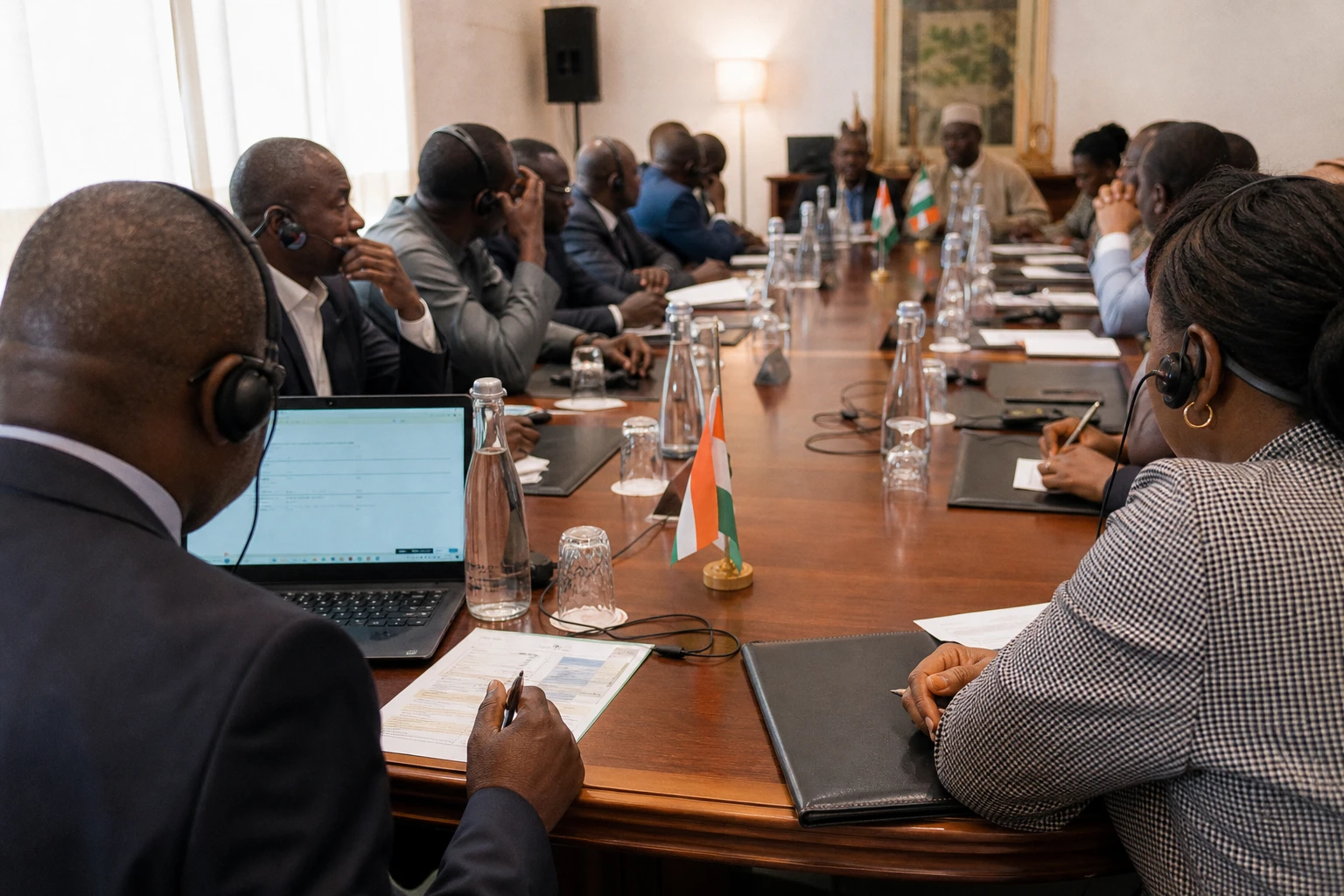
Between Tsernaoua and Tahoua, the road is more than a strip of asphalt in need of repair. It is one of the corridors linking markets, health centres, schools and production areas in west-central Niger. When this section deteriorates, journey times, transport costs and road-user safety all suffer at once.
This challenge is particularly significant in Niger. The country covers a vast Sahelian territory, with long distances and varied terrain, and its population depends heavily on roads to transport agricultural and pastoral products. The capital, Niamey, is far from many inland areas. In this context, every road restored becomes a tool for connecting isolated areas, not merely a prestige infrastructure project.
Work on National Road 29 is also beginning at a particular political and regional moment. Since 29 January 2025, Niger has no longer been part of ECOWAS, the Economic Community of West African States, but trade, human and logistical flows continue to cross borders and corridors. The road network therefore remains a lever of economic sovereignty as well as a means of everyday mobility.
What the RN29 project involves
On Wednesday 22 July 2026, Niger’s Minister of Equipment and Infrastructure launched the rehabilitation of the 115-km Tsernaoua–Tahoua section in Tsernaoua. The route, part of the RN29, links the RN1 to the regional capital, Tahoua, and also provides access to the north of the country. The state describes the project as a response to the gradual deterioration of a road opened in 1975 and already rehabilitated in 2011.
The project provides for a 7-metre-wide bituminous concrete carriageway, with 1.5-metre shoulders on either side surfaced with a single-layer treatment. It also includes a social component incorporated into the contract, with boreholes, classrooms and integrated health centres, among other facilities. This approach goes beyond routine road maintenance. It aims to make the route a platform for public services rather than a transit corridor cut off from its surroundings.
The authorities also highlight the economic importance of the section. The aim is to facilitate the transport of agro-sylvo-pastoral products to urban centres, reduce the time needed to reach markets and improve access to basic services. In a region such as Tahoua, where activity relies heavily on agriculture, livestock and local trade, a road that remains passable throughout the year can reduce losses, secure supplies and limit the isolation of some municipalities.
This is not the only project under way. The government has already launched other major works, including rehabilitation of the Dogondoutchi–Birni N’Konni–Tsernaoua road, and the development and paving of Malbaza–Dabnou and N’karkadan–Tahoua. These projects point to a strategy of building a network across southern and central Niger, with expected benefits for inter-city trade and access to production areas.
A necessary catch-up in a country under logistical strain
The Ministry of Equipment and Infrastructure says Niger has 23,024 km of roads, of which 5,874 km are paved, 9,810 km are unpaved and nearly 7,340 km are rural tracks. It adds that 34.9% of the network is considered to be in very good condition. These figures chiefly illustrate the scale of the need for maintenance and upgrading. Even with recent projects, the country has a long way to go. The debate is therefore not only about new roads, but also about preserving existing infrastructure.
This constraint has long been recognised. World Bank documents note that Niger has an extensive network, but that unpaved sections are often in poor condition, with direct consequences for rural access and economic mobility. A deteriorated road costs more to travel on, causes greater vehicle wear, delays deliveries and hits first those households living far from major centres.
For the Nigerien state, the issue is also a budgetary one. Road funding must contend with the country’s vast size, pressure on public revenues and the need to choose between national roads, access roads and rural tracks. Recent financing arrangements, such as the Southern Niger Integration and Connectivity Project, show that the authorities are seeking to mobilise substantial resources to rehabilitate major routes and upgrade several hundred kilometres of secondary and rural roads. This confirms one priority: connecting production areas to markets before focusing on headline-grabbing projects.
The benefits, however, are not distributed equally everywhere. Urban centres gain more reliable supplies. Traders reduce their logistics costs. Herders and agricultural producers get their goods to market faster. Social services become more accessible to villages along the route. But if maintenance is not sustained over time, the gains can quickly disappear. A rehabilitated road without a robust maintenance mechanism often slips back into a cycle of deterioration.
What this project says about Niger and West Africa
The RN29 is not an isolated case. It is part of a wider series of roadworks and connectivity projects affecting several regions of Niger. The state is seeking to address an infrastructure deficit that hampers the movement of people, goods and services. In a country where distances are long and climate shocks frequent, roads remain an economic shock absorber as important as a credit line or an agricultural programme.
Across West Africa, the issue goes beyond national borders. Cross-border movement with Nigeria, Burkina Faso, Benin, Chad and Algeria depends on reliable corridors. Niger has not been part of ECOWAS since January 2025, complicating institutional frameworks for cooperation without removing real logistical needs. The challenge now is to keep corridors functioning for the benefit of populations, producers and traders, whatever the political realignments of the moment.
The rehabilitation of Tsernaoua–Tahoua will therefore tell us more than the simple progress of a construction project. It will show whether Niger can turn one-off investments into territorial continuity, road safety and broader access to public services. In a country at the heart of the Sahel, the quality of a road affects the local economy, but also the state’s ability to maintain its presence across the territory and support trade with the rest of the region.