Algeria
 Egypt
 Libya
 Morocco
 Sudan
 Tunisia
 Benin
 Burkina Faso
 Cabo Verde
 Côte d'Ivoire
 Ghana
 Guinea-Bissau
 Liberia
 Mali
 Mauritania
 Niger
 Nigeria
 Senegal
 Sierra Leone
 The Gambia
 Togo
 Cameroon
 Central African Republic
 Chad
 DR Congo
 Equatorial Guinea
 Gabon
 Republic of the Congo
 São Tomé and Príncipe
 Burundi
 Comoros
 Djibouti
 Eritrea
 Ethiopia
 Kenya
 Madagascar
 Malawi
 Mauritius
 Mozambique
 Rwanda
 Seychelles
 Somalia
 South Sudan
 Tanzania
 Uganda
 Angola
 Botswana
 Eswatini
 Lesotho
 Namibia
 South Africa
 Zambia
 Zimbabwe
Simandou: a test of the mining promise
In Conakry, the name Simandou inspires as much hope as caution. The iron ore deposit offers Guinea a rare opportunity, but experience in mining areas offers a simple lesson: a mine can generate billions without improving daily life if the state and operators do not also provide roads, water, healthcare and lasting jobs. The project’s credibility now hinges on this.
The issue extends beyond the mining area itself. For several years, Guinea has made Simandou the centrepiece of its economic strategy, as part of a broader transformation programme known as Simandou 2040. Across West Africa, the stakes also matter to ECOWAS, which is closely monitoring Guinea’s institutional stability and the country’s ability to turn extractive revenues into genuine development.
The integrated Simandou project was officially launched on 11 November 2025 in Morébaya, with the commissioning of the rail and port project linked to the deposit. Guinean authorities and several African agencies described it at the time as one of the continent’s largest mining projects, with investment exceeding $20 billion. The project brings together several partners, including Rio Tinto, Chinalco, Winning Consortium Simandou and Guinean public entities.
But the national debate is no longer only about the mine. It is about what it will change for Guineans. The Timbuktu Institute report, Beyond Simandou: Guinea’s many faces of fragility, stresses one central point: expected growth will not automatically resolve social, regional and institutional vulnerabilities. In other words, higher public revenues will not be enough unless they translate into visible basic services in mining prefectures and along logistics corridors.
Why social issues are taking centre stage
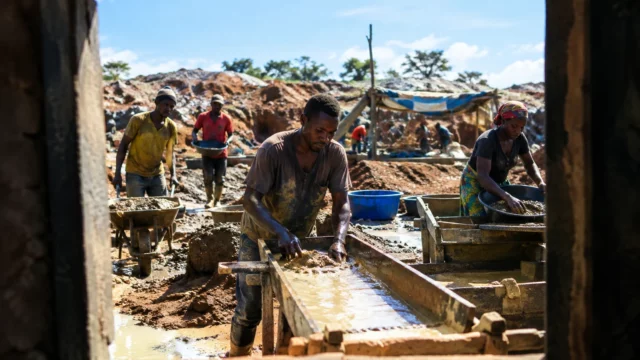
The warning is all the more pointed because Guinea has already seen the limits of the extractive model in other areas. In Boké, the historic heartland of bauxite, residents and researchers have for years described a gap between the wealth extracted and local infrastructure. Afrobarometer has shown that people living in mining prefectures have less access to electricity, water, schools, health centres and transport services than the rest of the country. The finding is specific, and directly relevant to Simandou.
This reality explains why calls for a “social policy” are not a slogan. They refer to very practical measures: housing for workers, access to drinking water for neighbouring villages, youth training, land compensation, repairs to secondary roads, health monitoring and ongoing dialogue with communities. Without these, people see trains, lorries and contracts pass by, but not the benefits. The risk is familiar: local tensions, disputes over mining corridors and a lasting sense of regional injustice.
This is also why the precedent of Boké comes up in almost every discussion. The region has supplied a major share of Guinea’s bauxite, while roads, clinics and water networks have remained inadequate for some communities living nearby. Guinean and African media have documented this paradox. The message is clear: if Simandou repeats this pattern, it will fuel frustration rather than become a driver of regional integration.
A challenge for the state, companies and regions
The Guinean government is now banking on a different approach. It wants Simandou to provide a basis for funding infrastructure, education, energy and agriculture, rather than serve simply as an export corridor. Several Guinean officials have referred to substantial annual revenues as the project ramps up. But these announcements will mean little unless governance keeps pace: transparent flows, oversight of subcontractors, regional redistribution and clear budget monitoring.
Companies, too, face a new standard. In a country where bauxite has already drawn criticism over environmental issues and social commitments, Simandou will be judged on its ability to create local value. That means more than temporary jobs during construction. The real test will be skilled occupations, maintenance, transport, Guinean subcontracting and a gradual shift towards processing locally. Otherwise, Guinea will remain an exporter of minerals whose high added value is captured elsewhere.
Across the continent, Simandou is being watched as a case study. On the one hand, it embodies Africa’s ambition to take control of strategic resources, organise value chains and fund public policy through mining revenues. On the other, it is a reminder that resource rents rarely generate lasting development without a strong social contract. For West Africa, where several states are still seeking a balance between extraction, industrialisation and social cohesion, Guinea is testing far more than the success of a mine: it is testing a model.
The issue therefore remains unresolved. The November 2025 launch gave Guinea’s leaders a powerful symbol. But the real verdict will come neither from Morébaya port nor from production announcements. It will come from the villages crossed by the railway, the neighbourhoods of Conakry waiting for services, and the mining regions that want, at last, to see lasting, tangible benefits from wealth that has long remained out of reach.