
 Algeria
 Egypt
 Libya
 Morocco
 Sudan
 Tunisia
 Benin
 Burkina Faso
 Cabo Verde
 Côte d'Ivoire
 Ghana
 Guinea
 Guinea-Bissau
 Liberia
 Mali
 Mauritania
 Niger
 Nigeria
 Senegal
 Sierra Leone
 The Gambia
 Togo
 Cameroon
 Central African Republic
 Chad
 Equatorial Guinea
 Gabon
 Republic of the Congo
 São Tomé and Príncipe
 Burundi
 Comoros
 Djibouti
 Eritrea
 Ethiopia
 Kenya
 Madagascar
 Malawi
 Mauritius
 Mozambique
 Rwanda
 Seychelles
 Somalia
 South Sudan
 Tanzania
 Uganda
 Angola
 Botswana
 Eswatini
 Lesotho
 Namibia
 South Africa
 Zambia
 Zimbabwe
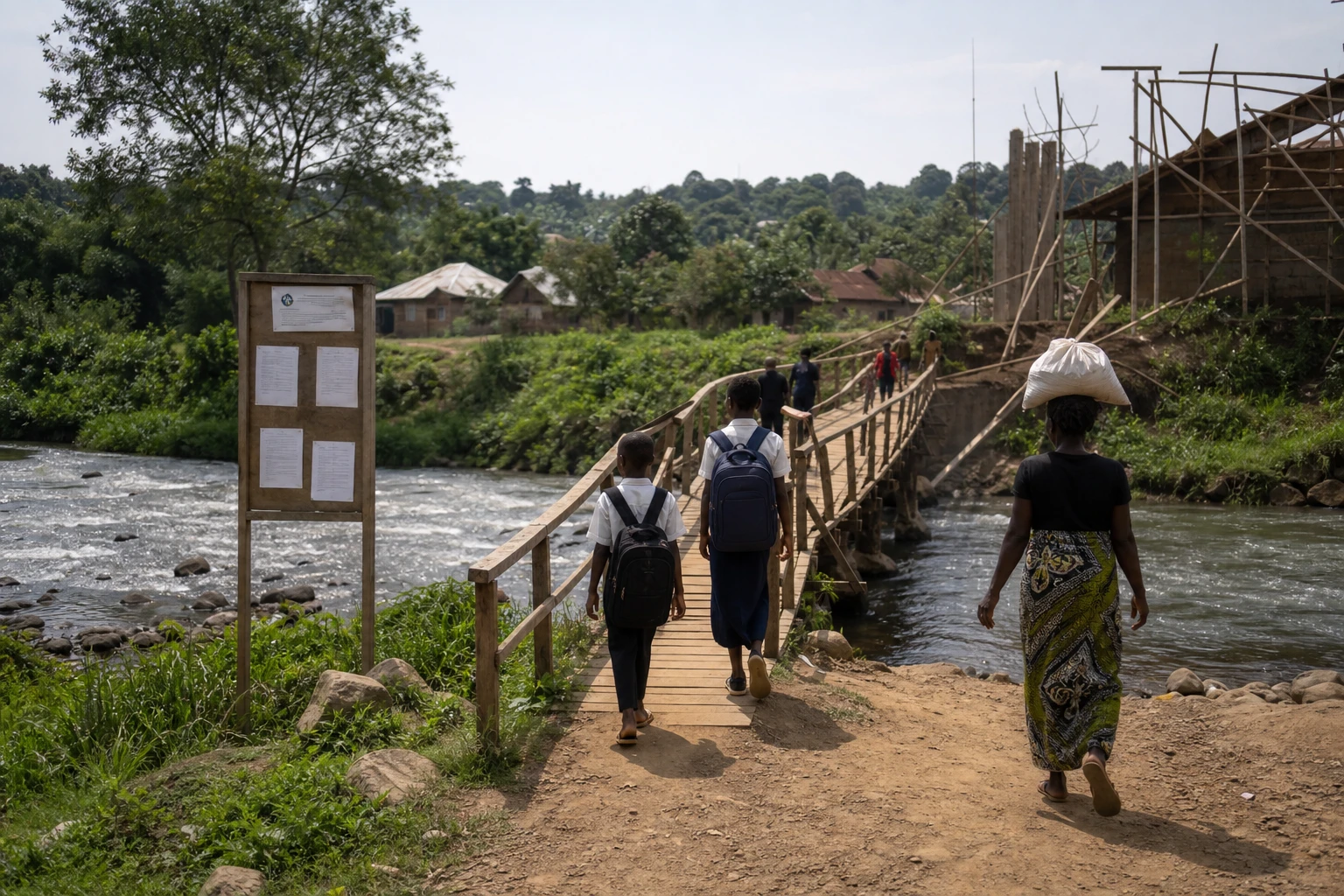
A collapsed bridge leaves a territory even more isolated
In Walikale territory, a simple wooden structure can matter as much as a national road. When it gives way, it is not only pupils or farmers who are left stranded; supplies, small-scale trade and access to healthcare are also put at risk.
On 3 June 2026, the Hombo bridge collapsed over the Luhoho river in North Kivu, in the east of the Democratic Republic of the Congo. Children fell into the water and were rescued, according to local information corroborated at the time. Residents then put up a makeshift footbridge, a sign of an emergency that has become routine in this part of the country.
The incident is about more than the accident itself. It says something about Walikale: a rich territory that is hard to reach; an active mining area where civilian infrastructure remains neglected.
Walikale, caught between isolation and mining pressure
Walikale lies in a province already battered by insecurity. North Kivu remains one of the epicentres of the crisis in the east of the country, amid the AFC/M23 rebellion’s consolidation of its grip on several areas of the Kivu provinces in 2025 and 2026. Roads are often disrupted, hampering both trade and the transport of heavy materials.
In this context, Hombo plays a practical role. The village is divided by the Luhoho river, with neighbourhoods on both banks. The bridge connects the two sides, but it is also used to transport agricultural produce and consumer goods, and by schoolchildren. Its collapse therefore has an immediate impact, especially in a largely informal local economy where every day spent on transport counts.
This vulnerability is not new. At the end of April 2026, other bridges in the territory had already collapsed within 24 hours of one another, including one incident that killed people, according to the local press. In Walikale, repeated collapses point less to fate than to chronic underinvestment in basic infrastructure.
Mineral wealth that is nowhere to be seen on the roads
The contrast is all the more striking because Walikale is home to the Bisie industrial mine, one of the region’s main tin sites. The site is operated by Alphamin Resources, which describes Bisie as a pillar of its global production and says it increased the complex’s annual capacity with the launch of Mpama South. Mining activity there therefore remains strategic, including for international supply chains.
But the presence of this mine has not produced a road network that meets local expectations. This is the central complaint voiced by many residents and community representatives: wealth leaves the territory, while roads, bridges and local services remain precarious. In practice, mining trucks share the area with roads that are impassable for villagers.
The DRC has, however, put mechanisms in place to link extraction with local development. The mining code, revised in 2018, introduced the social specifications document, which sets out a company’s commitments to communities. It also established a minimum allocation of 0.3% of turnover to fund development projects at local level.
On paper, the framework is clear. In practice, it is uneven. The 2023 decree also sets out how mining royalties are distributed among the central government, the province, the territorial entity, FONAREV and the Mining Fund for Future Generations. The aim is to channel part of the windfall back to the territories where production takes place.
The crux of the problem: royalties exist, but do not fund enough of everyday life
Walikale territory does receive a share of mining revenues. But the sums are not enough to bridge the gap between the value extracted and the actual cost of infrastructure. A rural bridge, an access track, a kilometre of road or a crossing structure can absorb significant budgets, especially in an isolated and insecure area.
This is where the debate becomes political. For local authorities, mining revenues improve some aspects of budgetary capacity. For residents, they remain too far removed from everyday life. A sense of injustice takes hold when a mining sector funds visible spending around the site, while nearby communities have to improvise a replacement bridge themselves.
The problem is not only financial. It is also institutional. The decision-making chain is long. Projects funded through the 0.3% allocation must go through procedures, approvals and administrative channels that are often centralised. This slows construction, raises costs and creates a gap between the promise of the mining code and the lives of communities.
In a territory such as Walikale, this gap has tangible effects. Families pay more for transport. Traders lose time and goods. Pupils rely on precarious structures to reach their schools. And when the rainy season or armed tensions add to the problems, isolation becomes an additional source of vulnerability.
What this bridge says about the DRC and the continent
The Hombo case goes beyond North Kivu province. It points to a familiar continental question: how can mineral royalties be turned into lasting infrastructure, rather than allowing modern extraction to coexist with makeshift roads? The DRC, which is seeking to harness its resources while stabilising the east of the country, is at the forefront of this debate.
The security situation makes the stakes even higher. Western embassies and official Congolese services describe a persistent deterioration in the east, with Goma and Bukavu taken by AFC/M23 and its Rwandan backers, as well as severe disruption to traffic on several routes. This instability directly affects the transport of materials, infrastructure maintenance and the state’s presence on the ground.
For Central Africa, the case is also a reminder that mineral wealth alone is not enough to create a connected territory. Without maintenance, local engineering expertise and citizen oversight, royalty mechanisms remain fragile. The real test is therefore not output at the mine, but the visibility of its effects in villages, markets and schools.
In Walikale, the Hombo bridge has collapsed. The question now is broader: how many more structures must fall before mineral wealth is finally visible in the daily lives of Congolese people from Kinshasa to Hombo, and not only in the accounts of companies and government bodies?



