Algeria
 Egypt
 Libya
 Morocco
 Sudan
 Tunisia
 Benin
 Burkina Faso
 Cabo Verde
 Côte d'Ivoire
 Ghana
 Guinea
 Guinea-Bissau
 Liberia
 Mali
 Mauritania
 Niger
 Nigeria
 Senegal
 Sierra Leone
 The Gambia
 Togo
 Cameroon
 Central African Republic
 Chad
 DR Congo
 Equatorial Guinea
 Gabon
 Republic of the Congo
 São Tomé and Príncipe
 Burundi
 Comoros
 Djibouti
 Eritrea
 Ethiopia
 Kenya
 Madagascar
 Malawi
 Mauritius
 Mozambique
 Rwanda
 Seychelles
 Somalia
 South Sudan
 Tanzania
 Uganda
 Angola
 Botswana
 Eswatini
 Lesotho
 Namibia
 Zambia
 Zimbabwe
A border, jobs and a shared value chain
In Windhoek, as in Pretoria, the issue is not solely diplomatic. It also affects the movement of goods, worker mobility, the cost of logistics corridors and how wealth is created on both sides of the border. In a region where industrialisation remains a shared goal, bilateral agreements have very practical significance for businesses, administrations and households.
Namibia, whose capital is Windhoek, and South Africa are part of a wider regional framework: SADC, the Southern African Development Community. Its 2020-2030 strategic plan emphasises market integration, infrastructure, human capital and industrial transformation. In parallel, the African Union’s Agenda 2063 and AfCFTA, the African Continental Free Trade Area, set a continental compass for increasing the flow of goods, services and investment produced in Africa.
Seven accords to move from dialogue to action
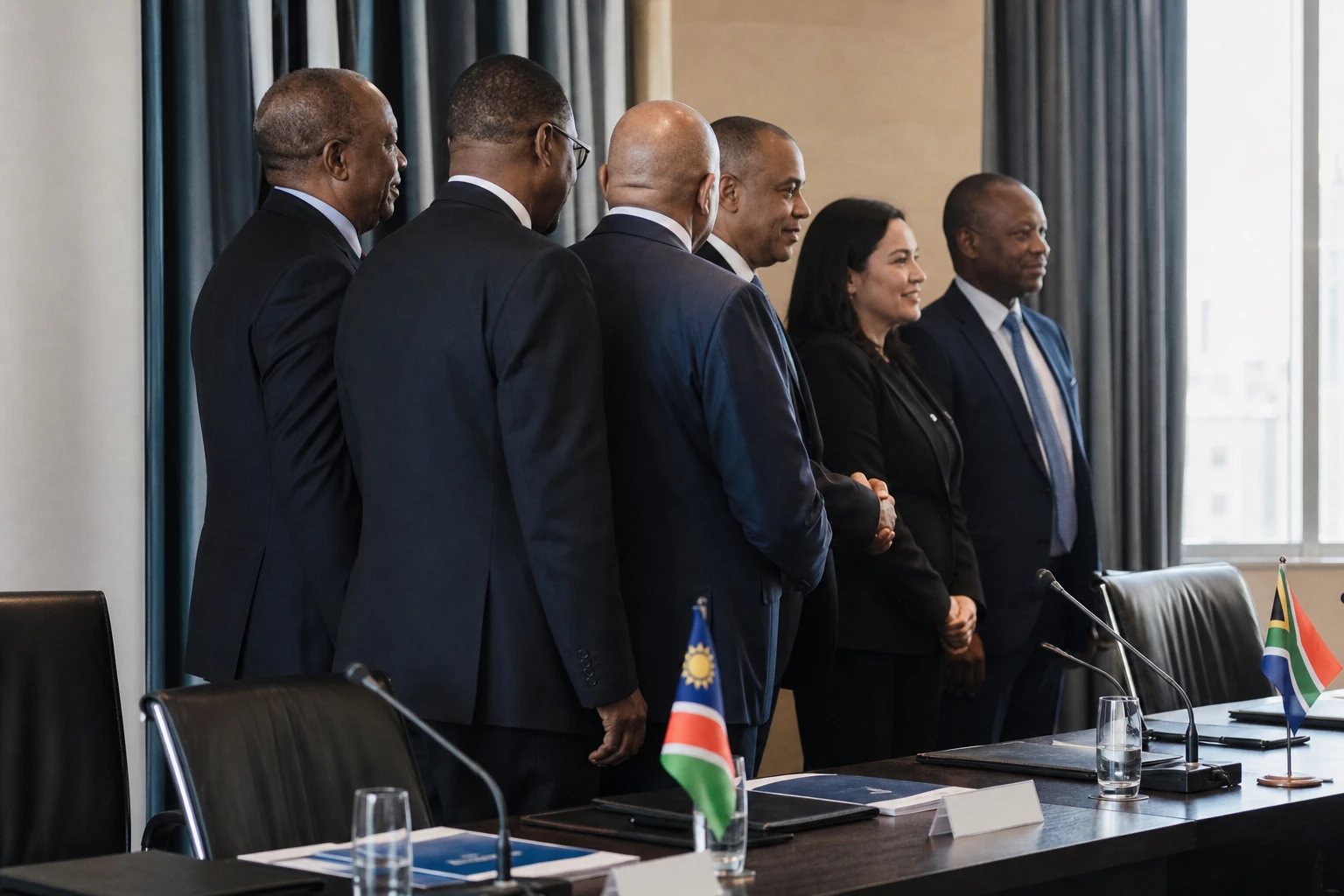
On 17 July 2026, at the fourth session of the South Africa–Namibia Bi-National Commission, the two governments announced the signing of seven cooperation agreements. They cover employment and labour, legal cooperation, air services, correctional services, capacity-building in public administration, partnerships between chambers of commerce, and gender equality and women’s empowerment. South African and Namibian authorities presented the package as a step towards more practical cooperation, less focused on diplomacy alone.
The signed texts add to an already extensive framework. Pretoria says the two countries have concluded 75 agreements and memorandums of understanding over the years, including on political, economic, social, security and environmental issues. The Bi-National Commission, established in 2013, remains their main institutional framework for follow-up. This continuity matters. It reduces the risk of announcements coming to nothing, a common pitfall in African regional cooperation.
The latest developments also have an immediate economic dimension. According to South African authorities, more than 50 South African companies invested in Namibia between 2023 and 2025, contributing around $1.2 billion and creating nearly 4,900 jobs in mining, banking, insurance, property and renewable energy. These figures were reported by both South African official sources and the Namibian press, lending them a greater degree of credibility.
What these agreements really change for Namibia
For Namibia, the goal is clear: to turn its position as a strategic neighbour into a lever for industrialisation. The country remains closely connected to the South African economy, which has a bearing on its trade flows, financial services and some investment. The new agreements on aviation, administrative training and chambers of commerce may seem technical. Yet they are crucial to transaction costs, the movement of skills and access to markets.
The mining, oil and gas dimension is particularly sensitive. Pretoria and Windhoek say they want to strengthen value chains in exploration, research, technology, skills and local processing. In other words, the aim is no longer simply to extract or transport, but to retain more value locally. For a country such as Namibia, that could mean more skilled jobs, greater local subcontracting and, over time, a stronger industrial base. But this also requires infrastructure, reliable energy, stable rules and an administration capable of following through.
The benefits will not be shared equally. Large companies and investors can seize opportunities quickly. SMEs, by contrast, will need genuine access to finance, public procurement and cross-border partnerships. For workers, the agreements on employment, labour and correctional services show that bilateral cooperation is not limited to trade. It also concerns the management of mobility, rights and institutions. This has a direct bearing on families, local administrations and sectors where labour movements remain an everyday reality.
The political dimension is also worth noting. The two capitals want to make progress in a regional context where SADC is seeking to consolidate integration, while AfCFTA promises a larger continental market. The SADC Ordinary Summit in Durban on 17 August 2026 gives this bilateral push broader significance. Namibia and South Africa are seeking to show that credible African integration starts with functioning corridors, implementable agreements and institutions that follow through.
Bilateral cooperation as a test of regional integration
The South Africa–Namibia partnership has demonstrative value. If two neighbouring economies, already linked by a long history and sustained trade, can turn their agreements into a tool for shared industrialisation, this could inspire other country pairings within SADC. Conversely, if the texts remain at the communiqué stage, the signal will be weaker. That is why the coming months will matter more than the signing ceremony itself.
The focus will be on practical implementation: putting air service agreements into effect, following up on partnerships between chambers of commerce, ensuring that joint employment mechanisms work effectively, and turning mining promises into bankable projects. In southern Africa, integration is measured not only by the number of declarations. It is measured by customs clearance times, investment actually unlocked, jobs created and value chains strengthened locally. That is where Namibia, with Windhoek as its decision-making centre, and South Africa will be judged.