
 Algeria
 Egypt
 Libya
 Morocco
 Sudan
 Tunisia
 Benin
 Burkina Faso
 Cabo Verde
 Côte d'Ivoire
 Ghana
 Guinea
 Guinea-Bissau
 Liberia
 Mali
 Mauritania
 Niger
 Nigeria
 Senegal
 Sierra Leone
 The Gambia
 Togo
 Cameroon
 Central African Republic
 Chad
 DR Congo
 Equatorial Guinea
 Gabon
 Republic of the Congo
 São Tomé and Príncipe
 Burundi
 Comoros
 Djibouti
 Eritrea
 Ethiopia
 Kenya
 Madagascar
 Malawi
 Mauritius
 Mozambique
 Rwanda
 Seychelles
 Somalia
 South Sudan
 Tanzania
 Uganda
 Angola
 Botswana
 Eswatini
 Lesotho
 Namibia
 Zambia
 Zimbabwe
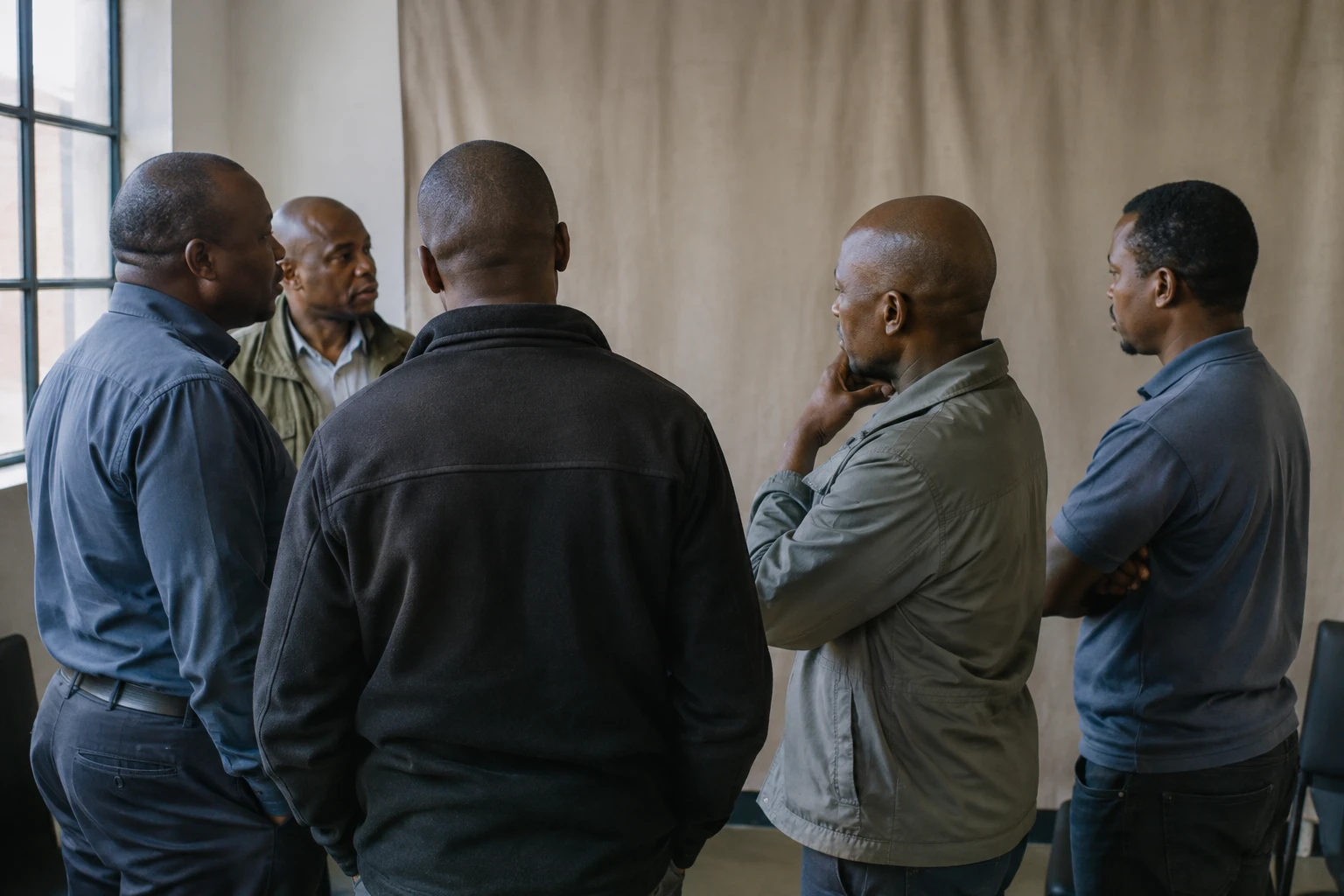
The fight against violence against women is not played out only in police stations or courts. In South Africa, men meet each week to talk about what they have learnt about masculinity, anger and power. These discussions do not replace the protection of victims or justice. They aim to intervene earlier, where certain behaviours become normalised.
A discussion circle challenging masculine norms
In a Johannesburg neighbourhood, a group meets outside a bar on Wednesdays. The participants sit in a circle and discuss their emotions, upbringing and violence. Sibusiso Shongwe, one of the founders, argues that men can help prevent violence by talking among themselves and intervening in their communities.
One participant, 18-year-old Ayanda Ngubane, says he comes in search of positive role models. He stresses the influence of family example: young people can reproduce behaviours they observe in adults. Other members say they are learning to see vulnerability as something other than weakness.
These meetings are linked to the work of Father A Nation, a South African organisation that supports men and promotes their involvement in efforts against gender-based violence. Its national co-ordinator, Zizipho Mtwesi, describes these spaces as a way to challenge norms sometimes passed down as self-evident, including the idea that a man could “punish” a woman.
A national crisis with multiple causes
The problem extends far beyond a Johannesburg neighbourhood. A national prevalence study published in November 2024 by the Human Sciences Research Council (HSRC), a South African public research body, provided the first nationwide assessment based on measured data. It estimates that 7.3 million adult women have experienced physical violence during their lives and that more than 2.15 million have experienced sexual violence. These figures describe experiences reported over a lifetime, not incidents that occurred in a single year. The findings of the HSRC national study also show the scale of violence within intimate relationships.
Institutions have gradually strengthened their response. In 2020, the state adopted a national strategic plan against gender-based violence and femicide. Then, on 21 November 2025, the National Disaster Management Centre officially classified this violence as a national disaster. This legal designation is intended to co-ordinate the state’s response; it does not mean that the violence is a new phenomenon. The South African government announced this classification, specifying that co-ordination now falls to the national executive.
Community prevention is therefore part of a broader response, which also involves the police, social services, health facilities and the justice system. The authorities have reported thousands of convictions for crimes related to gender-based violence and sexual offences during the 2024-2025 financial year. But judicial outcomes alone are not enough to measure real access to protection: victims must be able to report incidents, receive support and see investigations reach a conclusion.
Useful initiatives, but no substitute for public services
Men’s circles can open up a space for discussion where social pressure sometimes discourages boys and men from talking about their emotions. They can also encourage participants to challenge statements that excuse violence on the grounds of anger, alcohol or drugs. The organisation sums up this principle with the slogan “No Excuse”.
Their impact, however, is difficult to assess on the basis of individual accounts. Awareness alone does not guarantee a change in behaviour or a reduction in violence. Participation must be tracked over time, the effects on practices assessed, and women and organisations supporting survivors listened to as well. Prevention must not transfer to communities the responsibility that belongs to institutions.
Needs also vary according to location and available resources. Johannesburg has a concentration of specialist services, but women in rural or remote areas may face greater obstacles in accessing healthcare, safe accommodation or legal assistance. Economic resources matter too: leaving an abusive partner can be particularly difficult without an independent income or affordable housing.
An issue for southern Africa
South Africa occupies a central place in southern Africa’s economy and in the Southern African Development Community (SADC), a regional co-operation organisation. The fight against violence against women does not stop at borders: it concerns public policy, prevention and co-operation between neighbouring countries. For South African women and institutions, the test will be concrete: national commitments must translate into accessible services, investigations that are followed through and prevention efforts that involve men without sidelining victims’ voices.
The national disaster classification, decided in November 2025, now requires stronger co-ordination by the executive. It will be important to see how this responsibility translates into resources, prevention and on-the-ground support. In Johannesburg, the discussion circles illustrate one local approach; their effectiveness will also depend on institutions’ ability to respond when violence has already occurred.



