
 Algeria
 Egypt
 Libya
 Morocco
 Sudan
 Tunisia
 Benin
 Burkina Faso
 Cabo Verde
 Côte d'Ivoire
 Ghana
 Guinea
 Guinea-Bissau
 Liberia
 Mali
 Mauritania
 Niger
 Nigeria
 Senegal
 Sierra Leone
 The Gambia
 Togo
 Cameroon
 Central African Republic
 Chad
 DR Congo
 Equatorial Guinea
 Gabon
 Republic of the Congo
 São Tomé and Príncipe
 Burundi
 Comoros
 Djibouti
 Eritrea
 Ethiopia
 Kenya
 Madagascar
 Malawi
 Mauritius
 Mozambique
 Rwanda
 Seychelles
 Somalia
 South Sudan
 Tanzania
 Uganda
 Angola
 Botswana
 Eswatini
 Lesotho
 Namibia
 Zambia
 Zimbabwe
When land becomes an answer to unemployment
In Soweto, a plot of land can count for more than a speech. On four hectares made available near a former high school, a small community farm is trying to turn land long left neglected into a source of income, learning and stability for the neighbourhood. The initiative is built on a simple idea: if jobs are not reaching poorer communities quickly enough, sometimes the conditions for a decent income have to be created locally.
This choice also reflects South Africa’s social geography. Soweto remains one of the major townships in the Johannesburg metropolitan area, shaped by the history of urban segregation. The municipality notes that most working residents in the area still have to travel to other neighbourhoods for work, because there are not enough employment centres locally. In this setting, urban farming is no quaint tradition. It is a practical attempt to bring economic activity, training and food closer together.
In Soweto, a community farm bets on self-reliance
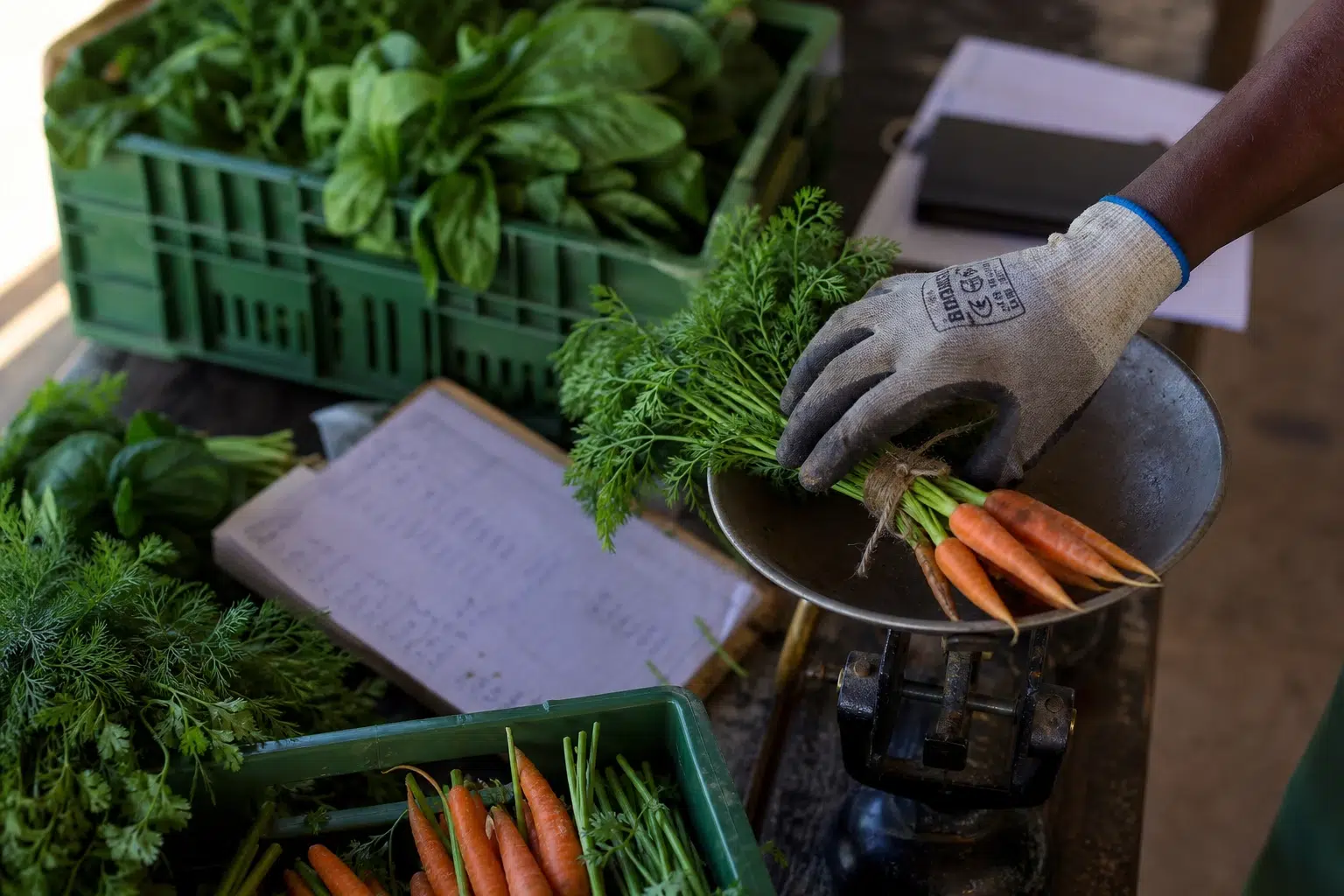
The project is called Ubuntu Farm. It is led by Francis Marsh, who started the initiative alone before bringing two neighbours on board. Together, they have built a small team and welcomed volunteers to plant new fruit trees, including lemon and apricot trees. According to information cross-checked, the farm has already covered about one hectare of the four available in just over two years.
The first crops were modest but useful: coriander, cabbage, spinach, beetroot and carrots, with a greenhouse to diversify production. The ambition, however, goes well beyond a simple vegetable garden. Francis Marsh says she wants to build a neighbourhood economy where people can work and earn a living without having to leave their community every day. This approach aligns with local food resilience policies that the City of Johannesburg itself is beginning to promote through urban farming projects and support for new producers.
In the team’s account, the social aspect is central. One of the project’s secretaries says farming helped her through a difficult period. Here, agricultural work also provides a framework for listening, routine and personal recovery. This is no small matter in a society where unemployment remains massive: in the first quarter of 2026, South Africa’s official unemployment rate stood at 32.7%, rising to 60.9% among 15- to 24-year-olds.
The figures convey the scale of the challenge. In the first quarter of 2026, formal non-agricultural employment fell by 80,000 jobs, according to Statistics South Africa, while agriculture continued to act as a buffer, adding 30,000 jobs in the final quarter of 2025. The South African government has also presented agriculture as a sector able to create value, support exports and contribute to employment. For neighbourhoods such as Soweto, the question is therefore a very practical one: how can they tap into this momentum without leaving it solely to large-scale farmers and established formal supply chains?
Ubuntu, a political legacy turned into an economic tool
The farm’s name was not chosen at random. Ubuntu refers to a philosophy of interdependence, often summed up by the idea that a person can only fully exist with and through others. Nelson Mandela described it as a moral component of the new South Africa, while the Nelson Mandela Foundation calls it the essence of a shared humanism. In South African political language, the word evokes dignity, mutual support and collective responsibility.
In Soweto, this legacy takes a very practical form. It is not just about invoking Mandela. It is about making Ubuntu a model for organising: learning together, producing together, selling together and passing on knowledge together. This approach is consistent with the urban farming strategies taking shape in Johannesburg, where municipal authorities and universities are already working on projects focused on local production, food resilience and training.
The economic benefit could be twofold. On the one hand, the farm creates direct activities, even on a small scale, for women in the neighbourhood. On the other, it reintroduces skills: sowing, maintenance, greenhouse work, fruit trees, collective organisation and sales management. In a context where many young people are neither in employment nor in education or training, this kind of project can provide a route into other activities, from agro-processing to local distribution.
The territorial impact also deserves attention. Townships such as Soweto are not just residential areas; they are home to a significant share of the working-age population and much of urban unemployment. Neighbourhood farming projects do not solve everything. But they shift the centre of gravity: they show that a vacant plot can become an asset, and that a place marked by exclusion can generate social and economic value.
What this experience says about South Africa and southern Africa
Soweto’s experience resonates beyond Johannesburg. It reflects a trend visible in several southern African cities: putting underused urban spaces back to work to address rising food prices, youth unemployment and the vulnerability of poorer neighbourhoods. In South Africa, this momentum is increasingly taking shape through partnerships between municipalities, universities, community organisations and small-scale producers.
It also says something about South African public policy. The state now recognises more clearly the potential of small-scale farming initiatives in townships, but the challenge remains one of scale. As long as projects remain isolated, their impact will be local. To make a difference, they will need more secure access to land, water, inputs, technical advice and markets. Without that, the farm remains a useful but fragile island.
The continental significance is clear. In Africa’s rapidly growing cities, urban farming is becoming a tool for economic survival as well as a source of dignity. The example of Soweto is a reminder that a local response, firmly rooted in the neighbourhood, can feed, train and employ people at the same time. In South Africa, where Pretoria is home to the national institutions but urban divides remain deep, this kind of initiative shows that another local economy is possible, provided it receives sustained support.



