Algeria
 Egypt
 Libya
 Sudan
 Tunisia
 Benin
 Burkina Faso
 Cabo Verde
 Côte d'Ivoire
 Ghana
 Guinea
 Guinea-Bissau
 Liberia
 Mali
 Mauritania
 Niger
 Nigeria
 Senegal
 Sierra Leone
 The Gambia
 Togo
 Cameroon
 Central African Republic
 Chad
 DR Congo
 Equatorial Guinea
 Gabon
 Republic of the Congo
 São Tomé and Príncipe
 Burundi
 Comoros
 Djibouti
 Eritrea
 Ethiopia
 Kenya
 Madagascar
 Malawi
 Mauritius
 Mozambique
 Rwanda
 Seychelles
 Somalia
 South Sudan
 Tanzania
 Uganda
 Angola
 Botswana
 Eswatini
 Lesotho
 Namibia
 South Africa
 Zambia
 Zimbabwe
A rapprochement no longer confined to the bilateral level
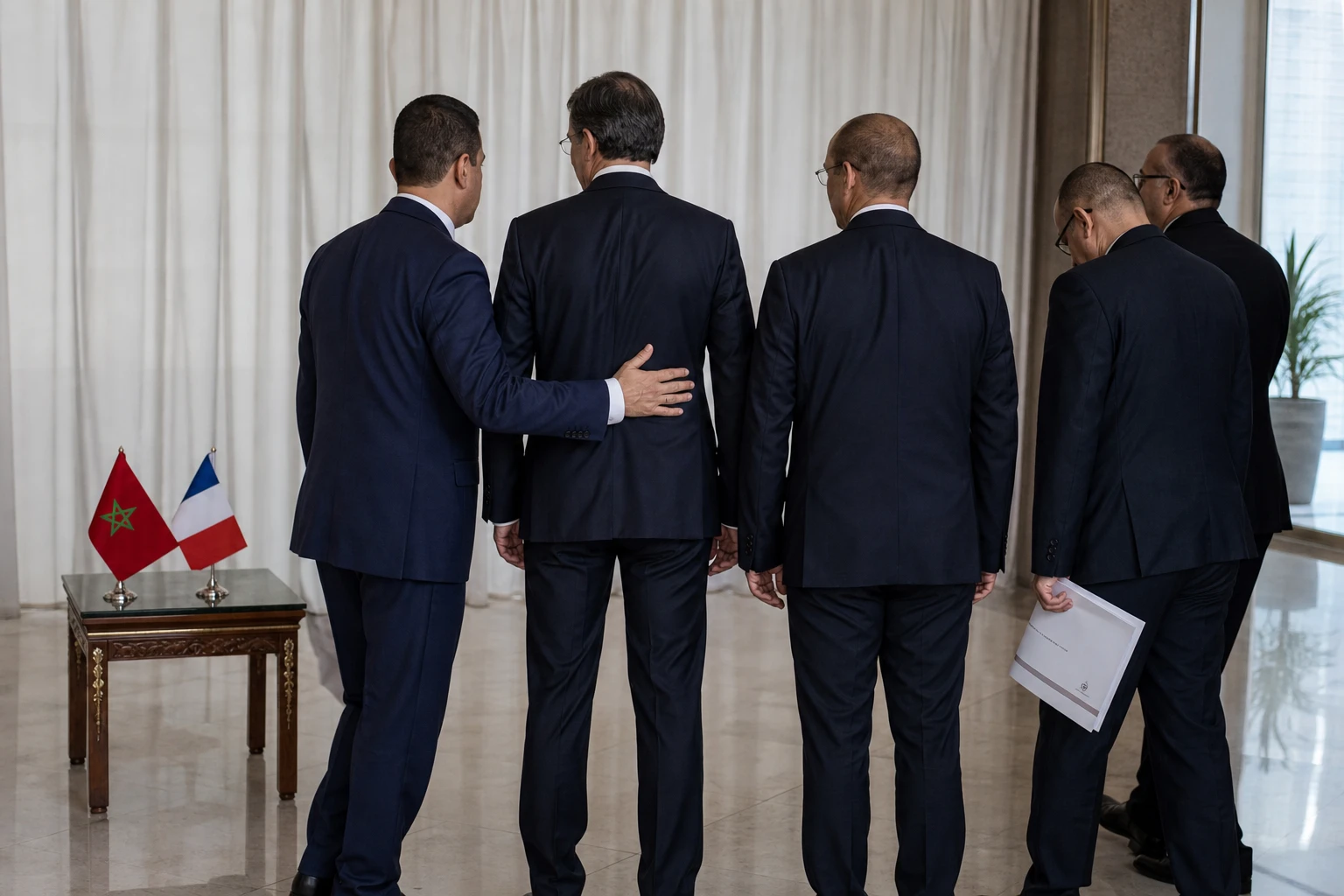
In Rabat, Franco-Moroccan diplomacy is now moving beyond ceremonies and the usual formalities. Relations between Paris and Morocco have entered a phase in which each announcement is intended to deliver concrete results: agreements, a timetable, security cooperation and, ultimately, a bilateral text of an unprecedented kind. For the Kingdom, the aim is clear: to turn a political thaw into lasting levers for the economy and security, and to strengthen Morocco’s standing in Europe and North Africa. For France, it is also a matter of consolidating a partner seen as central to the Maghreb and Sahel-related issues.
This sequence follows a precise timeline. In October 2024, Emmanuel Macron’s state visit to Morocco had already established an « enhanced exceptional partnership ». Paris had then officially reaffirmed that, for France, the present and future of Western Sahara lay within the framework of Moroccan sovereignty, with the autonomy plan as the basis for a settlement. Since then, the two capitals have stepped up ministerial visits, paving the way for the high-level meeting held in Rabat on 16 and 17 July 2026.
In Rabat, Sébastien Lecornu’s words point to a more ambitious framework
On Thursday 16 July 2026, Sébastien Lecornu, who was received in Rabat alongside a large ministerial delegation, co-chaired the 15th session of the Morocco-France High-Level Meeting with Aziz Akhannouch. The French prime minister described the gathering as a « pivotal moment » and said he wanted to « take the bilateral relationship to a new level ». He also confirmed that the two countries were working on a bilateral treaty, described as the first France would sign with a country outside the European Union.
The Moroccan side, too, gave the visit a strongly institutional character. The French delegation laid a wreath at the Mohammed V Mausoleum in Rabat before the official proceedings began. According to Moroccan statements, the meeting was expected to lead to the signing of several agreements, following bilateral discussions between ministers from both countries. The portfolios represented indicate the intended scope: interior, economy, industry, education, agriculture, transport, culture, defence, digital affairs and foreign trade.
The political substance of the discussions is just as significant. Lecornu highlighted cooperation against terrorism, drug trafficking, human trafficking and irregular migration. He also referred to recent « operational successes » achieved by the security services and judicial authorities of both countries. At the same time, he placed the relationship in the context of a forthcoming state visit to France by King Mohammed VI, for which no date has yet been set.
Western Sahara, the Sahel and Europe: issues that give the partnership weight
The rapprochement between Rabat and Paris is not based on symbolism alone. It rests on shared interests. For Morocco, France’s recognition of the Moroccan position on Western Sahara removed a major diplomatic obstacle after years of tension. For France, Morocco offers a political, security and economic foothold in a region where the balance is fragile, from the Maghreb to the Sahel. French diplomacy also describes Morocco as the leading recipient of funding from the French Development Agency, with an average of around €400 million in loans and €6 million in grants a year.
Against this backdrop, the idea of an « exceptional treaty of friendship » carries particular weight. It would mean a more structured relationship than a series of ad hoc agreements, with a more stable framework for the coming decades. According to the French account, a committee of eminent figures is already working on the text, which is intended to go beyond protocol and organise cooperation in the economy, culture, education, diplomacy and security. For Rabat, such an instrument could strengthen its ability to attract investment and secure long-term partnerships. For Paris, it would help anchor its presence in a pivotal North African country at a time when French influence is being challenged on several African fronts.
Morocco’s approach to the issue is more pragmatic than ideological. In practice, the Kingdom is seeking to capitalise on its position as a hub between Europe, Africa and the Atlantic. The prospect of closer cooperation on infrastructure, transport, energy and defence fits this strategy. It also meets a domestic expectation: to show that diplomatic rapprochements generate jobs, projects and new capabilities, beyond gestures between palaces, ministries and diplomatic services.
What Rabat and Paris are testing for North Africa and beyond
The significance of this visit extends beyond Franco-Moroccan relations. In North Africa, it confirms that issues of sovereignty, security and infrastructure are now being negotiated through more flexible, more political and more targeted partnerships. It also shows that a country such as Morocco can influence both Euro-Mediterranean debates and African balances of power, without being confined to a single diplomatic geography. This is precisely the kind of framework Rabat is seeking to consolidate: a network of useful alliances in Paris, Brussels and African capitals.
The sequence also says something about the balance of power in North Africa. Morocco and France are moving forward on the basis of converging interests, but in an environment where regional rivalries, security realignments and debates over Western Sahara remain decisive. The next stage will therefore be political as well as diplomatic: formalising the agreements announced, followed by a possible state visit to France by Mohammed VI. That is when the real strength of the renewed momentum will be tested.