Algeria
 Egypt
 Libya
 Morocco
 Sudan
 Tunisia
 Benin
 Burkina Faso
 Cabo Verde
 Côte d'Ivoire
 Ghana
 Guinea
 Guinea-Bissau
 Liberia
 Mali
 Mauritania
 Niger
 Nigeria
 Senegal
 Sierra Leone
 The Gambia
 Togo
 Cameroon
 Central African Republic
 Chad
 DR Congo
 Equatorial Guinea
 Gabon
 Republic of the Congo
 São Tomé and Príncipe
 Burundi
 Comoros
 Djibouti
 Eritrea
 Ethiopia
 Kenya
 Madagascar
 Malawi
 Mauritius
 Mozambique
 Rwanda
 Seychelles
 Somalia
 South Sudan
 Tanzania
 Uganda
 Angola
 Botswana
 Eswatini
 Lesotho
 Namibia
 South Africa
 Zambia

Exporting more is not enough to transform an economy. For Zimbabwe, the challenge is to ensure that a larger share of the income from minerals and crops is generated at home, rather than in the factories of its trading partners.
An ambitious target in an economy still geared towards raw materials
On 4 November 2026 in Harare, Allan Majuru, chief executive of ZimTrade, set a target: to raise Zimbabwe’s value-added exports to $1bn by 2030. The announcement was made during the Export Week Buyers’ Forum.
Recent results give an indication of the challenge. Between January and September 2026, merchandise exports reached $10.4bn, according to figures presented by ZimTrade. Processed products generated $671m, up 68% year on year. These figures were also reported by Zimbabwe’s state-owned press and local media.
Growth in total exports does not, therefore, mean that the economy has already diversified. Minerals and agricultural products continue to account for a significant share. The National Development Strategy 2026–2030, known as NDS 2, aims to increase the share of value-added exports in total exports from 5.5% in 2025 to 18.4% in 2030. It also seeks to strengthen manufacturing.
The industrial push also hinges on mining
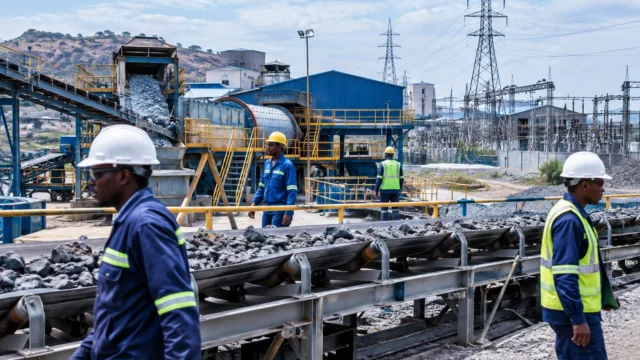
Lithium illustrates this approach. In February 2026, the Ministry of Mines suspended exports of raw lithium ore and concentrates. The measure, announced in Harare, was intended to encourage companies to process more raw material in Zimbabwe. The government had previously banned exports of unprocessed lithium ore in 2022.
The move gives the country leverage in negotiations with mining companies and foreign buyers. But export restrictions alone do not create factories. Reliable electricity, equipment, skills, financing and predictable rules are also needed. The Zimbabwe Environmental Law Association supported the principle of local processing while raising concerns about the abrupt implementation of the ban and the lack of consultation.
The debate is therefore as much about the pace and conditions of the policy as it is about its goal. If processing capacity fails to keep up, restrictions could complicate sales and investment. Conversely, operational facilities could support industrial employment and keep more value in the country. The benefits will also depend on the role given to local suppliers and Zimbabwean workers.
Agriculture and textiles: processing closer to producers
The strategy also covers agricultural value chains. In August 2026, the government and the United Nations Food and Agriculture Organization endorsed an analysis of the value chains for avocados, sunflower, traditional grains and goat meat. The work, carried out with public-sector bodies, producer organisations, businesses and researchers, identified needs in storage, financing, processing and market access.
These obstacles have tangible effects beyond Harare. For small-scale producers, local storage or processing capacity can reduce post-harvest losses and open up more reliable markets. But such facilities must be accessible, and markets sufficiently organised, for the benefits to reach rural farms as well as large export companies.
Textiles are another area of focus. The government aims to process at least 60% of its cotton locally by 2030, up from less than 20% in 2024, according to figures cited in the strategy. In tobacco, the ambition is to develop the manufacture of cigarettes and cut tobacco, as well as nicotine extraction from waste. These projects must, however, turn industrial targets into investment, market opportunities and lasting jobs.
A challenge for southern Africa
Zimbabwe is pursuing this approach through SADC, the Southern African Development Community, which is seeking, among other things, to strengthen trade and regional value chains. The national strategy also draws on SADC’s regional development plan and the African Union’s Agenda 2063. The agricultural analysis conducted with the FAO likewise builds on SADC’s regional agricultural policy.
For Zimbabwean businesses, neighbouring markets could absorb processed products and support the growth of industrial activity. But countries across the region are also seeking to capture a greater share of the value generated from their resources. Competition for investment and infrastructure is therefore an additional factor alongside the opportunity to build complementary production chains.
The $1bn target provides a benchmark, but monitoring will need to establish exactly what it covers: which products, how many jobs, what share of value is created locally and what benefits accrue to producers. It will also be important to see whether mining measures are matched by sufficient processing capacity and whether agricultural projects reach rural areas. The announced transformation will be measured by these outcomes as much as by rising revenues.